EDPB Statement on Smart Glasses: GDPR Privacy Rules Explained
On 13 October 2026 the European Data Protection Board adopted a statement on smart glasses. It says personal use is exempt from GDPR, but public posting, professional use and the companies behind the glasses are not. Here is what that means for anyone filming in public.
Update — November 5, 2026: A UK minister told the Commons the government is weighing limits on smart glasses in certain settings and on sales to certain users; see the UK smart glasses ban debate.
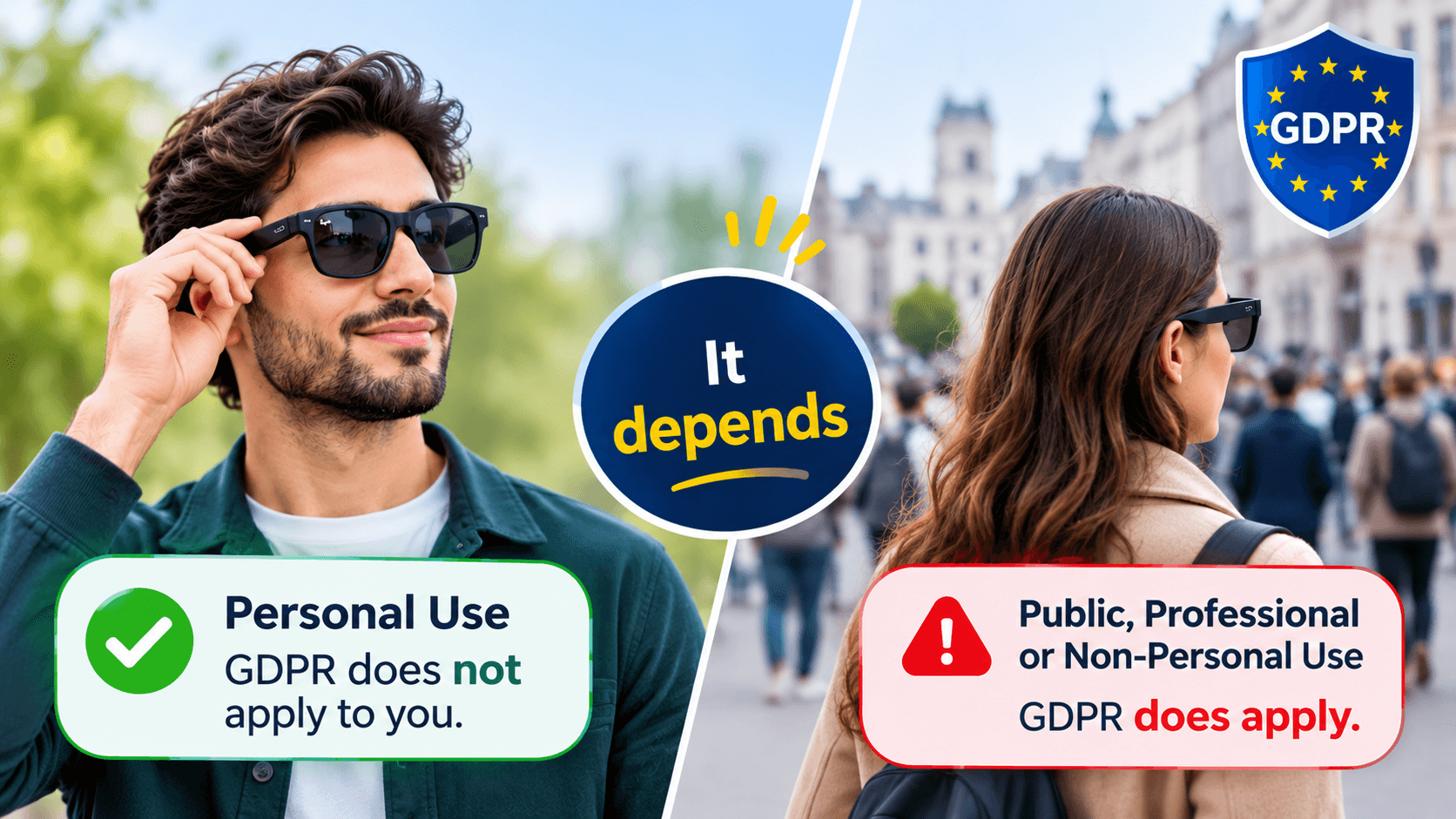
It depends on how they are used. If your use is purely personal, GDPR does not apply to you as the wearer. If your use is public, professional or otherwise non-personal, it does. The EDPB says the user's legal status depends on the use, not on the device.
The Household Exemption: When You Are Not Covered by GDPR
GDPR does not apply to a wearer whose actions are a purely personal or household activity, outside any professional or commercial context. The EDPB gives two examples:
- Sharing a photo or video only with a family member or a friend
- Using the glasses for personal translation in a private setting
When Does the Wearer Become Responsible Under GDPR?
The EDPB stresses that the household exemption must be read narrowly and assessed case by case. It would not apply if:
- The photo or video is shared with an indefinite number of people on a public social media account
- The glasses are used in official, professional, political or other non-personal activities
In those situations the wearer counts as a controller, or a joint controller, and has to comply with GDPR obligations, notably transparency. In practice that means telling people they are being recorded. For a broader view of what this means for video, read our GDPR video compliance guide for faces and license plates.
Can Other Laws Still Apply Even If GDPR Does Not?
Yes. The statement is explicit that someone recording voice or images may be subject to other laws, and some uses may fall under criminal law. Depending on the country and the situation, civil law, labour law and sector-specific rules can also apply. The Board gives examples: filming facilities with protected status, filming indoors in a home, filming in a dressing room, or filming for harassment can be an offence in some places, and sharing that footage can be a separate or additional offence. Breaking such rules can also call into question whether the processing of personal data was fair under GDPR.
Is It Legal to Post Smart Glasses Videos on Social Media in Europe?
You can post, but a public account removes the personal-use protection. This is the question most creators actually have, and the statement answers it clearly. If footage goes to an unlimited audience, the household exemption would not apply, and you would be treated as responsible for the data under GDPR.
Here is how that plays out in common situations:
| Situation | Likely position under the EDPB statement |
|---|---|
| Sending a clip to a family group chat | Personal use, outside GDPR for the wearer |
| Posting to a public Instagram, TikTok, YouTube or X account | Indefinite audience, exemption does not apply |
| Filming for a brand, campaign or business page | Professional or commercial use, GDPR applies |
| Political or official activity | Non-personal use, GDPR applies |
Strangers in your footage are identifiable when their faces or license plates are visible. The statement also notes that some national laws protect the right to one's image and require consent to reproduce and publicly distribute it. In those countries, consent is likely the most appropriate legal basis. If that sounds unfamiliar, our guide to unauthorized filming and privacy protection explains how filming and publishing rules differ, and the right to privacy in photos and video covers portrait rights.
Who Is Responsible Under GDPR: The Wearer, the Manufacturer or the AI Provider?
Possibly all three. The EDPB says responsibility can sit with the user, the producer of the device, or the provider of a linked app or service, including AI systems. One actor can be the sole controller, or two or more can be joint controllers. The test is who determines the purposes and means of the processing.
Why GDPR Still Applies to Manufacturers and App Providers
The statement says GDPR still applies to those who provide the means for processing personal data, even for personal activities. Producers and app or AI providers may be independent or joint controllers, notably when an AI feature processes personal data to answer a question about the wearer's surroundings, for example by analysing a camera image in which other people appear.
Two consequences stand out:
- Companies cannot offload their duties. The Board says controllers should not rely on users' actions to meet their own GDPR obligations, such as transparency toward the people around the wearer.
- Reuse needs a compatible purpose. If a company processes the data for a new purpose, that purpose must remain compatible with the original one, with particular attention to the context, especially when the people filmed have no relationship with the company.
What Legal Basis Can Companies Use for Bystander Data?
Consent is difficult. Companies have no relationship with bystanders, so obtaining freely given, specific, informed and unambiguous consent is hard, and consent collected after a recording would not be valid because the legal basis must exist before and during processing.
Legitimate interests is also a difficult route. The EDPB says it would require careful case-by-case analysis and would be especially hard to demonstrate for commercial reuse beyond the service the user asked for, or for AI training, which bystanders would not expect if they never knew they were recorded. Even where it applies, people must be able to object at any time. For the real-world debate, see Senators Press Meta on Smart Glasses Footage and Does Meta Blur Faces in Smart Glasses Videos?.
Why Are Smart Glasses a Bigger Privacy Risk Than a Phone Camera?
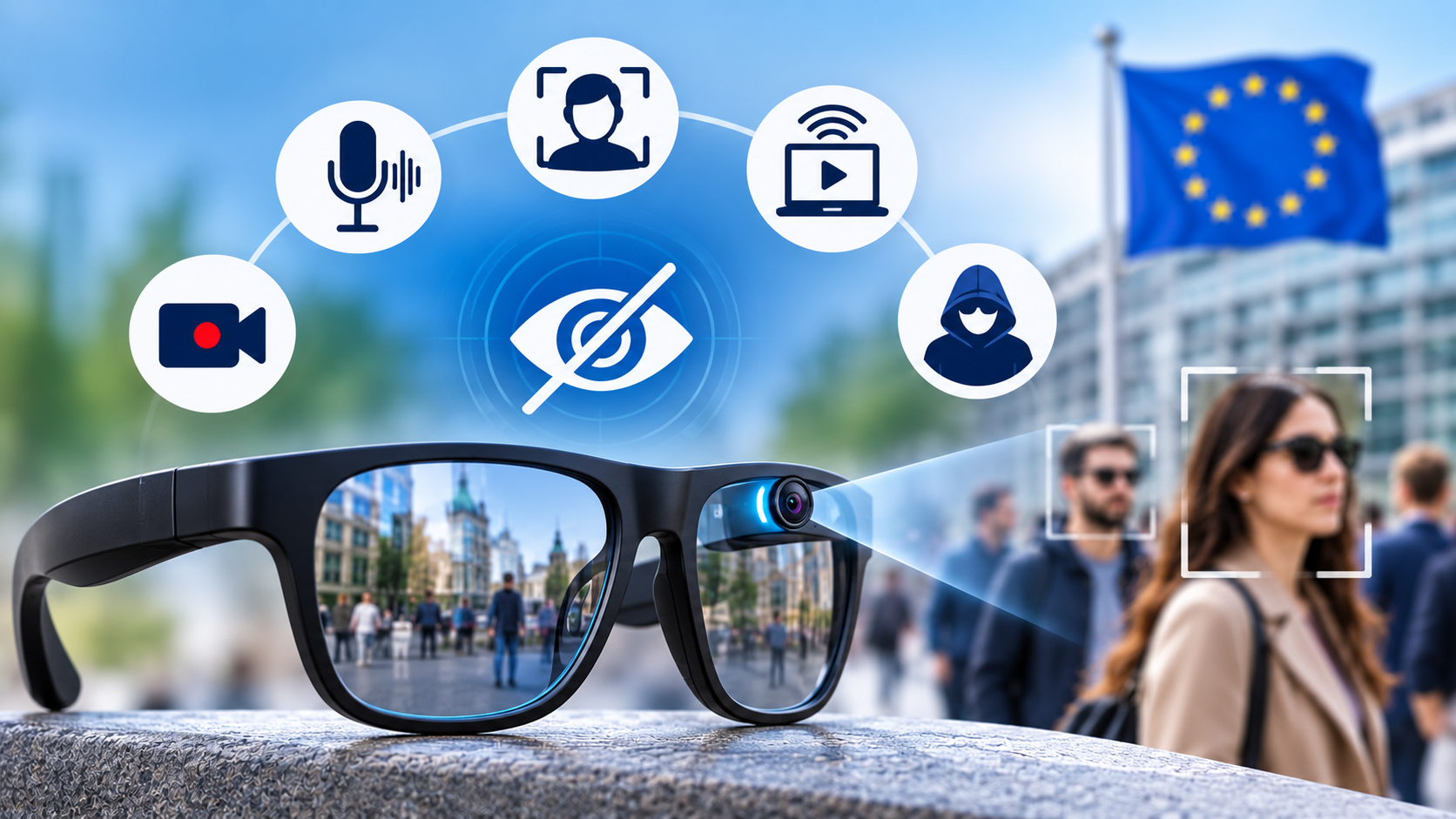
Because they are hard to spot. Unlike most recording devices, smart glasses allow near invisible or hidden collection of data, since they are difficult to tell apart from ordinary eyewear. The statement lists several specific concerns:
- Unauthorised recording of people who do not know it is happening
- Microphones that can pick up background conversations the wearer is not part of
- Facial or voice recognition, which the EDPB says raises unprecedented societal questions and poses a high risk to rights and freedoms in public spaces
- Live streaming and online sharing, which affect privacy, security, freedom of expression and freedom of movement
- A chilling effect, where people change their behaviour and suppress spontaneity because they feel they may be watched
Even when a device is recognisable as smart glasses, people may still object to being filmed. The Board asks users to respect the privacy and dignity of others and notes that explicitly telling people about the glasses is relevant. For more on the facial recognition angle, read Smart Glasses Facial Recognition: ACLU Backlash.
Where Is It Inappropriate to Record With Smart Glasses?
In places that are private, intimate or protected. The EDPB names several contexts where recording or audio capture may be inappropriate or prohibited under national law or local rules:
- Medical facilities
- Schools and other places where minors are present
- Changing rooms
- Swimming pools or beaches
- Toilets and other private or intimate situations
- Workplaces, where recording raises employee monitoring concerns and risks exposing trade secrets and intellectual property
Children receive special attention. The statement says they may be less aware of smart glasses and more vulnerable to covert or intrusive processing. If you share family footage online, our guide on what sharenting is and how to protect your child's privacy is a useful companion.
Do Smart Glasses Need a Recording Light? What the EDPB Recommends
There is no binding rule yet, but the Board wants stronger signals. The statement says the current state of indicators leaves many bystanders unaware that their data is being processed. It suggests producers combine several transparency measures, which should be difficult or impossible to disable and easy for bystanders to notice.
| Measure | What the EDPB says |
|---|---|
| LED or visual indicators | Visible in many lighting conditions, noticeable, and active long enough for people to understand recording is happening. Recording should not be possible while the indicator is covered. |
| Audio indicators | Sounds such as a shutter click, and voice activation requirements, can raise awareness. |
| Smartphone proximity alerts | Apps can detect nearby glasses through Bluetooth identifiers. Notifications should never be the only method, must be optional for the person, and must not allow tracking of wearers. |
| Design cues | Features that help people tell smart glasses from regular glasses. |
The Board adds that LEDs can be hard for visually impaired people to notice and that a white LED can be mistaken for a reflection or glare. It also recommends industry-wide standards and awareness campaigns.
What Other Safeguards Does the EDPB Recommend?
Reduce what is captured, and protect identities before sharing. Beyond indicators, the statement encourages controllers to adopt technical measures that limit risk:
- Data minimisation, such as limiting continuous recording, live streaming and retention periods. A wearer should not justify continuous, indiscriminate recording of others by a general worry about personal safety.
- Blurring or obscuring bystanders, plus pseudonymisation or anonymisation before sharing or re-use, ideally on the device.
- Geofencing, which limits recording in contexts likely to be sensitive.
- Privacy frictions that slow down sharing on social platforms.
The second point is the one creators can act on today. A regulator is naming bystander blurring as a protective measure, and that is something you can do yourself before anything is published. The statement also reminds companies about data protection by design, security, special categories of data, children, and the ePrivacy framework, which may apply when device sensors store or send information.
How to Blur Faces and License Plates in Smart Glasses Footage With BGBlur
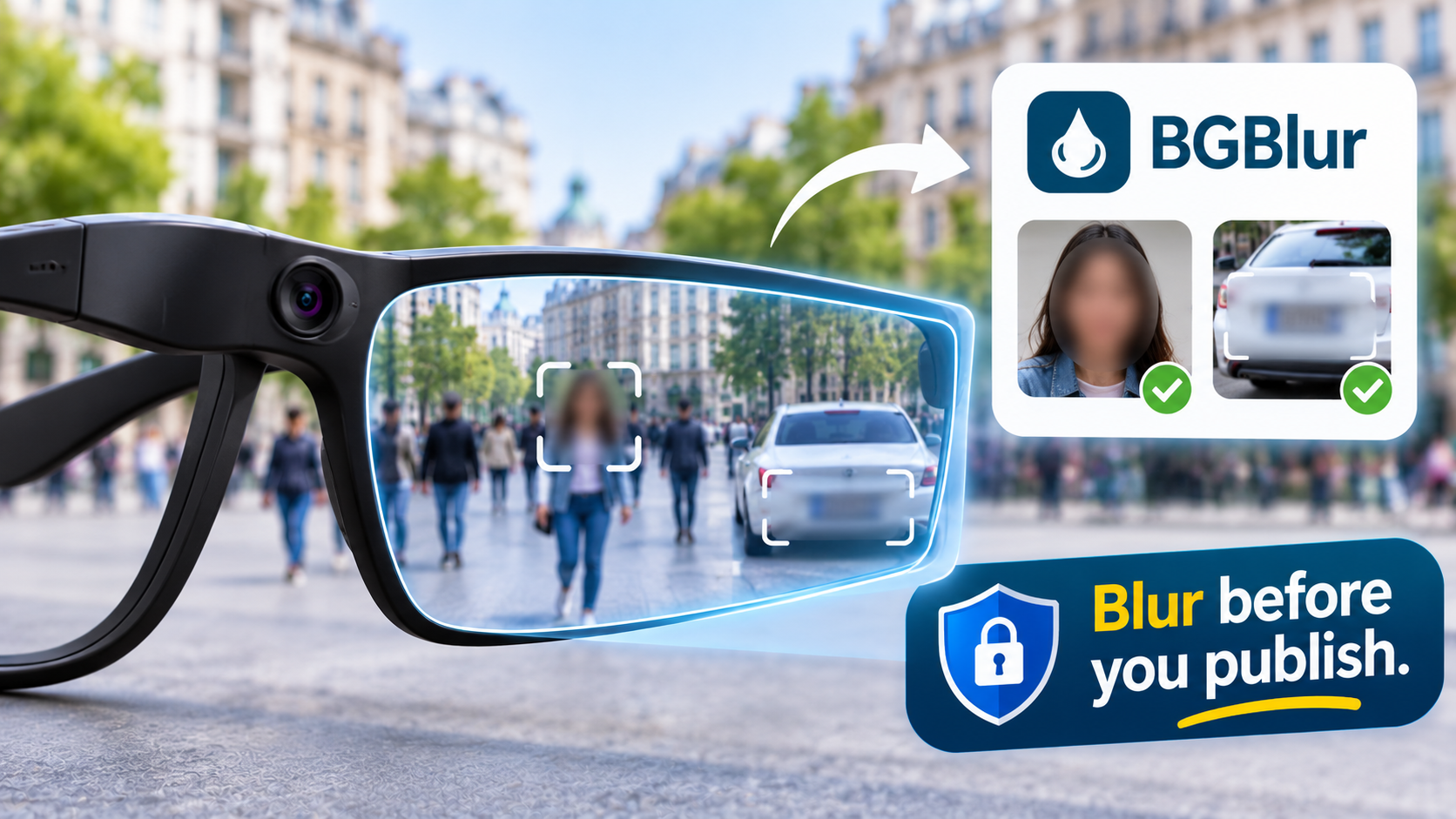
Blur before you publish. If you record in public with smart glasses and plan to post online, remove the identifying details of people who did not agree to be filmed. BGBlur works in your browser with no app to download, and uploaded videos are deleted within 24 hours.
Step 1: Export Your Clip
Export the video from your glasses app or your phone. BGBlur accepts MP4, MOV and M4V files.
Step 2: Blur Faces Automatically
Upload the clip and use Blur Faces in Videos. The AI detects and tracks every face with motion tracking, so you do not have to edit frame by frame. For stills, use Blur Face in Photos. Our guide to blurring faces in photo and video with AI in seconds walks through the core workflow.
Step 3: Add License Plates and Other Personal Information
Turn on Blur License Plate so vehicles cannot be identified. Use Blur Anything for other personal details, such as a screen showing private information or a document in view. Filming a lot? Bulk Video Blur handles batches.
Step 4: Review and Export
Check the preview, then export in MP4, MOV or WebM, up to 4K. The free plan covers short clips so you can test the result first.
Honest Limitations
Blurring is a strong safeguard, not a legal shield. It does not replace consent where national image rights require it, it does not remove voices from the audio, and it does not change whether criminal or workplace rules apply to the recording itself. Weak blur can also fail, so read our explainer on why weak blur fails under GDPR. Review the output before you publish.
Who Benefits From Blurring Smart Glasses Footage?
Anyone who publishes what they film in public.
Content creators and vloggers: Street footage, travel clips and POV videos often capture dozens of strangers. Blurring bystanders before posting reduces exposure on a public account, where the personal-use exemption does not protect you.
Journalists and documentarians: Professional use is outside the household exemption, so protecting identities of people who are not part of the story is a basic safeguard.
Businesses and brands: Marketing clips shot with smart glasses count as commercial use. Blurring faces and plates before release helps avoid avoidable complaints.
Educators and trainers: Hands-free recording in classrooms or workshops can capture students, so blurring before sharing matters, especially where minors are present.
Parents sharing family moments: Even family events in public places include other people's children and faces.
Pro Tips for Safer Smart Glasses Footage
- Decide your audience before you record. Private sharing and public posting are treated very differently.
- Tell people. Explicitly informing others that you are wearing recording glasses is part of respecting their dignity, and it is a duty if you are a controller.
- Avoid sensitive places. Skip medical facilities, schools, changing rooms, pools and toilets.
- Do not record continuously. Capture what you need, then stop.
- Blur before upload. Faces, license plates and any personal information should be handled before the file leaves your device.
- Check the audio. Background conversations can be captured by microphones and are not fixed by visual blur.
- Keep a record of your reasons if you publish professionally, in case a person asks you to remove footage.
For more reading, see Hans Anders Halts Meta Ray-Ban Sales: Privacy and Smart Glasses Should Blur Faces by Default.
Conclusion: What the EDPB Statement Means in Practice
The EDPB's message on smart glasses and GDPR is that how you share matters more than what you wear. Private clips for family are outside GDPR for the wearer. Public posts, professional use and anything aimed at a wide audience are not. The companies that build the glasses and their AI features carry their own duties and are being pushed to make recording far more visible.
Because the statement is preliminary, expect more detail later. Until then, the sensible approach is simple: record respectfully, avoid sensitive places, tell people when you can, and protect the identities of bystanders before you publish. Blurring faces and license plates is the step you control completely, and it is one the regulator itself names as a protective measure.
Ready to publish safely? Try BGBlur and blur faces and license plates in your smart glasses footage in a few clicks, right in your browser.
Related Articles
- Why Meta Smart Glasses Got Nicknamed "Pervert Glasses": how misuse led to bans and pushback
- Meta VR Glasses vs Ray-Ban Meta: Connect 2026: what the newest glasses can record
- Doorbell Camera GDPR: Bystander Footage Guide: another camera that films people who never agreed
- Blur Face for Privacy: Laws, Ethics and Best Practices: when blurring is the right call
- Can You Publish Someone's Recorded Voice? Consent Laws: the audio side smart glasses also capture
- Blur Faces and Plates in Video, but Keep the Location: protect people without losing context
- EU AI Act Facial Recognition: CCTV Archive Rules: how EU rules treat facial recognition
- Right to Publicity and Filmmaking Laws Explained: using people's likeness in published video
Source: European Data Protection Board, Statement on Smart Glasses, adopted 13 October 2026. This article is general information, not legal advice.