Federal Judge Calls Flock Mass Surveillance [2026]
On October 3, 2026, reports revealed that a federal judge in Oklahoma ruled a Tulsa-area deputy violated a woman's Fourth Amendment rights by searching Flock Safety for her license plate without a warrant. The ruling isn't binding precedent, but it calls Flock 'indiscriminate mass surveillance' — and arrives the same week Sen. Bernie Sanders announced the Block Flock Act.
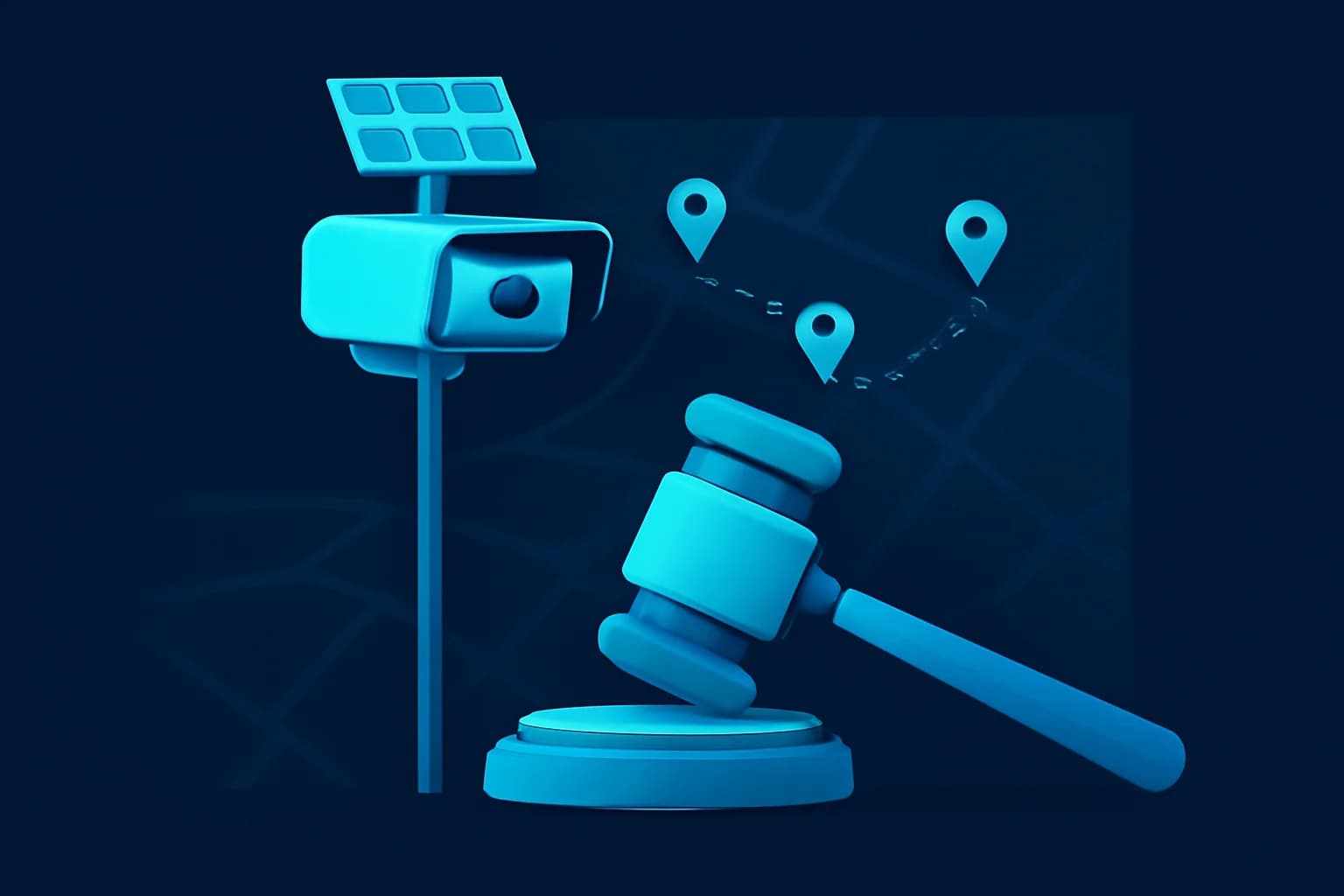
A federal judge has now written, in a court opinion, that Flock Safety's license plate camera network is "a type of indiscriminate mass surveillance." The October 2026 ruling by Judge Sara Hill found that a Tulsa, Oklahoma sheriff's deputy violated a woman's Fourth Amendment rights by searching Flock for her license plate without a warrant. It was first reported by 404 Media and TechCrunch, and it is one of the first times a federal judge has called a Flock search unconstitutional.
It is not a ban, and it is not binding on other courts. But it lands in a week when a U.S. senator introduced a bill to bar federal agencies from using automated license plate readers, and when Hacker News commenters were arguing about whether anyone has a privacy interest in a public road at all. This guide answers the questions people are actually asking: what happened, what the judge said, why it matters, what it doesn't change, and what you can do about the footage you publish yourself.
Quick Answers
| Question | Answer |
|---|---|
| What happened? | A federal judge ruled a warrantless Flock search of a woman's plate violated the Fourth Amendment |
| Who is the judge? | Judge Sara Hill (federal court, Oklahoma) |
| What was suppressed? | All evidence obtained after the Flock search, as "fruit of the poisonous tree" |
| Is it binding precedent? | No — it is a single district court ruling |
| Are Flock cameras now illegal? | No. The ruling is about warrantless searches of the database |
| Is Congress acting? | Sen. Sanders introduced the Block Flock Act on October 2, 2026 |
| Can I stop Flock from recording me? | No, but you can blur plates and faces in your own footage |
What Did the Judge Actually Rule?
Judge Hill ruled that searching the Flock database for a person's license plate, with no reason beyond her car's out-of-state plate, required a warrant — and the deputy didn't have one. According to TechCrunch's report, the deputy had "no apparent reason" for the search "other than the fact that [the woman's vehicle] had a California license plate."
The deputy then used the woman's travel history in Flock as part of the justification for searching her car, where he allegedly found 91 pounds of methamphetamine. Judge Hill held that everything obtained after the Flock search "must be suppressed as the fruit of a poisonous tree." That doctrine means evidence derived from an unconstitutional search can't be used against the defendant.
The practical consequence is stark: the drug evidence is out, regardless of what was in the car. That is exactly how Fourth Amendment remedies are supposed to work, and it is why defense lawyers across the country will be reading this opinion closely.
The Quote That Will Be Cited Everywhere
The broader passage is the one that matters beyond this single case. Judge Hill wrote that tracking people's location, even in public, becomes "constitutionally problematic when law enforcement can indiscriminately and passively catalog your whereabouts over an extended period of time and then use that information for any purpose whenever convenient." She described Flock as "a tool that collects information about all vehicles that pass by any network-connected camera at all times, and it serves up the information to law enforcement on demand."
That is a description of the architecture, not just of one deputy's behavior. The judge isn't saying a single plate photo is unlawful; she is saying the aggregate, searchable history is the problem.
Why Does the Judge Cite Carpenter v. United States?
Because Carpenter established that you can have a privacy interest in your movements even when those movements happen in public and the data is held by a company. In Carpenter v. United States (June 22, 2018), the Supreme Court held that the government's acquisition of historical cell-site location records is a Fourth Amendment search requiring a warrant supported by probable cause. The Court observed that a phone "faithfully follows its owner beyond public thoroughfares and into private residences, doctor's offices, political headquarters, and other potentially revealing locales."
Judge Hill's logic extends that reasoning to license plate networks. A cell phone travels in public too. What changed in Carpenter, and what she applies here, is that collecting everything and keeping it for later is different in kind from a person watching a street corner.
If you've followed the litigation wave, this is the same constitutional thread running through our coverage of the Kansas ALPR lawsuit arguing license plates are GPS trackers, which relies on the Supreme Court's later location-data reasoning. The Oklahoma ruling is the first time we've seen a federal judge actually apply that theory to suppress evidence.
Isn't There "No Expectation of Privacy" on a Public Road?
That's the strongest counterargument, and it is the one that dominated the Hacker News discussion of this ruling. The traditional rule is that what you knowingly expose to the public isn't protected, and that a police officer could sit on a corner and write down every plate that passes.
Judge Hill's answer, as quoted in that discussion, is that "freedom from persistent, dragnet-style surveillance while in public is not a foreign concept in our society." The difference is scale and permanence. One officer can't watch every road, can't identify every driver's face, and doesn't produce a searchable log going back months.
The Fourth Amendment's text protects "the right of the people to be secure in their persons, houses, papers, and effects, against unreasonable searches and seizures." Courts have spent decades deciding what counts as a "search" in an era of new technology. This ruling is one more data point in that long argument, not the end of it.
Where Other Courts Disagree
It would be dishonest to present this as settled. A Stanford Law post summarizing recent decisions noted that a federal district court in Central California ruled that using Flock cameras is not a Fourth Amendment "search". Different judges, different fact patterns, different results.
That split is precisely why this issue is heading toward appellate courts. A ruling that suppresses evidence is more likely to be appealed by prosecutors than one that doesn't.
What Does This Ruling Not Do?
It does not shut down Flock, does not apply outside this case, and does not create a nationwide warrant requirement. TechCrunch was explicit that the ruling "does not create a binding precedent." It binds the parties in that case and persuades, but doesn't control, other judges.
A few things people are assuming that the ruling doesn't say:
- Cameras stay up. The holding concerns how police search the database, not whether the cameras may exist.
- A warrant may fix it. The judge's point was that a warrant was required. Police who obtain one can still query the system.
- No effect on private use. HOAs, retailers, and businesses that use plate readers aren't governed by the Fourth Amendment, which restricts government action.
That last point is the one many creators miss. The same plate and face data that police need a warrant to search can still be captured, kept, and shared by private systems, and it can be posted by you.
What Is Congress Doing? The Block Flock Act
On Friday, October 2, 2026, Sen. Bernie Sanders introduced the Block Flock Act, which would bar federal agencies from using automated license plate readers such as Flock. It follows Sanders' public pledge to introduce legislation to "stop Flock and AI mass surveillance", in which he argued that Flock cameras log residents dropping children at school, visiting doctors, or heading out on dates. According to that reporting, Flock has installed more than 120,000 AI-powered cameras that scan about 20 billion vehicles a month across more than 6,000 communities.
Opposition isn't limited to one party. TechCrunch reports that numerous local and state governments, including Florida and Texas, have said they will stop using the technology, and that Flock has reportedly offered voluntary employee buyouts as cancellations pile up. Flock's CEO has called for a "compromise" between privacy and safety and apologized to women who were stalked by law enforcement officers using the system.
We've been tracking that local backlash for months, including city councils cancelling Flock contracts, Gardner, Kansas discontinuing its cameras, and documented cases of police using Flock to stalk people.
What Are People Asking About This Ruling?
The debate in public forums splits into a few recurring questions. Here are honest answers to each.
"But it caught a drug courier. Doesn't that prove it works?"
It does show the technology can find people. The judge's point is that effectiveness isn't the constitutional test. As one commenter put it, the issue is that everyone is tracked to catch the few. A tool can be effective and unconstitutional when used without a warrant.
"Why not just store plates only when they match a hot list?"
Many technologists propose a design where cameras only flag plates on a warrant-backed watchlist and discard everything else. That is a real policy alternative, and it's close to what privacy advocates want. The counter-argument is that oversight erodes over time, and that a system built to retain everything is easy to loosen later. Either way, it's a design choice vendors and legislatures can make, not something drivers can set on their own.
"Does Flock only read license plates?"
No, and this matters for how you think about your own footage. The cameras capture whole vehicles and their distinguishing features, which is why advocates describe them as more than "plate readers." We explain the broader capabilities and risks in our guide to what Flock cameras are and their benefits and risks.
Who Should Pay Attention to This Ruling?
Drivers and travelers. Out-of-state plates seem to have drawn extra attention in this case. If a stop starts with a database lookup rather than observed behavior, the legality of that lookup is now something a lawyer can challenge.
Defense attorneys. Expect motions to suppress citing this ruling, especially in cases where a Flock query preceded a stop or search. Remember it's persuasive, not binding.
City councils and police chiefs. Departments weighing renewals now have a federal judge's language to consider, plus the risk that evidence collected after warrantless queries gets thrown out.
Content creators and dashcam owners. You aren't the government, so the Fourth Amendment doesn't restrict you, but your footage can still expose plates and faces of people who never agreed to appear in it. See whether others can post your license plate on social media.
What Can You Do About Your Own Footage?
You can't control what Flock cameras capture, but you can control what you publish. If you post dashcam clips, neighborhood vlogs, or street footage, every visible plate and face is a data point you are adding to the public record. Blurring them before upload is the simplest protection for the people in your video.
How to Blur License Plates and Faces with BGBlur
- Upload your video. Go to bgblur.com and drag in your clip (MP4, MOV, or M4V, up to 4K).
- Choose the blur type. Select license plate blur, face blur, or both. BGBlur's AI detects plates and faces automatically and tracks them frame by frame, so moving cars stay covered.
- Review the preview. Scrub through to confirm every plate is covered, and add any missed ones manually.
- Export and download. Save as MP4, MOV, or WebM. Processed files are deleted within 24 hours.
For a full walkthrough on road footage, see our guide on how to blur faces and license plates in dashcam videos. If you are weighing physical anti-plate gadgets instead, read whether license plate concealer devices are legal.
Honest Limitations
Blurring your own video does nothing about Flock, municipal cameras, or anyone else's footage. Free-tier exports are 720p with limits of 200MB, 10 minutes, and 3 videos a month; the Pro plan ($12/month) removes the watermark and unlocks 1080p, and Business ($29/month) adds 4K and batch processing. For very large archives, such as thousands of hours of fleet footage, you may want to estimate processing time first.
What Happens Next?
Expect three things. First, prosecutors may appeal, and an appellate court could narrow or affirm the reasoning. Second, more defendants will file suppression motions, creating more rulings in both directions. Third, legislatures will keep moving: the Block Flock Act is a federal bill with an uncertain path, but state and local restrictions on retention, sharing, and warrants are where change has been fastest.
The throughline is that courts and lawmakers are converging on a question that technology created: whether the ability to record everyone, always, and search it later changes what "public" means. The answer will likely differ by jurisdiction for a while.
The Bottom Line
A federal judge has called Flock "indiscriminate mass surveillance," suppressed evidence from a warrantless search, and tied her reasoning to the Supreme Court's location-privacy decisions. It isn't binding, other courts have disagreed, and Flock cameras remain in operation across thousands of communities. But the direction of travel is clear: warrantless searches of aggregated location history are now a live constitutional problem.
You can't opt out of government cameras, but you can stop adding to the pile. Before you post that dashcam clip, street video, or travel vlog, blur the plates and faces with BGBlur: it runs in your browser, handles moving subjects automatically, and deletes processed files within 24 hours.