Flock Cameras: Vandalism & Police Data Misuse [2026]
Vandals across at least five states have destroyed more than two dozen Flock Safety license plate cameras since early 2025 — and police are using the same camera network to identify the vandals. Meanwhile, dozens of officers have been caught misusing Flock data to track people they know personally.
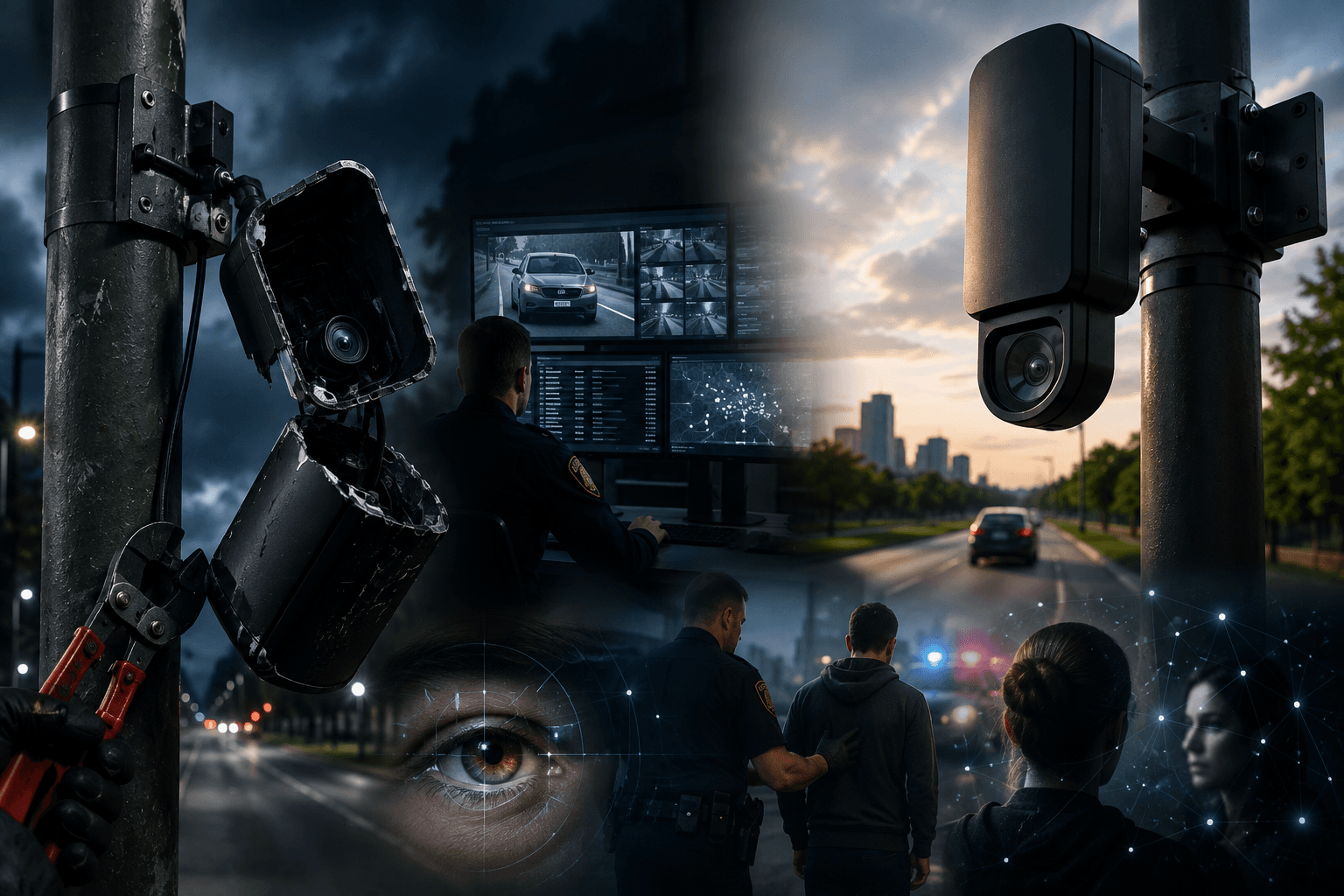
Flock Safety's license plate readers are having a rough 2026. Across at least five states, more than two dozen of the solar-powered cameras have been smashed, sawed down, or hauled off since early 2025 — and in a twist that captures everything wrong with unregulated surveillance networks, police are using the cameras' own data to hunt down the people destroying them. At the same time, court records show dozens of officers have secretly used that same data to track women they know personally, not suspects.
Both stories are really the same story: a nationwide camera network with almost no independent oversight, where the data can be turned against ordinary drivers by vandals' targets, vengeful exes with badges, or anyone who queries the system without real cause. If you drive, walk, or film in public — and especially if you post video online — this affects you.
This guide breaks down what's actually happening with Flock vandalism and misuse in 2026, what the law says about your license plate data, and how to protect your own footage before you publish it.
TL;DR: What's Happening With Flock Cameras in 2026
| Question | Answer |
|---|---|
| How many cameras have been vandalized? | 25+ across at least 5 states since early 2025 |
| Most prominent vandalism case? | Suffolk, VA — Air Force engineer charged with destroying 13 cameras (13 felony counts) |
| Do police use Flock data to catch vandals? | Yes — audit logs show routine use of camera footage and search history to identify suspects |
| How many officers accused of misuse? | At least 50 accused/charged with stalking via ALPR data; ~24 resigned or arrested per Institute for Justice |
| Worst documented misuse case? | Milwaukee officer ran 179 searches on a partner and her ex in two months |
| How was misuse caught? | Victim checked her own plate on haveibeenflocked.com, a public audit-log transparency site |
| Is warrantless plate tracking settled law? | No — being litigated post-Carpenter v. United States in multiple state courts |
| Can BGBlur help? | Yes — automatically blurs license plates and faces in video before you publish it |
Why Are People Destroying Flock Cameras?
The vandalism wave isn't random property crime — it's organized dissent against a surveillance system people feel they never consented to. Flock Safety cameras photograph every passing vehicle, read the plate with AI, and log the timestamp, GPS location, and vehicle characteristics into a searchable database that police departments nationwide can query. There's no warrant requirement, no consent step, and in most jurisdictions no opt-out.
The most closely watched case is out of Suffolk, Virginia. Air Force engineer Jeffrey Sovern is charged with 13 felony counts of destroying property, six counts of petit larceny, and six counts of possession of burglary tools after allegedly disassembling and disposing of 13 Flock cameras between April and October 2025 — starting by redirecting camera angles, then knocking down poles, and eventually throwing units off bridges onto interstates below. According to a criminal complaint filed in Suffolk General District Court, Sovern admitted to using vice grips to take apart the two-piece camera poles and kept wiring, batteries, and solar panels from the units.
Sovern has pleaded not guilty and argues the cameras amount to unconstitutional mass surveillance. Privacy activists have since donated more than $37,000 to his legal defense, turning the case into a rallying point for broader Fourth Amendment challenges to ALPR networks — the same legal theory underpinning active lawsuits in Kansas and California.
Similar incidents have been reported across Minnesota — including a wave of camera smashing in Winona and Edina — and other communities where residents have organized against new camera installations before they even go online.
Police Are Using the Cameras to Catch the People Vandalizing Them
Here's the part that makes this story genuinely strange: audit logs show law enforcement frequently pulls Flock footage and search history specifically to investigate attacks on Flock's own hardware. Departments have used camera data — sometimes from a neighboring, still-functioning unit — to identify vehicles or people near a vandalized camera around the time of the incident, then filed felony destruction-of-property charges.
In other words, the same all-seeing network that vandals are protesting is also the evidence base used to prosecute them. Most people charged in these cases are facing multiple felonies, since destroying a single unit — which can cost several thousand dollars to replace — is often charged per-incident when a suspect is linked to multiple destroyed cameras, as in the Suffolk case.
This dynamic hasn't slowed the vandalism. If anything, it's sharpened the underlying argument: a surveillance system with no warrant requirement for surveillance can still produce airtight evidence when it's convenient for the system's operators.
Dozens of Officers Have Been Caught Misusing Flock Data to Stalk People
While vandals attack the hardware, a separate and arguably more troubling pattern has emerged from inside police departments: officers using their access to Flock's nationwide search tool to track people they have no legitimate investigative reason to track.
Court and audit records reviewed by CNN show at least 50 officers across the country have been accused or charged with using license-plate reader systems to monitor women they know personally — romantic partners, exes, or people they were pursuing. The Institute for Justice, a nonprofit public interest law firm, has tallied at least two dozen cases where officers resigned or were arrested specifically for this kind of ALPR stalking abuse.
The clearest documented example: a former Milwaukee Police Department officer, Josue Ayala, ran 179 searches through the department's Flock system between late March and late May 2025, using it to track a romantic partner's location 124 times and her ex's location 55 times. According to the criminal complaint, Ayala logged "investigation" as the justification for every single search. He agreed to resign and plead guilty to attempted misconduct in public office as part of a plea deal.
How the Misuse Was Discovered
The victim in the Milwaukee case didn't find out through an internal audit — she checked her own plate on haveibeenflocked.com, a transparency tool built from Flock audit logs obtained through public records requests. That's a structural weak point worth understanding: Flock logs every search an officer runs, including a timestamp and a self-reported reason, but nothing in the system stops an officer from typing a vague or false justification. Oversight depends almost entirely on someone — a victim, a journalist, an auditor — reviewing the logs after the fact, not on any control that prevents the search in the first place.
Is Warrantless License Plate Tracking Even Legal?
Courts haven't settled this yet. The traditional rule — the third-party doctrine — holds that data you hand to a private company (a phone carrier, a bank, a camera network) loses Fourth Amendment protection because you "assumed the risk" it could reach the government. That doctrine was built for phone records, not a nationwide, continuously updated map of everywhere your car has been.
Carpenter v. United States (2018) complicated that logic. The Supreme Court ruled 5-4 that accessing long-term cell-site location data without a warrant was unconstitutional, even though a phone company held the data, because comprehensive location tracking reveals "the privacies of life" in a way isolated records don't. Legal scholars and litigants — including plaintiffs in the ongoing Kansas GPS-tracking lawsuit — argue ALPR networks are exactly the kind of continuous tracking Carpenter was written to limit. Whether courts agree is still being tested case by case. For a full state-by-state and doctrinal breakdown, see our guide to Flock Safety camera license plate privacy rights.
What You Can Actually Control: Your Own Published Video
You can't stop a Flock camera from photographing your plate on a public road, opt out of the database, or force a department to delete a scan. What you can control is what you publish yourself — dashcam clips, neighborhood security footage, vlogs, real estate walkthroughs, protest coverage. Every one of those can contain other people's plates and faces, and once you upload it, you've created a searchable record with none of even Flock's limited audit trail.
How to Blur License Plates Before You Publish
- Upload your clip to BGBlur — drag and drop MP4, MOV, or M4V footage, up to 4K resolution, directly in the browser. Nothing installs.
- Let AI detect the plates. BGBlur's object-detection model locates license plates automatically and tracks them across frames as vehicles move, so you're not manually drawing boxes on every frame.
- Select faces too, if relevant. Dashcam and doorbell footage often catches bystanders and neighbors — BGBlur's motion-tracked face blur works in the same pass.
- Export and download. Choose MP4, MOV, or WebM. Files are deleted from BGBlur's servers within 24 hours; nothing is stored permanently.
This matters most for the exact footage types tied to the Flock controversy: dashcam recordings that catch a Flock pole (and other vehicles' plates) in frame, doorbell or security clips shared to neighborhood groups, and protest or news footage where bystanders' plates and faces shouldn't be identifiable. See our step-by-step guide on blurring faces and license plates in dashcam videos for platform-specific tips.
Who Should Be Paying Attention to This
Dashcam and rideshare drivers: Your footage often captures Flock poles, other drivers' plates, and pedestrians. If you post clips publicly or submit them as evidence, blur third-party identifiers first.
Neighborhood watch and HOA video admins: Private Flock deployments are run by HOAs and apartment complexes, which face fewer legal constraints than police. If your community shares raw footage in group chats or Facebook groups, you're creating an uncontrolled surveillance archive with worse oversight than Flock's own audit logs.
Journalists and researchers covering ALPR stories: Publishing footage of a vandalism incident or a protest against Flock cameras means handling other people's identifying information responsibly — blur bystanders unless there's a clear editorial reason to show them.
Anyone posting protest or activism footage: Camera vandalism protests, like the demonstrations covered in our guide on protecting privacy at protests, routinely get filmed by attendees. Faces and plates in that footage can expose participants to identification long after the event.
Honest Limitations
BGBlur protects footage you control and choose to publish — it does nothing to stop Flock or police departments from collecting your plate data on public roads in the first place, and it can't retroactively scrub footage already indexed by a third party's camera network. If your goal is systemic change (banning ALPR in your city, forcing audit reform), that's a policy and legal fight, not a video-editing one. For high-volume institutional footage — police body cam archives running into thousands of hours — dedicated redaction platforms built for chain-of-custody workflows, like those covered in our best video redaction software comparison, may fit better than a browser tool built for individual creators.
Frequently Asked Questions
Why are people vandalizing Flock Safety cameras? Vandals argue the cameras enable warrantless mass surveillance with no consent step or opt-out. Over two dozen cameras have been destroyed across at least five states since early 2025, most notably in a Suffolk, Virginia case where the defendant faces 13 felony counts and has become a privacy-activist cause célèbre.
Are police using Flock data to catch camera vandals? Yes. Departments routinely pull footage and search logs from Flock's network to identify and charge people suspected of destroying cameras, using the same surveillance infrastructure that's being protested as the evidence base for prosecution.
Have police misused Flock data to stalk people? Yes — at least 50 officers nationwide have been accused or charged with using license-plate reader access to track women they knew personally, according to CNN's review of court and audit records. A Milwaukee officer ran 179 unauthorized searches over two months before resigning and pleading guilty.
How do I check if my plate was searched without cause? File a public records request for your plate's Flock audit log, or check haveibeenflocked.com, a site built from publicly obtained audit data, if your jurisdiction is indexed.
Is it legal for Flock to track my plate without a warrant? It's unresolved. Courts are actively deciding whether Carpenter v. United States, which limited warrantless cell-phone location tracking, extends to ALPR networks — litigation is ongoing in California and Kansas.
Can I get my license plate data deleted from Flock's database? Generally no. Most jurisdictions treat ALPR data as a law-enforcement record with no individual deletion right, though a few states like Maine and New Hampshire impose retention limits or usage restrictions.
What can I do to protect my own privacy in video I post online? Blur license plates and faces before publishing dashcam, security, or protest footage. BGBlur automates this with AI-tracked blurring directly in your browser, with processed files deleted within 24 hours.
Does blurring my footage stop Flock cameras from tracking me on the road? No. Blurring controls what you publish; it can't stop a roadside ALPR camera from photographing your plate as you drive past. The two are separate problems — one about publication risk, one about ambient surveillance you can't opt out of.
Bottom Line
Flock's 2026 has been defined by two mirrored failures: a public that doesn't trust the network enough to leave it standing, and officers inside the system abusing it in ways no policy stopped in advance. Both point to the same gap — audit trails that catch misuse after the damage is done, not before. You can't fix Flock's oversight problem yourself, but you can control the footage you publish. Blur plates and faces in your own dashcam, security, and protest video with BGBlur before it becomes someone else's searchable record.
Update — August 12, 2026: The misuse cases have now tipped into a cancellation wave — 82 Flock contracts terminated across 28 states, with Narragansett and Glocester, Rhode Island both voting to pull out in the first week of August 2026. Cancelling doesn't delete the scans already collected, though. See what happens to plate data after a town cancels its Flock contract and why private HOA and storefront cameras become the bigger publishing risk.
Update — August 20, 2026: The Washington Post's misuse count has grown to at least 69 police officials, and Gardner, Kansas just became the latest city to cancel its Flock contract after a resident group found more than 1,200 vendors had access to the city's plate data. See our coverage of Gardner's Flock cancellation and what a city vote does and doesn't cover.
Update — August 14, 2026: A volunteer project called SparrowMap flipped this model on its front page of Hacker News — instead of logging every driver, its cameras keep only government vehicles and destroy everyone else's plate on-device before anything is uploaded. See our breakdown of SparrowMap's crowdsourced government-vehicle tracking and how it compares to Flock's model.
Update — August 29, 2026: Vandalism is only one form of pushback. See our roundup of the council votes and lawsuits driving Flock's 2026 cancellation wave for the lawful playbook residents and officials are using instead.
Update — August 30, 2026: Viral posts about adversarial "digital camouflage" shirts confuse person-detection demos with plate-tracking ALPR networks — an adversarial shirt does not stop Flock from reading your plate. See what Simon Weckert's Digital Camouflage project actually proves about YOLO tests, limits, and why publish-side blur still matters.