Protect Privacy at Protests: Drone and Bodycam Face Blur
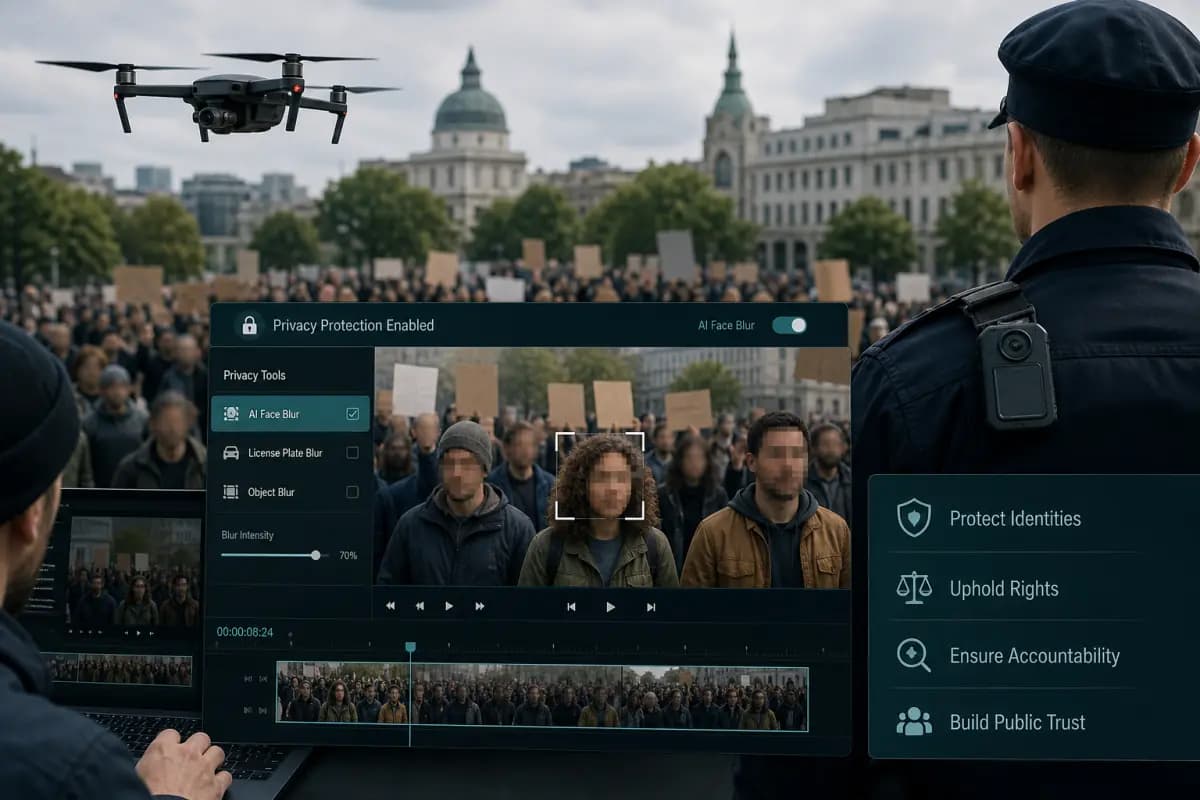
Global protests face comprehensive surveillance through drones, body cameras, and facial recognition. Learn how AI-powered face blurring protects peaceful protesters while documenting important civic events in India, France, US, and worldwide.
Introduction
From India to France, Hong Kong to the United States, a new reality has emerged at protests worldwide: comprehensive surveillance through drones, body cameras, and facial recognition technology. While the right to peaceful protest remains fundamental to democracy, the ability to document these events while protecting participant privacy has become increasingly complex.
This isn't about politics—it's about privacy. Whether you're a journalist covering demonstrations, an activist documenting civil movements, or a protester exercising your democratic rights, understanding surveillance technology and privacy protection tools has become essential in 2026.
The New Surveillance Reality at Global Protests
India: Comprehensive Documentation Systems
Recent protests in India have showcased the evolution of protest surveillance technology. Police departments now deploy:
- Body-worn cameras on officers to capture every interaction
- Drone surveillance providing aerial coverage of entire protest areas
- Multiple camera angles ensuring comprehensive documentation
- Real-time monitoring of crowd movements and individual participants
This level of documentation, while potentially useful for accountability, raises significant privacy concerns for peaceful protesters who may face identification and potential repercussions.
France: Yellow Vests and Surveillance Evolution
France's extensive protest movements have led to sophisticated surveillance deployments:
- Automated facial recognition systems in public spaces
- Drone monitoring of large gatherings
- Video analytics identifying individuals across multiple protest events
- Database compilation of frequent protest participants
The tension between security and privacy rights has become a central debate in European democracies.
Hong Kong: Digital Surveillance Integration
Hong Kong protests demonstrated how surveillance extends beyond physical cameras:
- Smart city infrastructure repurposed for protest monitoring
- Public transport tracking to identify protest participants
- Social media monitoring and digital footprint analysis
- Cross-reference databases linking online and offline identities
United States: Multi-Agency Coordination
US protests have seen coordination between federal, state, and local surveillance:
- Cell tower simulators (Stingrays) tracking phone locations
- License plate readers identifying vehicle owners
- Social media intelligence gathering from public posts
- Inter-agency data sharing creating comprehensive participant profiles
Why Privacy Protection Matters
The Chilling Effect on Democratic Expression
When protesters know they're being comprehensively surveilled and identified, it creates a "chilling effect" on democratic participation:
- Self-censorship: People avoid exercising their rights due to fear of consequences
- Reduced participation: Legitimate concerns about privacy prevent democratic engagement
- Targeted retaliation: Identified protesters may face employment, social, or legal consequences
- Long-term profiling: Participation in lawful protests becomes permanent record data
Protecting Vulnerable Participants
Not everyone at a protest can safely be identified:
- Undocumented immigrants exercising their rights
- People in sensitive employment (teachers, government workers, healthcare professionals)
- Minors participating in democratic movements
- Victims of abuse who cannot risk identification
- International students who may face visa complications
Journalistic Responsibility
Journalists and documentarians face ethical obligations:
- Source protection: Shielding participants from identification
- Ethical reporting: Documenting events without compromising safety
- Legal compliance: Meeting privacy regulations across jurisdictions
- Professional standards: Maintaining subject anonymity when requested
How Surveillance Technology Works
Drone Surveillance Capabilities
Modern protest drones are far more sophisticated than consumer models:
- 4K and 8K resolution capturing fine facial details from 100+ feet
- Optical zoom allowing facial identification from safe distances
- Thermal imaging identifying individuals even in crowds
- AI-powered tracking following specific individuals through crowds
- Persistent aerial surveillance documenting entire protest timelines
Body Camera Technology
Police body cameras have evolved significantly:
- Wide-angle lenses capturing everyone in frame
- High frame rates preventing motion blur for facial clarity
- Night vision capabilities for low-light identification
- Cloud upload systems making footage immediately searchable
- Integration with facial recognition databases
Facial Recognition Systems
The most concerning development is real-time facial recognition:
- Live matching against government databases
- Social media scraping to identify individuals from online photos
- Cross-event tracking linking the same person across multiple protests
- Predictive analytics identifying "likely protesters" before events
- Automated watchlists flagging individuals for enhanced scrutiny
Privacy Protection Strategies
For Protesters: Physical Protection Methods
Traditional privacy protection remains important:
- Face masks and scarves: Still effective against basic identification
- Clothing choices: Avoiding distinctive patterns and logos
- No branded items: Removing identifying accessories
- Umbrella tactics: Physical barriers against overhead surveillance
- Laser pointers: Disrupting camera sensors (check local legality)
Important: While these physical methods help, video footage captured at protests will eventually be shared online, posted to social media, or used in news reports—and that's where digital face blurring becomes essential.
For Journalists: Documentation Best Practices
Professional documentation requires balancing coverage with privacy:
- Shoot wide angles: Capture the scene without focusing on individuals
- Blur during capture: Use real-time privacy filters when possible
- Immediate post-processing: Blur faces before footage leaves your device
- Consent protocols: Get explicit permission for identifiable footage
- Secure storage: Protect raw footage with encryption
For Activists: Digital Protection
Activists sharing documentation need comprehensive privacy strategies:
- Phone security: Leave SIM cards out, use airplane mode
- Anonymous uploads: Use VPNs and anonymous accounts
- Metadata removal: Strip location and time data from photos/videos
- Secure communication: End-to-end encrypted messaging only
- Face blurring: Process all footage before sharing publicly
The Solution: AI-Powered Face Blurring
Why Manual Blurring Fails at Protests
Protest footage presents unique challenges:
- Crowd density: Hundreds or thousands of faces per video
- Movement and chaos: Constantly shifting camera angles and subjects
- Time pressure: News value decreases rapidly, requiring quick processing
- Multiple videos: Events generate hours of footage from various angles
- Consistency requirements: Every face must be protected, no exceptions
Manual frame-by-frame blurring is simply not feasible for protest documentation.
AI-Powered Automated Face Detection
Modern AI face blurring solves these challenges:
Comprehensive Detection:
- Automatically identifies all faces in video footage
- Works with crowded scenes and multiple subjects
- Handles varied angles, lighting, and movement
- Processes hours of footage in minutes
Consistent Protection:
- Never misses a face that needs protection
- Applies uniform blurring across all frames
- Maintains temporal consistency as people move
- Prevents partial blurring that could compromise privacy
Professional Quality:
- Preserves video quality while protecting privacy
- Natural-looking blur that doesn't distract from content
- Maintains editorial context while ensuring anonymity
- Compatible with all major platforms and formats
bgblur.com: Purpose-Built for Protest Documentation
bgblur.com provides specialized capabilities for protest video privacy:
Rapid Processing:
- Process hours of protest footage quickly
- Batch processing for multiple video files
- Cloud-based system requiring no powerful hardware
- Fast turnaround for time-sensitive news coverage
Reliable Protection:
- AI detection ensuring comprehensive face coverage
- Multiple detection passes to prevent missed faces
- Quality verification before final output
- Customizable blur intensity for different contexts
Journalism-Friendly Features:
- Preserves video quality for professional broadcast
- Supports high-resolution and 4K footage
- Compatible with all major editing software
- API integration for workflow automation
Privacy-First Design:
- No data retention of processed videos
- Secure cloud processing with encryption
- Compliance with international privacy standards
- No facial recognition database creation
Real-World Use Cases
Case Study: Indian Student Protests
Recent student protests in India demonstrate the critical need for face blurring:
The Situation:
- Students protesting education policy reforms
- Comprehensive police surveillance with body cameras and drones
- Concerns about academic consequences and future employment
- Need to document events while protecting participants
The Solution:
- Journalists used bgblur.com to process all protest footage
- Comprehensive face blurring before publication
- Protected student privacy while documenting important civic events
- Enabled whistleblowers and participants to share footage safely
The Result:
- News coverage maintained without compromising student safety
- Documentary evidence preserved for historical record
- Students felt safer participating knowing privacy tools existed
- International coverage possible without endangering participants
Case Study: French Labor Demonstrations
France's ongoing labor protests illustrate another dimension:
The Challenge:
- Workers fearing employer retaliation for protest participation
- Government surveillance systems creating permanent participation records
- Need to demonstrate public support without individual exposure
- International workers concerned about visa implications
The Implementation:
- Activist groups established face-blurring protocols
- All shared footage processed through privacy tools
- Social media campaigns maintained anonymity
- Documentary evidence available without identity compromise
Case Study: US Reproductive Rights Protests
American protests following policy changes show domestic needs:
Privacy Concerns:
- Participants in states with restrictive laws fearing consequences
- Healthcare workers unable to risk public identification
- Students concerned about campus discipline
- Employment consequences in conservative areas
Protection Strategy:
- Grassroots organizers educated participants about surveillance
- Provided resources for privacy-protecting documentation
- Coordinated with journalists on anonymization standards
- Created safe documentation that protected while informing
Legal Considerations Across Jurisdictions
European Union: GDPR Compliance
Under GDPR, recording identifiable individuals requires consideration:
- Legitimate interest: Journalism and civic documentation may qualify
- Data minimization: Blur faces you don't need to show
- Right to erasure: Individuals can request removal
- Privacy by design: Implement blurring as default practice
Face blurring helps ensure GDPR compliance in protest documentation.
United States: State-by-State Variation
US privacy law varies significantly:
- Public space recording: Generally legal but evolving
- Commercial use restrictions: Identifiable faces in monetized content
- State privacy laws: California, Illinois, and others have specific requirements
- Harassment concerns: Targeted individual filming may face legal challenge
Asia-Pacific: Diverse Privacy Frameworks
Different countries require different approaches:
- Japan: Strong privacy protections requiring consent
- South Korea: Personal Information Protection Act considerations
- India: DPDP Act creating new privacy requirements
- China: Complex regulations around public gathering documentation
Best Practice: Default Anonymization
Regardless of jurisdiction, the safest approach is:
Blur first, ask questions later
- Process all protest footage with face blurring by default
- Only keep unblurred versions if explicit consent obtained
- Secure storage for raw footage separate from published content
- Regular deletion of personally identifiable raw footage
Technical Implementation Guide
Step 1: Secure Your Recording Setup
Before filming:
- Use devices without personal accounts logged in
- Remove SIM cards or use airplane mode
- Disable GPS tagging on photos/videos
- Use encrypted storage from the start
Step 2: Capture Strategy
While recording:
- Maintain awareness of who you're filming
- Note anyone requesting not to be recorded
- Capture establishing shots without focusing on faces
- Document the event, not the individuals
Step 3: Immediate Processing
After filming:
- Transfer footage to secure storage immediately
- Upload to bgblur.com for automatic face detection
- Review AI processing to ensure complete coverage
- Adjust blur intensity if needed for context
Step 4: Verification and Publication
Before sharing:
- Watch entire video to verify comprehensive protection
- Check for reflections, screens, or other identification vectors
- Remove metadata containing location and time information
- Publish through secure, anonymous channels if appropriate
Step 5: Secure Disposal
After publication:
- Encrypt or delete raw footage containing identifiable faces
- Maintain only fully anonymized versions
- Document consent if keeping any identifiable footage
- Regular security audits of stored content
Building a Privacy-First Documentation Culture
Educating Participants
Help create safer protest environments:
- Pre-protest briefings: Educate participants about surveillance
- Privacy resources: Share tools like bgblur.com with organizers
- Consent protocols: Establish clear filming agreements
- Mutual protection: Create culture of protecting fellow participants
Journalist Standards
Professional media should adopt privacy-first protocols:
- Default anonymization: Make face blurring standard practice
- Editorial guidelines: Clear policies on when identification is necessary
- Technical training: Ensure journalists understand privacy tools
- Source protection: Extend traditional source protection to visual subjects
Activist Best Practices
Movement organizers should prioritize privacy:
- Privacy toolkits: Provide resources to all participants
- Designated documentarians: Train specific individuals in privacy-protecting filming
- Verification systems: Ensure shared content meets privacy standards
- Rapid response: Quick processing enables timely yet safe content sharing
The Future of Protest Privacy
Emerging Threats
Surveillance technology continues advancing:
- Gait recognition: Identifying individuals by walking patterns
- Clothing recognition: Tracking same outfit across events
- Voice identification: Audio surveillance matching identities
- Network analysis: Identifying relationships between protesters
- Predictive policing: Anticipating protest participation
Counter-Surveillance Evolution
Privacy protection must keep pace:
- Real-time blurring: Live anonymization during streaming
- Comprehensive anonymization: Protecting beyond just faces
- Encrypted documentation: Secure storage becoming standard
- Decentralized systems: Blockchain-based privacy-first documentation
- AI privacy tools: Automated detection of all identification vectors
Legal and Ethical Frameworks
Society must address surveillance balance:
- Right to privacy at protests: Legal protections for participant anonymity
- Surveillance limitations: Restrictions on comprehensive monitoring
- Data retention limits: Requirements to delete surveillance footage
- Transparency requirements: Public disclosure of surveillance systems
- Democratic safeguards: Protecting fundamental rights in digital age
Conclusion: Privacy as a Democratic Right
The right to protest is fundamental to democratic society. As surveillance technology becomes more comprehensive, more sophisticated, and more integrated into public spaces, protecting protester privacy isn't just a technical challenge—it's a democratic necessity.
Tools like bgblur.com exist to ensure that civic participation doesn't require sacrificing privacy. By making face blurring accessible, automatic, and reliable, we can document important social movements while protecting the individuals who make them possible.
Whether you're in New Delhi, Paris, New York, or Hong Kong, the challenges are similar: comprehensive surveillance that can identify and track peaceful protesters. And the solution is universal: privacy-protecting documentation tools that enable civic engagement without permanent surveillance records.
Key Takeaways:
- Surveillance is now universal at protests worldwide—drones, body cameras, and facial recognition are standard
- Privacy protection is essential for safe democratic participation without chilling effects
- AI face blurring provides the only practical solution for comprehensive protection in crowd footage
- Default anonymization should become standard practice for all protest documentation
- bgblur.com offers purpose-built tools for journalists, activists, and protesters protecting privacy
The future of protest documentation must be privacy-first. By adopting automated face blurring as standard practice, we can ensure that civic participation remains accessible to all, regardless of the sophistication of surveillance technology.
Document responsibly. Protect privacy. Preserve democracy.
Protect participant privacy in your protest documentation. Try bgblur.com today for AI-powered automatic face blurring that preserves your message while protecting people.