Digital Camouflage Shirt vs AI Surveillance [2026]
Berlin artist Simon Weckert unveiled Digital Camouflage, a shirt engineered with adversarial patterns that can intermittently fool open-source YOLO person detectors while remaining visible to humans. The project responds to AI video surveillance at Kottbusser Tor and raises a sharper question for anyone publishing footage: how do you protect privacy when detection runs in both directions?
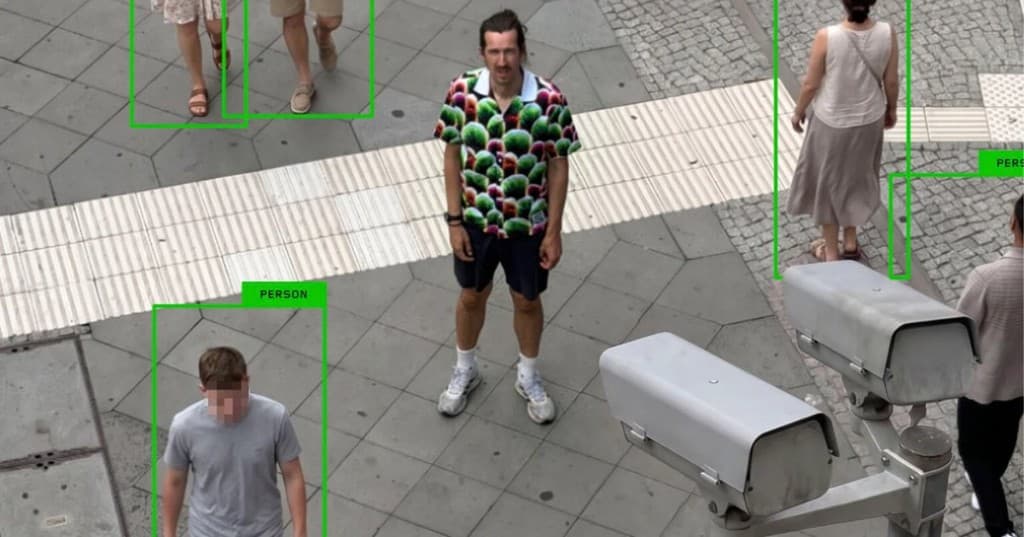
Demonstration screenshot: open-source YOLO labels other pedestrians as "PERSON" while the Digital Camouflage shirt wearer receives no stable detection box. © Simon Weckert — project page.
On August 30, 2026, a Polymarket post about a German technologist's "digital camouflage" shirt ricocheted across social feeds — complete with a surveillance-camera screenshot showing pedestrians boxed as PERSON while the central figure in a loud, cactus-patterned shirt has no box at all. The image looks like magic. The engineering story behind it is real. The takeaway most people need is narrower than the headline suggests.
Berlin-based artist and technologist Simon Weckert calls the project Digital Camouflage. It is a conceptual garment collection designed to disrupt AI person detection using adversarial texture — visual noise tuned to break the statistical patterns object detectors rely on. Weckert developed it as Berlin prepares an AI video surveillance pilot at Kottbusser Tor, a flashpoint in Europe's debate over automated monitoring in public space.
This article explains what adversarial clothing actually does, where Weckert draws explicit limits on "invisibility," why viral demos overstate real-world protection, and what video publishers should do instead when AI is watching — and when they are the ones releasing footage.
What Is Simon Weckert's Digital Camouflage Shirt?
Digital Camouflage is adversarial fashion — clothing printed with a continuous pattern engineered to lower confidence scores in person-detection models. To human eyes it reads as eccentric resort wear: saturated greens, coral accents, overlapping bulbous shapes. To a convolutional detector trained on body silhouettes, those high-frequency transitions fire early network layers while fragmented shapes break the continuity of head-shoulders-torso grouping.
Weckert's process, described to Dezeen and PetaPixel, is deliberately recursive:
- Generate a candidate textile pattern.
- Present it to a detector (he tested with open-source YOLO).
- Measure how confidently the model still finds a person.
- Adjust the pattern and repeat — an adversarial loop until confidence collapses.
"You cannot design against machine perception by eye, only the machine can tell you what it fails to see," Weckert told Dezeen — noting the symmetry that the same class of AI used for surveillance also taught the shirt how to hide.
The collection uses a tileable Adversarial Texture (AdvTexture) covering the whole garment, addressing a known weakness of older adversarial patches: when fabric folds or camera angles shift, partial patches stop working — the segment-missing problem described in Designboom's coverage. Digital textile printing on recycled polyester applies the pattern at production scale in Latvia.
Crucially, Weckert exhibits the work as critical design, debuting in contexts like Ars Electronica 2025 — not as certified personal security gear.


Does "Digital Camouflage" Actually Make You Invisible to AI Cameras?
No — it can intermittently fool specific models in controlled demos, but it does not make wearers reliably invisible to AI surveillance in the wild. That distinction matters because social posts strip it out.
Responsible reporting on the project — including PTTL's breakdown — emphasizes Weckert's stated limits:
- Tested on a generic open-source YOLO detector, not a named government or vendor stack tied to Berlin's pilot.
- Success is intermittent in the demo video: sometimes the wearer lacks a stable label; sometimes detection returns.
- No promise of anonymity, no claim of defeating police systems, and no presentation as an evasion tool.
When Polymarket and repost accounts say wearers become "effectively invisible," the honest translation of "effectively" is: under a particular model, angle, and lighting, classification confidence can drop below the detector's threshold. That is scientifically interesting. It is not a cloak.
Compare with peer-reviewed physical adversarial clothing research. A CVPR 2023 paper on camouflage-style adversarial textures reported high attack success rates against YOLOv3, Faster R-CNN, and deformable DETR — after 3D modeling, fabric printing, and controlled trials. Even that work assumes known model weights and favorable viewpoints. Deployed city systems can differ on every axis.
What "effectively invisible" looks like in the demo
In the demonstration screenshot above, green bounding boxes appear on other pedestrians while the shirt wearer has no box — the visual hook that made the story viral. That gap is exactly what adversarial attacks optimize for: not disappearing from the sensor, but preventing the downstream classifier from emitting person with sufficient confidence.
Edge AI pipelines often run detection on-camera with tight latency budgets. Dark Reading's profile of DEF CON's noRecognition project notes that on-device models trade accuracy for speed — which creates exploitable blind spots. But backends can re-run stronger models, fuse multiple frames, or add human review. A shirt that beats YOLOv8 today may not beat a retrained ensemble six months later.
Does the Shirt Fool Face Detection — or Just Person Boxes?
No — the demo targets person classification, not faces. Look at the hero screenshot again: the wearer's face is fully visible and unobstructed. The adversarial textile covers the torso; it was optimized in an adversarial loop against YOLO person confidence, not against face landmarks or identity embeddings.
That matters because real systems — and privacy tools — rarely stop at one detector:
| Model type | What it looks for | Broken by this shirt? |
|---|---|---|
| Person detection (YOLO) | Body-level "person" box | Sometimes — that is the demo |
| Face detection | Eyes, nose, jaw in a facial region | No — face still exposed |
| Face recognition | Identity embedding from a face crop | No — not the attack target |
| BGBlur face blur | Facial regions for anonymization | No — detects faces directly |
Surveillance pipelines often chain detect person → track → detect face → match. Missing the first box does not automatically break the third. BGRemover.video segmentation is a different task again — foreground matting usually still isolates the subject because pixels remain visually present even when a classifier hesitates.
So when headlines ask whether digital camouflage "really works," the honest answer is narrow yes, broad no. We break that down fully in does digital camouflage really work against face detection and AI blur? — including why BGBlur still blurs wearers before you publish footage.
How Do Adversarial Patterns Trick Person Detectors Like YOLO?
They inject high-frequency visual features that decouple human-visible body structure from the statistical cues neural networks learned as "person." Most modern detectors — YOLO ("You Only Look Once") included — slide over an image in stages, combining edge detectors, texture filters, and part layouts into a class score.
Adversarial textiles target three weak points:
High-frequency noise vs silhouette continuity
Person detectors lean heavily on head-and-shoulders envelopes and limb proportions. When a shirt floods early layers with saturated color transitions, the network spends capacity on local texture instead of binding parts into one instance. Weckert describes this as breaking the outline continuity so the detector "can no longer bind the parts into one figure."
Full-garment texture vs patch attacks
Early adversarial T-shirts used fixed patches that failed when wrinkles hid part of the pattern. Full-surface AdvTexture spreads adversarial signal across the torso so folds still expose enough noise at most angles — the design problem AdvTiles research (2026) continues to refine with learnable tile layouts and 3D Gaussian splatting simulation.
Model-specific optimization
Patterns are not universal keys. They are tuned against particular weights. Swearingen's noRecognition workflow — described at DEF CON and in Dark Reading — generates a pattern, scores confidence drops across multiple models, keeps winners, discards failures, and iterates. Mozilla Foundation's survey of anti-surveillance fashion warns that once a pattern ships at scale, vendors can retrain detectors to recognize it — the same arms race as malware signatures.
Why Viral Surveillance Hacks Fail Against Real City Camera Networks
Real deployments combine vendor secrecy, model updates, multi-camera tracking, and sensors adversarial shirts never tested against. Social demos use open weights and known APIs. Municipal pilots do not publish their full stack.
Berlin's Kottbusser Tor context
Weckert timed Digital Camouflage to Berlin's planned AI video surveillance at Kottbusser Tor — a neighborhood already saturated with political debate over policing and monitoring. Dezeen frames the shirt as a direct response to that pilot. Even if person detection were the only capability deployed — which public documentation rarely guarantees — municipal vendors are not obligated to use the exact YOLO checkpoint from a design demo.
Flock, ALPR, and the wrong threat model
Much US surveillance discourse in 2026 centers on Flock Safety license plate readers — networks capturing plates at scale, searchable by police and, as audit logs show, sometimes misused to track individuals. An adversarial person shirt does not alter plate OCR. If your privacy concern is vehicular tracking, you need plate blur on published video and policy pressure on retention — not a Hawaiian shirt.
Retraining closes the loop
Anti-surveillance fashion vendors including Cap_able and AntiAI Fashion test against YOLO or TensorFlow, per Mozilla's reporting — but all acknowledge efficacy is temporary. Adam Harvey's earlier CV Dazzle projects became less effective as models evolved. Digital Camouflage fits that lineage: culturally sharp, technically real, operationally perishable.
Is Adversarial Clothing Legal to Wear in Public?
Usually yes as expression — but legality is not the same as effectiveness, and special venues are different. Weckert positions Digital Camouflage as commentary on opaque automated surveillance, explicitly not as police evasion gear. Walking through a public square in loud pattern clothing is generally protected in Germany and comparable jurisdictions.
Friction appears when:
- Private operators ban obscured identity on premises.
- Security contracts require visible compliance with monitoring (construction sites, some transit agencies).
- Evidence tampering statutes intersect with deliberate defeat of mandated recording — context-dependent and fact-specific.
For creators, the mirror-image legal exposure is more common: publishing identifiable people captured without consent. Commercial YouTube, brand campaigns, and news clips trigger personality rights and GDPR biometric rules faster than wardrobe choices ever will. Our unauthorized filming and face blurring guide maps that terrain.
What Should Video Creators Do Instead of Trusting Anti-AI Clothing?
Blur and anonymize before you publish — that is the workflow you control end-to-end. Adversarial shirts address live capture by third-party cameras you do not operate. Most BGBlur users face the opposite problem: they hold footage and need to share it without exposing faces, plates, screens, or bystanders.

Publish-side privacy beats capture-side tricks
When you edit video for TikTok, documentary release, FOIA publication, or training libraries, you need deterministic anonymization you can verify frame by frame. AI video blur with motion tracking applies consistent redaction across angles and motion — something a shirt cannot do for people around you. For security teams comparing redaction vendors, see our best video redaction software for business comparison.
Strong blur matters legally now
Weak pixelation is no longer defensible where GDPR-style irreversibility applies. Forensic de-pixelation research shows low-radius blur and coarse blocks can be reversed — see our forensic de-pixelation and GDPR analysis. For archival CCTV and EU-facing releases, pair face blur with compliance guidance in our GDPR video redaction guide.
How to anonymize surveillance-style footage with BGBlur
- Upload MP4, MOV, or M4V up to 4K in the browser — no install.
- Enable AI face and plate detection; add text-prompt object blur for logos or screens if needed.
- Preview tracked blur across motion; increase strength for compliance-grade exports.
- Export and publish; BGBlur deletes source and output within 24 hours.
For a faster single-subject pass, see how to blur a face in photo or video in seconds.
Who Benefits from Understanding Adversarial Surveillance — and Who Needs Blur?
Journalists and activists should understand Digital Camouflage as evidence that person detectors are fallible — useful when challenging blanket claims that AI monitoring is neutral or infallible. It does not replace legal fights over retrospective facial recognition on CCTV archives or ALPR retention.
Street creators and vloggers still owe bystanders publish-side protection. A shirt does not blur the faces of people behind you.
Security and IT teams publishing clips need audit trails and consistent redaction, not wardrobe policies.
Policy readers should separate demo success from procurement reality: cities buy systems; vendors patch; the public rarely gets to test them before deployment — Weckert's central critique.
The Takeaway: AI Surveillance Has Blind Spots — Your Published Video Should Not
Simon Weckert's Digital Camouflage shirt is a credible demonstration that adversarial texture can break person detection on open-source YOLO under demo conditions. It is also explicitly not a guaranteed invisibility cloak, not tested against Berlin's vendor stack, and not a substitute for the publish-side privacy tools creators already need.
The viral image — boxed crowds, unboxed shirt — is worth studying. It shows how cheap edge detectors fail. It does not show that you can walk past municipal AI unscanned forever.
If you control footage leaving your camera roll, dashboard, or NVR, the durable move is stronger: motion-tracked AI blur for every face and plate you lack consent to show, exported once, verified once, shared safely. That is the problem BGBlur built for — and it works whether or not you own a cactus-print adversarial shirt, because face blur does not depend on YOLO person labels.
Go deeper: Does digital camouflage really work on face detection? · BGRemover segmentation test
Try it free in your browser at bgblur.com before your next upload goes live.