Does Digital Camouflage Work on Face Detection? [2026]
Simon Weckert's Digital Camouflage shirt breaks open-source YOLO person classification in controlled demos — but the wearer's face stays visible, and real surveillance pipelines chain multiple models. This post explains why person-detection failure is not invisibility, how face detectors and BGBlur still find subjects, and where adversarial clothing actually stops working.
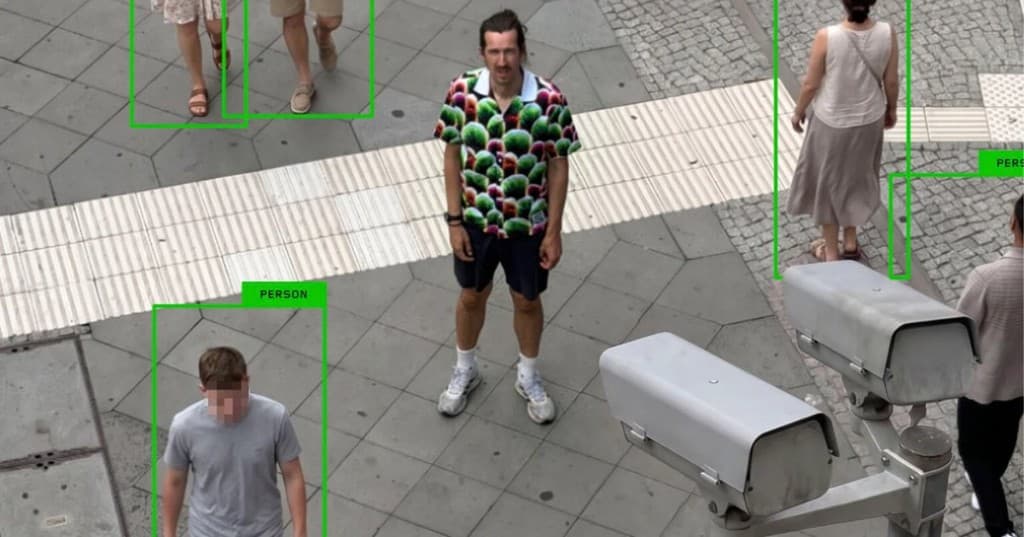
The viral demo breaks YOLO person labeling on the shirt wearer — note the unobstructed face and limbs still clearly visible. © Simon Weckert.
The August 2026 digital camouflage wave asks a seductive question: can a cactus-print shirt make you invisible to AI? Simon Weckert's Digital Camouflage project shows something real — open-source YOLO intermittently skips the person box on the wearer while labeling passers-by PERSON. But zoom into that screenshot. The face is fully visible. Arms, legs, and shadow remain. The camera still records every pixel.
That is why "does it really work?" needs a sharper split: person detection is not face detection, and neither is face recognition, license plate OCR, or publish-side blur. This article maps what adversarial shirts actually break, what surveillance and editing pipelines still see, and why BGBlur face blur remains effective on footage of patterned subjects.
For background removal specifically — whether BGRemover.video segmentation still isolates the wearer — see our companion piece on matting versus classification. For the full project context, start with what Weckert's shirt proves about AI surveillance.
What "Really Works" Means in the Viral Demo
The shirt really disrupts one person-classifier on one model — not all of computer vision. Weckert built the textile in an adversarial loop against YOLO: generate pattern, measure person-detection confidence, adjust until confidence collapses. Dezeen quotes him describing saturated transitions that fire early network layers and break torso outline continuity.
What the demo does not show:
- Face landmarks disappearing from the frame
- Facial recognition failing on a cropped face
- License plates becoming unreadable
- Proprietary municipal stacks matching the open-source test
- Stable success on every frame — success is intermittent, per PTTL
Polymarket-style "effectively invisible" headlines translate to: under this YOLO build, this angle, and this lighting, the person logit dropped below threshold. That is a valid research result. It is not a cloak.
Person Detection vs Face Detection: Why They Split
Surveillance and privacy tools rarely stop at one model. Treating a missing YOLO box as total AI blindness misreads how pipelines are built.
| Stage | What it detects | Adversarial shirt impact | BGBlur relevance |
|---|---|---|---|
| Person detection (YOLO-family) | Body-level "person" box | Primary target of Weckert's pattern | Not how BGBlur finds faces |
| Multi-object tracking | Same person across frames | May break if detection drops | Blur tracks faces independently |
| Face detection | Facial region + landmarks | Face still visible in demo | Core BGBlur input |
| Face recognition | Identity embedding vs database | Requires face-specific adversarial attack | Blur removes biometric signal before publish |
| License plate OCR | Plate characters | Shirt irrelevant | BGBlur plate blur still applies |
Person detectors learn holistic body silhouettes — head-shoulders-torso envelopes and limb ratios. Face detectors learn eyes, nose, mouth, and jaw contours on a smaller region. They can run without a person box: scan the frame, find faces, crop, proceed.
In Weckert's demo image, a standard face detector would still anchor on the central figure's unobstructed face — the adversarial pattern stops at the shirt, not the skin.
Why BGBlur still blurs the wearer
BGBlur uses AI face detection with motion tracking — not YOLO person labels. When you upload street footage, dashcam video, or event coverage:
- Face models scan each frame for facial regions.
- Tracks persist across motion, partial turns, and lighting shifts.
- Blur or stronger anonymization applies to detected faces — including the shirt wearer and bystanders.
The shirt optimizes torso texture against person-class weights. It does not erase facial geometry from the pixel data BGBlur reads. Unless the face is turned away, occluded, or below resolution — the same limits as any footage — blur still lands.
That is the practical answer to "does it really work against tools like BGBlur?" No — not for face privacy on published video. For live evasion of every camera stage, also no — for separate reasons below.
Does It Beat Face Recognition and Multi-Model Surveillance?
Not reliably — because deployed stacks chain stages the shirt was never tested against.
Face recognition runs on crops, not shirt patterns
Facial recognition systems (ArcFace-style embedders, vendor FR APIs) consume aligned face crops. Research on adversarial face attacks uses specialized patches, infrared dots, or makeup patterns — not Hawaiian-shirt torso noise. Dark Reading's coverage of DEF CON's noRecognition project focuses on geometric patterns affecting detection confidence — a different design space from Weckert's person-detector loop.
The demo subject's face is clear, front-facing, and uncovered. That is the input FR systems want.
Backend re-analysis beats edge shortcuts
Edge cameras often run lightweight detectors for speed — the exploitable tier in demos. Backends can:
- Re-run stronger models on stored footage
- Fuse detections across multiple frames and camera angles
- Apply separate face and plate modules regardless of a missed person box
A shirt that beats YOLOv8 on-camera today may not beat a retrained ensemble on the server tomorrow. Mozilla Foundation's anti-surveillance fashion survey documents the same retraining loop for every public adversarial pattern.
Flock, plates, and the wrong threat model
US discourse in 2026 often centers on Flock Safety ALPR — plate OCR, not torso classification. A person-detection adversarial shirt does nothing for vehicle tracking. Berlin's Kottbusser Tor pilot that inspired Weckert may use vendor stacks unrelated to his YOLO test.
Segmentation Tools See You Too — BGRemover Is Not Fooled the Same Way
Background removal asks which pixels are foreground — not whether YOLO says person. BGRemover.video uses semantic segmentation and matting. The wearer still presents face, limbs, and contrast against pavement even when a bounding box fails.
Digital camouflage is not invisibility to editing AI either — only to one classification metric on one detector family. Creators compositing footage should expect the subject to remain extractable, with possible edge noise around the busy shirt pattern.
What Actually Protects You When AI Is Watching
Split live capture from publish-side control.
Live public space — shirt is a provocation, not a product
Weckert frames Digital Camouflage as critical design about opaque surveillance — not certified evasion gear. Wearing adversarial clothing may lower one detector score intermittently. It does not guarantee escape from face recognition, plate readers, multi-camera tracking, or human operators reviewing footage.
Footage you publish — blur beats wardrobe
If you hold the video file, you control the export:
- Upload to BGBlur in the browser.
- Run AI face and plate detection — independent of person boxes.
- Preview tracked blur on every identifiable subject.
- Export and delete sources within 24 hours.
Pair with GDPR-grade anonymization guidance — weak pixelation fails forensic reversal tests documented in our de-pixelation analysis.

Audit every frame before release
Shirt or no shirt, verify blur on hard frames: fast motion, profile angles, partial occlusion, 4K export resolution. The adversarial demo teaches that one model failing ≠ privacy. Your publish checklist should assume faces are detectable until proven blurred.
Who Should Read This — and What to Do Next
Journalists and policy readers: use the demo to challenge "AI always sees everything" — but quote Weckert's limits and the face-visible screenshot, not Polymarket invisibility hype.
Creators and security teams publishing clips: assume face detection still works on subjects in adversarial shirts. Run BGBlur before upload.
Editors compositing scenes: BGRemover segmentation likely still cuts out the subject — see the BGRemover segmentation test write-up.
The Honest Answer: Does It Really Work?
Yes — at one narrow task: breaking person-class confidence on open-source YOLO in demo conditions.
No — as general invisibility against face detection, facial recognition, plate OCR, multi-model city surveillance, BGBlur anonymization, or BGRemover segmentation.
The face in the viral image is the tell. AI that hunts faces — including the tools you use to protect privacy before publishing — operates on a signal the shirt was never designed to destroy. Person box gone; face still there; blur still works.
Try BGBlur free at bgblur.com on your next clip — patterned shirt optional.
Update — September 24, 2026: See our new guide on the Clearview AI B.C. appeal ruling on face scraping.