Real Humans, Face Blur vs AI Synthetic Performers 2026
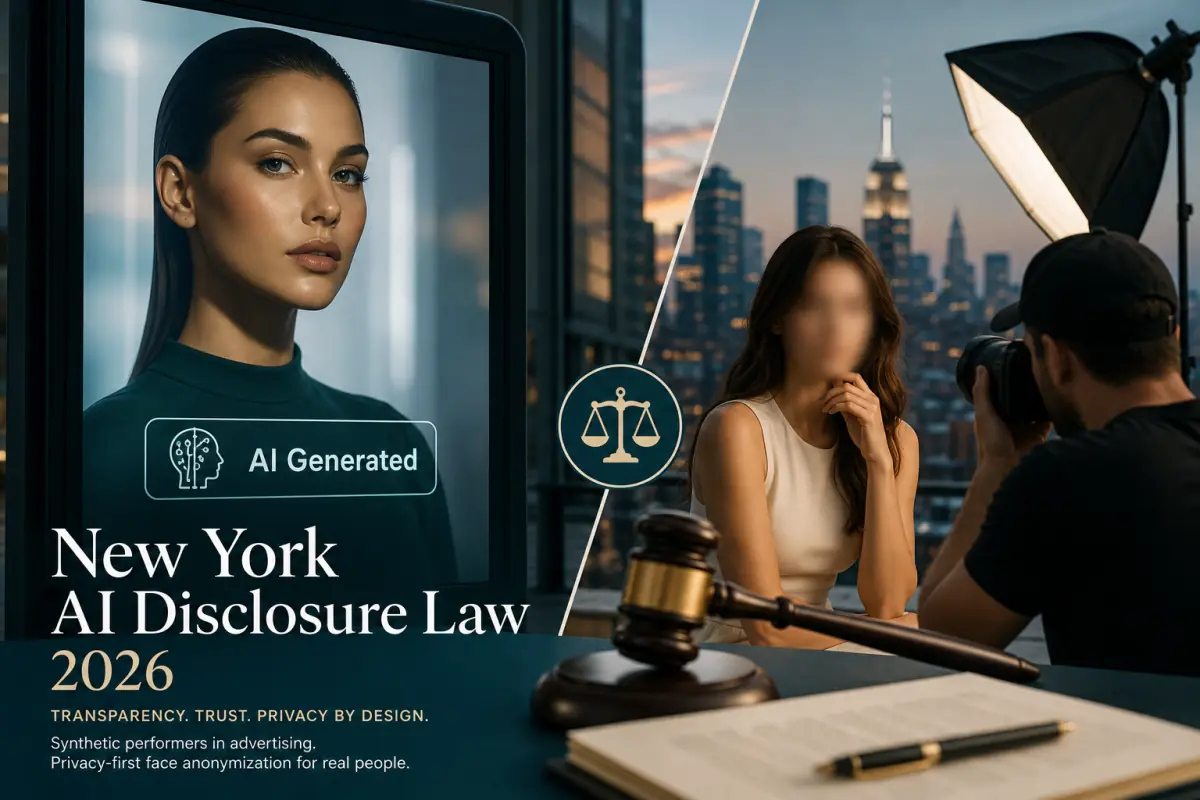
Post-NY S.8420-A and EU AI Act, brands face a fundamental creative choice: use real human performers with face blur, or use AI-generated synthetic performers and carry mandatory disclosure requirements. This guide breaks down the legal exposure, trust impact, platform policies, and workflow implications of each approach — and shows why real-humans-with-blur is the dominant compliance strategy.

Two major laws changed the calculus of AI-generated advertising content in 2026. New York's S.8420-A took effect in June. The EU AI Act hits full force on August 2. Both require explicit disclosure when AI-generated synthetic performers appear in commercial content — and both carry meaningful penalties.
For brands, agencies, and marketing teams, this creates a direct choice that sits at the intersection of legal compliance, production cost, and audience trust: use real human performers (with privacy protection as needed) or use AI-generated synthetic performers (with mandatory, potentially conversion-killing disclosures).
This guide gives you the complete picture — legal exposure by jurisdiction, the trust and conversion research, platform policies from Meta to TikTok, and the BGBlur workflow for building real-human campaigns that are compliant by default.
What Are Synthetic Performers?
Before comparing approaches, it is important to be precise about what constitutes a "synthetic performer" under 2026 law.
Synthetic performers include:
- AI-generated human faces created with tools like Midjourney, DALL-E, Stable Diffusion, or Flux
- Virtual influencers with AI-generated appearances (Lil Miquela, Imma, and their descendants)
- AI-generated video spokespersons (fully generative, not based on a real person)
- AI-generated digital replicas of real people (face-swapped or likeness-cloned versions)
- AI voice clones deployed in video to simulate a real person speaking
- Animated digital humans created using generative AI
What is NOT a synthetic performer:
- A real human actor whose face is blurred in post-production
- A real human performer with other features obscured (body blur, silhouette)
- Stock footage of real people (even if you don't know their identity)
- AI-assisted editing of real footage that doesn't generate a new human likeness
The distinction matters enormously: the entire legal framework is built around whether the human representation in your content is real or generated.
The Master Comparison Table
| Dimension | Real Humans + Face Blur | Synthetic Performers (AI) | Unprotected Real Humans |
|---|---|---|---|
| NY S.8420-A disclosure required | No | Yes | No |
| EU AI Act Art. 50 disclosure required | No | Yes | No |
| UK AI regulation compliance | Clean | Disclosure required | Privacy risk |
| Meta ad policy disclosure | No | Yes (sensitive topics) | No |
| Google Ads disclosure | No | Yes (elections) | No |
| TikTok AI Content label | No | Yes | No |
| Consumer trust impact | Neutral to positive | Negative (-15-23% intent) | Positive |
| Talent cost | Moderate | Near-zero | Low-moderate |
| Production flexibility | High | Very high | High |
| Performer identity protected | Yes | N/A | No |
| Privacy law compliance | Yes | N/A | Risk (GDPR, CCPA) |
| Ongoing rights management | Simple | Complex (platform by platform) | Simple |
Legal Risk Matrix by Jurisdiction
United States — New York S.8420-A (June 2026)
New York's AI disclosure law targets "covered advertisements" that use "synthetic performers" — AI-generated depictions of human beings used in commercial advertising content.
Penalties: $1,000–$5,000 per advertisement in violation. Critically, each ad unit, placement, or creative variant is a separate "advertisement" for purposes of the penalty calculation. A campaign with 15 creative variants could face up to $75,000 in penalties per violation cycle.
Safe harbor: Real human performers are explicitly outside the law's scope. A real human performer with face blur applied remains a real human performer — no disclosure is required.
Current enforcement: New York Attorney General enforcement, with private right of action for synthetic performers whose likeness was used without consent.
For the full NY law breakdown, see our New York AI disclosure law guide.
European Union — AI Act Article 50 (August 2, 2026)
The EU framework is broader in geographic scope and higher in potential penalty. Any content accessible to EU users falls within scope.
What triggers disclosure: AI-generated or AI-manipulated video content depicting real persons saying or doing things they did not actually say or do — including synthetic faces, voice clones, and face-swapped content.
Penalties: Up to €15M or 3% of global annual turnover — whichever is higher. Enforcement by national data protection authorities (the same regulators who enforced GDPR).
Safe harbor: Real human footage. Content featuring real human performers — even with face blur, background modification, or other non-generative editing — does not trigger Article 50 disclosure.
For the complete Article 50 analysis, see our EU AI Act Article 50 deepfake disclosure guide.
United Kingdom
UK GDPR and the Online Safety Act create layered obligations for content featuring human depictions. The UK is developing its own AI regulation framework, expected to include disclosure requirements aligned with — but distinct from — the EU AI Act. Real human content with appropriate privacy protections (face blur, consent documentation) is the clean path here as well. See the UK GDPR video privacy guide for current obligations.
Germany (BDSG + EU AI Act)
Germany applies both EU AI Act requirements and additional obligations under BDSG (Bundesdatenschutzgesetz). The German data protection framework has historically been among the most aggressively enforced in the EU. Our Germany BDSG video privacy guide covers the layered compliance picture.
India (DPDP Act)
India's DPDP Act creates consent and transparency requirements for use of personal data including biometric data — which includes facial data in video. Content featuring real humans without appropriate consent documentation creates exposure. Face blur effectively pseudonymizes the data, reducing DPDP obligations. See the India DPDP Act video privacy guide.
The Trust and Conversion Argument
The compliance argument for real-humans-with-blur is clear. The business argument is equally compelling.
Consumer Research on AI Disclosure
Mandatory "AI-generated" disclosures function as a trust signal — and the signal is negative. Research consistently shows that when consumers know they are viewing AI-generated human representations, their perception of authenticity, brand trust, and purchase intent all decrease.
Key findings from 2024–2026 research:
- Purchase intent drops 15–23% when AI-generated model disclosure is present vs. real human models, particularly in personal care, fashion, health, and luxury categories (Journal of Marketing, 2025)
- Brand authenticity perception falls with AI-generated content disclosure — consumers interpret the use of synthetic humans as indicating the brand is concealing something or cutting costs
- The "uncanny valley" effect persists even with high-quality AI generation — a percentage of viewers consistently identify something "off" about synthetic faces, even when they cannot articulate why
- Younger consumers (18-34) show the highest sensitivity to AI-generated content disclosure, despite being heavy AI users themselves — this demographic interprets mandatory disclosure as a red flag about brand transparency
The Authenticity Premium
Real human performers — even with face blur — carry an authenticity signal that synthetic content cannot replicate. A real person demonstrating a product, expressing genuine emotion, or performing a real action registers differently with audiences than a generated simulation.
Face blur, counterintuitively, can enhance this authenticity signal in some contexts: the blur signals privacy protection (real person), not generation (synthetic). Audiences are increasingly sophisticated about the difference.
Platform Algorithm Context
Social platforms are building AI content detection into their recommendation and distribution algorithms. Content flagged — manually or automatically — as AI-generated may receive different distribution treatment than organic real-human content. This algorithmic dimension adds a non-legal business risk to synthetic performer campaigns.
Platform Policies: Meta, Google, TikTok
Beyond legal requirements, the major ad platforms have implemented their own AI content disclosure policies — and these are enforced through ad account review, content takedowns, and in some cases account suspension.
Meta (Facebook/Instagram)
Meta's advertising policies (updated 2025) require advertisers to disclose when ads:
- Use AI-generated photorealistic imagery of real people
- Alter real footage to falsely depict what a person said or did
- Use AI-generated digital humans in sensitive topic categories (politics, elections, social issues, health, finance)
Non-disclosure in required categories results in ad rejection. Repeated violations trigger account review and potential suspension.
Real human content with face blur does not trigger Meta's AI disclosure requirements.
Google Ads
Google requires disclosure for election advertising that features AI-generated content. For broader commercial advertising, Google is implementing AI content transparency requirements on a rolling basis. The current policy flags AI-generated content in health, pharmaceutical, and financial services advertising.
Real human content, including footage with face blur, does not trigger Google's AI content disclosure requirements.
TikTok
TikTok implemented its AI Content label requirement for all content — organic and paid — that is AI-generated or significantly altered by AI. For advertising content specifically, TikTok requires the label when AI is used to generate or manipulate human appearances.
TikTok's policy explicitly distinguishes between AI-generated content (label required) and AI-assisted editing that does not alter human appearances (label not required). Face blur falls into the second category — it does not generate a human appearance, it protects an existing one.
The BGBlur Workflow for Real-Human-with-Blur Campaigns
Here is the complete production workflow for compliance-clean advertising content:
Stage 1: Pre-Production
- Cast real human performers (actors, employees, talent, customers)
- If performers want identity protection (testimonials, sensitive product categories), plan face blur in post
- Obtain standard talent releases — note that the release does not need to address AI-generated content because there is none
- Consider whether performer voices also need protection (use BGBlur voice anonymization if so — see voice anonymization guide)
Stage 2: Production
- Shoot normally with real human performers
- No AI generation during production
- Standard film and video production practices apply
Stage 3: Post-Production with BGBlur
- Upload footage to bgblur.com (MP4, MOV, M4V up to 4K)
- Select face blur tool — BGBlur's AI automatically detects and tracks all faces across frames
- Apply blur to individual performers or all detected faces
- Optionally apply voice anonymization if audio identity protection is needed
- Apply background blur, object blur, or license plate blur as needed for your content type
- Preview the output
- Export: 720p (free, 3/month), 1080p (Pro, $12/mo), 4K (Business, $29/mo)
Stage 4: Compliance Documentation
- Document that performers are real humans (talent contracts, release forms)
- Document that no AI generation was used to create human likenesses in the content
- Note the face blur tool used (BGBlur) and that it applies privacy protection, not AI generation
- Store documentation alongside campaign assets
Stage 5: Distribution
- Publish without AI-generated content disclosure (none required)
- No platform AI content labels required
- Standard campaign metrics apply — no disclosure-related conversion drag
Making the Decision: A Framework
Use this framework to decide which approach fits your campaign:
Choose Real Humans + Face Blur when:
- The campaign targets EU, US, or UK audiences (highest legal exposure markets)
- The product category is health, personal care, finance, or luxury (highest trust sensitivity)
- Direct response is a key campaign objective (purchase intent matters most)
- Long-term brand reputation is a consideration (AI disclosure can create lasting trust signals)
- You want a single compliant workflow that works across all jurisdictions and platforms
Synthetic Performers may be acceptable when:
- The content is clearly stylized, animated, or abstract (lower trust expectations)
- The campaign is narrowly targeted to markets with no current disclosure law
- The creative concept requires impossible or impractical real-human scenarios
- Full, prominent disclosure is feasible without materially impacting the campaign objective
- Legal review confirms compliance in all target markets
Avoid Unprotected Real Humans when:
- Privacy laws in the target market require consent for biometric data processing (GDPR, CCPA, DPDP)
- Performers request identity protection
- Content features people in sensitive contexts (health, legal, financial matters)
- Bystanders appear in footage without consent
The safe middle ground — real humans with face blur — threads all of these considerations: legally clean, authenticity-preserving, platform-compliant, and privacy-protective. It is the production choice that requires the least downstream legal management.
The advertising landscape in 2026 has changed permanently. Synthetic performers are no longer a legal gray area — they are a regulated category with real penalties. Real human performers with face blur, processed through a tool like BGBlur, are the cleanest path to campaigns that are compliant across every relevant jurisdiction without any mandatory disclosure that could affect consumer trust and conversion.
For related compliance research, see our guides on AI face anonymizer tools and face anonymization vs face blur.