Face Anonymization vs Face Blur: Which Wins in 2026
Face blur hides a face behind pixels, while face anonymization replaces it entirely with an AI-generated identity. This guide compares both methods, shows where each fails under GDPR and DPDP scrutiny, and explains how BGBlur applies the right technique per use case.
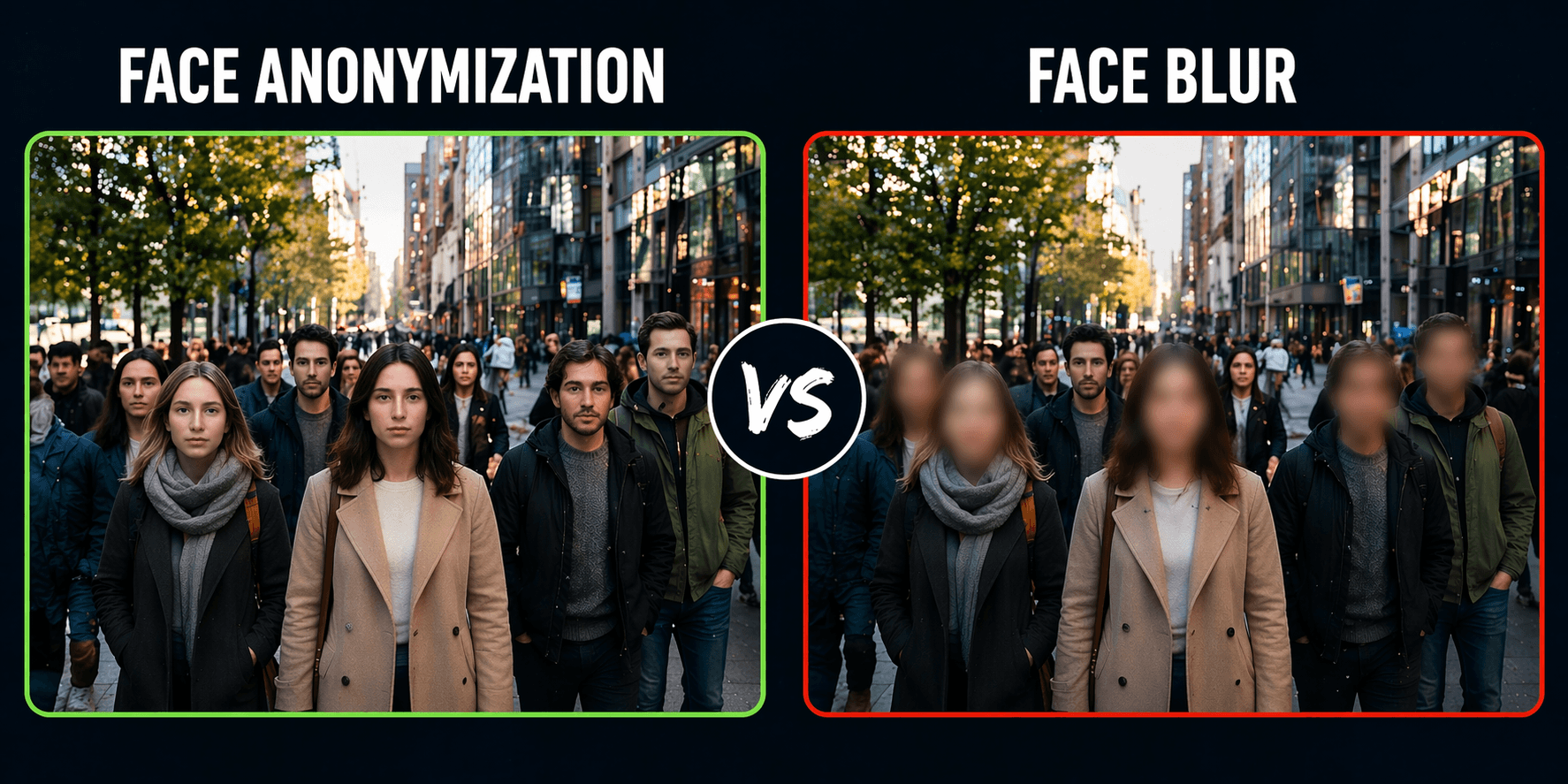
Video has quietly become the default way we communicate. From creators filming in public to companies analyzing user footage, faces are constantly being captured—often unintentionally. For a long time, the solution was simple: blur it out. But today, that approach feels outdated. Not because it doesn't work, but because it doesn't go far enough. This is where face anonymization enters the picture. Instead of masking identity, it removes it entirely. And as privacy expectations grow, that distinction is becoming critical.
| Question | Answer |
|---|---|
| Is blur enough for legal compliance? | Often no — a blurred face can still count as personal data under GDPR/DPDP if it remains re-identifiable |
| What's the main difference? | Blur hides a face behind pixels; anonymization replaces it with a synthetic identity |
| Which is faster? | Blur — real-time, motion-tracked, no generation step |
| Which is more reversible-proof? | Anonymization — non-reversible, no mathematical link to the original face |
| Does BGBlur support both? | Yes — AI face blur and AI face swap, both processed in-browser |
Why Face Blur Isn't Enough Anymore
Face blur was built for convenience. You drop a blur filter over a face, and the job is done. Modern AI face blur tools like BGBlur automate that step with motion-tracked detection, so the blur locks onto a face throughout an entire video. It's fast, widely available, and still used across news clips and social content.
But when you watch closely, blur often feels like a compromise. The person is still there—just hidden behind pixels. In high-quality videos, it breaks immersion. In sensitive situations, it doesn't fully protect identity.
Imagine a street interview video. Even with blur, body language, surroundings, or partial features can still give someone away. That's not ideal if privacy is the goal. This is exactly why ai face anonymization is replacing blur in more serious workflows.
What Face Anonymization Changes
Face anonymization shifts the approach completely. Instead of hiding a face, it replaces or reconstructs it using AI. So the person in the video still looks natural—same expressions, same movement—but the identity is no longer real.
This is where technologies like AI face swap and face swap video tools become important. They allow seamless identity replacement, often powered by an ai face generator that creates entirely new, synthetic faces. The result doesn't feel edited. It feels original.
How This Plays Out in Real Use Cases
The difference between blur and face anonymization becomes obvious when you look at how people actually use it.
Take content creators, for example. A vlogger walking through Mumbai streets will inevitably capture dozens of faces in the background. Blurring each one is not only time-consuming, it also makes the video look cluttered. With face anonymization video tools, those faces can be automatically replaced, keeping the scene clean and watchable while respecting privacy. Tools like bgblur are designed exactly for this kind of workflow.
In journalism, the stakes are even higher. When reporting on sensitive topics, protecting a person's identity isn't optional—it's essential. Blur leaves room for doubt. AI face anonymization removes that risk by ensuring the individual cannot be recognized at all, even with advanced tools.
Now consider tech companies building AI models. Training datasets often include human faces, which creates serious privacy concerns. By using an ai face generator or anonymization pipeline, companies can keep the data useful without exposing real identities. This is becoming standard practice in responsible AI development.
There's also a growing category of consumer apps offering free face swap video features. While many people see these as entertainment tools, they're actually introducing millions of users to anonymization technology. What starts as fun—swapping faces in a clip—can easily translate into real privacy applications.
Even businesses handling customer footage—like retail analytics or security systems—are moving toward face anonymization to stay compliant with privacy laws while still extracting insights. If you're looking to understand how AI tools are reshaping content workflows more broadly, this guide on how to automate Instagram comments without sounding spammy is a great parallel read.
The Role of AI Face Swap in Privacy
It's easy to dismiss face swap as just a trend, but in reality, it's one of the most practical implementations of face anonymization. When used responsibly, AI face swap replaces identity without altering the rest of the video. This makes it incredibly useful for protecting individuals in public footage, creating anonymized datasets, and maintaining realism in edited content. The key is intent. In privacy-first systems, face swap isn't about creativity—it's about protection.
Compliance Is Driving the Shift
Beyond quality and convenience, there's a bigger force at play: regulation. Privacy laws today focus heavily on personally identifiable information, and facial data falls directly into that category. A blurred face can still carry identifying signals, which makes it a weak solution from a legal standpoint.
Face anonymization, on the other hand, removes those signals entirely. That's why ai face anonymization is being adopted by platforms that need to comply with frameworks like GDPR or India's DPDP Act. It's not just about editing anymore—it's about reducing risk. For brands and creators managing large volumes of video content, pairing anonymization with smart content strategy is essential—learn more about improving brand visibility without paid ads to see how content decisions add up.
Choosing the Right Approach
There's still a place for blur. If you're editing a quick video or dealing with low-risk content, it's the fastest option available. But if your work involves scale, professionalism, or compliance, face anonymization is the better long-term choice. It preserves quality, protects identity more effectively, and aligns with where the industry is heading.
If you need a deeper primer on the anonymization side of this comparison, our guide on AI face anonymization tools walks through the underlying detection and replacement pipeline in more detail. For teams weighing blur vs. synthetic replacement specifically for identity protection at scale, see AI face anonymizer tools: blur vs synthetic replacement.
Blur vs. Anonymization: A Side-by-Side Comparison
| Factor | Face Blur | Face Anonymization |
|---|---|---|
| Processing speed | Real-time, motion-tracked | Slightly slower, generation step required |
| Visual quality | Pixelated or gaussian region, breaks immersion | Natural-looking, no visible edit |
| Identity protection | Partial — gait, silhouette, context can still identify someone | Complete — no link back to the original face |
| Compliance strength | Weak under GDPR/DPDP if re-identifiable | Strong — meets the legal bar for "anonymized" data |
| Best for | Quick edits, low-risk clips, internal review | Public-facing footage, journalism, regulated datasets |
| BGBlur support | AI face blur with motion tracking | AI face swap with synthetic identity generation |
Neither approach is universally "better" — the right pick depends on how the footage will be used. A dashcam clip shared with an insurer has different risk than a documentary interview published to millions of viewers. If your footage also includes license plates, our dashcam face and plate blurring guide covers both in one workflow.
Conclusion
The move from blur to face anonymization isn't just a technical upgrade—it's a shift in how we think about video privacy. As video becomes more central to everything we do, the expectation is no longer to simply obscure identities, but to protect them properly. And that's exactly what modern AI solutions are enabling. With tools like bgblur, face anonymization is becoming seamless, scalable, and accessible. And once you see the difference in both quality and protection, going back to blur doesn't really make sense anymore.
Frequently Asked Questions
What is the best way to hide faces in video today? For most use cases, face anonymization video tools offer better protection and quality than blur. BGBlur applies AI motion-tracked blur for speed-first workflows, but full anonymization is the safer default when footage will be published or shared with regulators.
Is AI face swap only for fun content? No, AI face swap is widely used in privacy workflows to safely replace identities in professional and journalistic settings. Newsrooms, researchers, and businesses handling customer footage use it to protect sources and subjects while keeping the video watchable.
Are there accessible tools available? Yes, many platforms now provide free face swap video features powered by AI, making it easy to get started without a big investment. BGBlur offers a free tier with face blur and object blur before you need to upgrade.
Why are companies moving away from blur? Because ai face anonymization removes identity completely, while blur only hides it visually—leaving partial identifying signals behind such as gait, silhouette, or surroundings. Under GDPR and India's DPDP Act, a merely obscured face can still count as personal data if it remains re-identifiable.
Does face blur still have a legitimate use case? Yes. Blur is faster to apply, works in real time, and is sufficient for low-risk content like quick social clips or internal review footage. It remains the practical choice when speed matters more than irreversible anonymization.
Can face anonymization be reversed to reveal the original identity? No, properly implemented face anonymization is non-reversible. Unlike blur, which could theoretically be reduced with the right filter, AI-generated replacement faces have no mathematical link back to the original identity.
How does BGBlur decide between blurring and replacing a face? BGBlur lets you choose per project: use AI face blur for speed and a familiar look, or apply face swap for a cleaner, anonymized result. Both run client-side in the browser with motion tracking, and processed files are deleted within 24 hours.
Update — August 4, 2026: For the precise legal line between "blurred," "redacted," and "anonymized," see our deeper guides on what "digitally anonymized" actually means and what "redacted" means in law.
Update — August 6, 2026: For a practical guide on reducing your own exposure to likeness-generation tools, see how to opt out of Meta's Muse Image deepfake feature and why proactive face blur matters.