China PIPL Compliance Guide for Content Creators [2026]
China's Personal Information Protection Law treats faces, license plates, and addresses caught on camera as personal data, putting creators and brands at risk of fines for footage they never meant to expose. This guide explains what PIPL requires and how automated blur keeps production moving without slowing teams down.
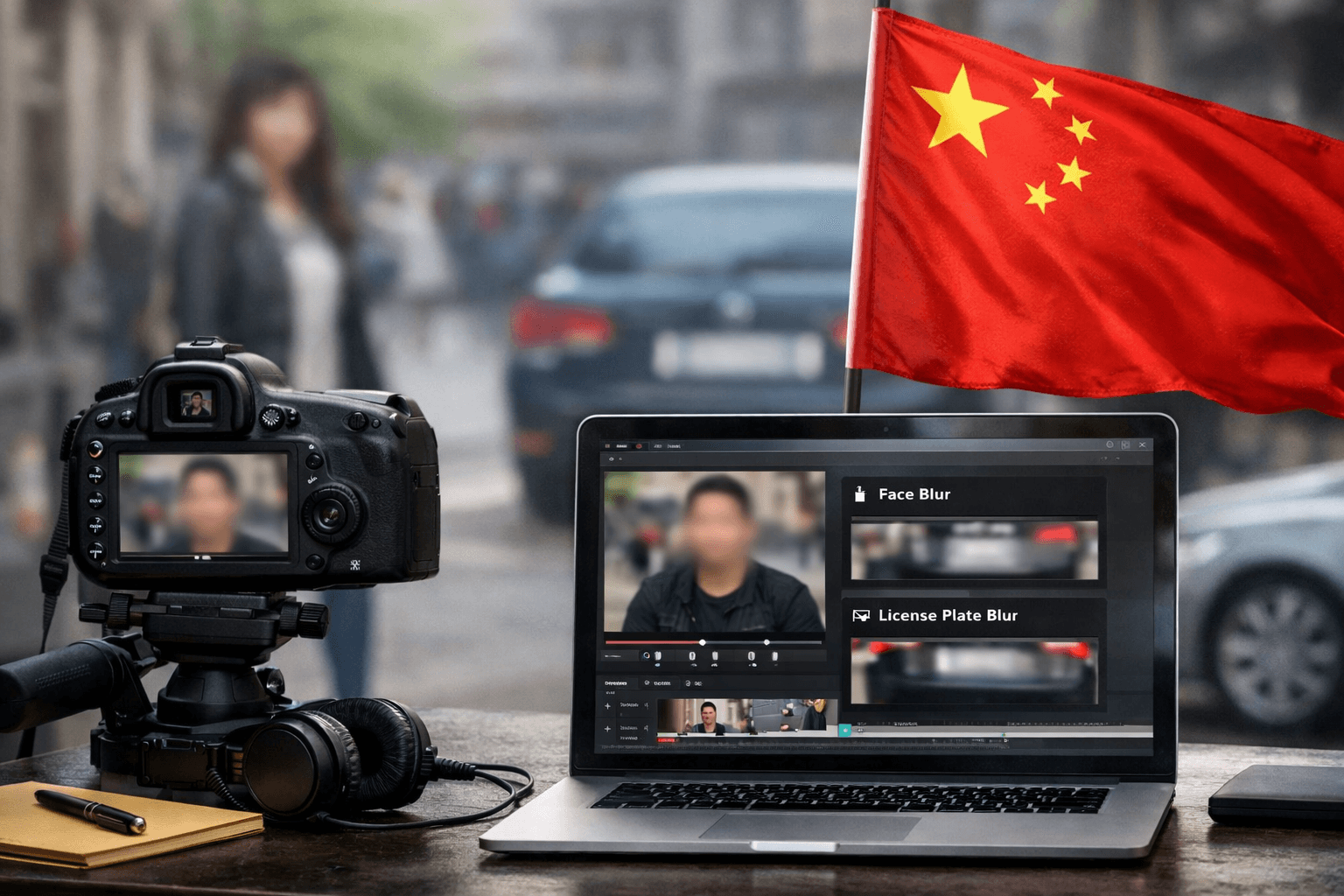
Every piece of content you create today carries more than just visuals it carries data. A simple street video might capture a stranger's face. A vlog could reveal a home address in the background. Even a casual clip can expose a vehicle's number plate. Most of the time, this happens unintentionally but that doesn't reduce the risk.
This growing concern around privacy in video content is exactly what led to China introducing the Personal Information Protection Law (PIPL). It's a strict framework built around data protection, ensuring that individuals have control over how their personal information is captured and used. For creators, marketers, and businesses, this changes how content needs to be handled it's no longer just about what you publish, but also about what you might accidentally reveal.
| Question | Answer |
|---|---|
| What is PIPL? | China's Personal Information Protection Law, effective since November 2021 |
| Does it apply outside China? | Yes — it covers any content involving personal data of individuals in China |
| What counts as personal data in video? | Faces, license plates, addresses, and other identifiable details, even shown accidentally |
| Maximum penalty? | Up to RMB 50 million (~$7M) or 5% of annual turnover |
| Is BGBlur compliant? | Yes — automated face, background, and license plate blur with no permanent footage storage |
Update — August 7, 2026: Filming bystanders isn't just an incidental PIPL risk anymore — in China, entire "content farm" operations are built around it. See our deeper look at China's content farms filming strangers on the street, including real court cases, the 2025 CAC crackdown, and what changes when filming strangers is the business model rather than an accident.
Why PIPL Exists and What It Means for Content Creators
Before PIPL came into effect, personal data was often collected and shared without clear boundaries. Companies could store user information, process it, and even distribute it with minimal accountability. At the same time, the explosion of video content meant that more real-world data faces, locations, vehicles — was constantly being recorded and uploaded across social media and business platforms.
This created a widening gap between content creation and privacy protection in video editing. PIPL was introduced to close that gap. It establishes clear rules around how personal data should be handled and puts responsibility directly on the entity creating or processing that data. If your content includes identifiable information, you are expected to take steps to protect it.
What makes this law particularly significant is that it doesn't just focus on intentional misuse. Even accidental exposure a visible face in the background, a readable license plate, or a home address caught on camera can fall under non-compliance. That's where things become genuinely challenging for modern content workflows, especially for teams producing content at scale.
PIPL is also not isolated. Laws like GDPR in Europe, CCPA in California, and similar frameworks globally are all pushing in the same direction: more control for individuals, more responsibility for publishers. Understanding PIPL isn't just a regional concern it's an early look at where content compliance is heading everywhere.
The Hidden Privacy Risk in Everyday Video Content
The biggest issue isn't negligence it's scale. Creators today are producing content faster than ever. Brands are pushing out campaigns across multiple platforms simultaneously. Agencies are handling hundreds of assets at once. In this environment, manually reviewing every frame for sensitive data becomes practically impossible, even with a dedicated team.
And yet, the risks are hidden in the most ordinary footage. A person walking behind you in a video becomes identifiable. A parked car reveals its owner through a visible plate. A background shows details about a private office or someone's home. These aren't edge cases they're everyday scenarios that show up in product demos, travel vlogs, street interviews, and even internal training videos.
Without proper safeguards, this kind of content can easily violate data protection standards and the consequences aren't minor. Under PIPL, violations can result in significant fines, mandatory content takedowns, and reputational damage that's hard to recover from. For brands operating in or targeting Chinese markets, this risk is immediate and real.
The real question for any content team then becomes: how do you stay compliant without slowing down your entire production workflow?
How Background Blur Protects You and Your Audience
Background blur has evolved well beyond its cinematic origins. What started as a creative technique for separating subjects from their environments has become one of the most practical tools in a privacy-conscious creator's toolkit.
When you apply background blur to video content, you're not just improving aesthetics you're actively removing identifiable environmental data from the frame. A visible street sign, a recognizable storefront, the layout of a private office all of these can reveal location or organizational information that individuals haven't consented to share. Background blur neutralizes this risk without requiring you to reshoot your footage.
For businesses creating training videos, client testimonials, or internal documentation, background blur for data protection is particularly valuable. It allows teams to record in real working environments without inadvertently exposing confidential information like whiteboards, computer screens, or workspace layouts that might appear in the background.
The most effective modern tools for this like bgblur use AI to automatically detect and separate the background from the main subject, applying blur with motion tracking so that it holds steady even when the camera or subject moves. This removes the need for manual keyframing, which would otherwise make background blur impractical at scale.
If you're also looking at improving your overall content workflow with AI, you'll find useful parallels in how AI tools are helping creators improve Instagram brand visibility without paid ads the same principle of automation enabling consistency at scale applies directly here.
Face Blur: The Non-Negotiable for Public Filming
Face blur is arguably the most critical aspect of video privacy compliance under laws like PIPL. A face is the most direct identifier of a natural person, and capturing someone's face without consent even accidentally creates immediate legal exposure.
This is especially challenging for creators filming in public spaces: street documentaries, event coverage, consumer interviews, or any outdoor content where bystanders naturally appear in the frame. Under PIPL, those individuals have privacy rights over their identifiable information, including their faces.
Manual face blurring is tedious and error-prone. A fast-moving crowd, multiple people in different areas of the frame, or a subject that turns unexpectedly these situations make manual editing slow and unreliable. AI-powered face blur solves this by automatically detecting every face in the frame and applying blur with tracking, so even moving individuals stay protected throughout the clip — see our step-by-step guide to blurring faces in photos and video for the exact workflow.
For journalists, documentary filmmakers, and news teams, face blur is also ethically essential not just legally required. Protecting the identity of sources, vulnerable individuals, or people who haven't consented to being filmed is a core professional responsibility. Having an automated tool that handles this reliably makes it far easier to uphold that standard at speed.
License Plate Blur and Other Sensitive Visual Data
License plates are a data point that most creators don't think about until it becomes a problem. A visible plate in a video can be traced back to a registered vehicle owner making it personal data under PIPL and similar regulations. For content shot in parking lots, streets, driveways, or any outdoor environment, license plate blur is no longer optional.
The same logic extends to other pieces of visual data that can indirectly identify individuals. Documents left on desks, computer screens with visible content, ID badges, business signage with employee names, and even building access codes visible in the background all qualify as sensitive data worth protecting.
What makes automated video redaction so useful here is the flexibility. Modern tools don't just recognize faces and plates they allow you to define custom regions for blur, so if your footage captures something specific that needs to be hidden, you can select and blur it without affecting the rest of the frame. Our complete guide to object and region blur covers exactly how to select and protect these custom regions. This level of control ensures that even edge cases are handled without having to re-record expensive footage.
Understanding how to manage and protect digital assets at scale is becoming a core skill for agencies and content teams. You'll find related thinking on this in how to manage and scale your social media agency in 2025, where the emphasis on systematic, repeatable processes maps directly onto what's needed for compliant content production.
Staying Compliant Without Slowing Down Your Workflow
The practical challenge of PIPL compliance for content creators isn't understanding the law it's integrating compliance into a production workflow that's already moving fast. Most teams can't afford to add hours of manual review per video, and the margin for error in privacy protection is zero.
This is where bulk processing becomes essential. Instead of treating each video as a separate compliance task, the right tools let you upload multiple files at once, apply consistent blur settings across all of them, and process the entire batch without manual intervention per clip. For brands managing content libraries with dozens or hundreds of videos, this is the only practical path to compliance at scale.
The other piece of this is consistency. Manual processes introduce human error a reviewer misses a face in the corner of the frame, or a license plate in a brief establishing shot slips through. Automated AI detection catches what humans miss, running frame-by-frame analysis across the entire duration of every file. This level of thoroughness is simply not achievable manually at any reasonable speed or cost.
For influencer marketing teams and agencies working across multiple client accounts, the same logic applies. If you're already thinking about how to scale your influencer workflows efficiently, you'll find direct synergies in how influencer marketing performance can be measured and optimized through analytics systematic automation that reduces manual overhead applies equally to compliance and campaign management.
Building a compliant content process also means documenting your procedures. If your content is ever questioned under PIPL or similar laws, being able to demonstrate that you have a systematic process for reviewing and redacting personal data is a meaningful protection. Tools that log processing history and maintain output records make this documentation straightforward.
Conclusion
PIPL is more than just a regional regulation it's a signal of where the entire global conversation around content and privacy is heading. Audiences are more aware of their data rights. Platforms are tightening their own policies. Regulators in every major market are introducing or strengthening frameworks that mirror PIPL's core principles.
For content creators and brands, this means that privacy-compliant video production isn't a compliance checkbox to tick once it's an ongoing practice that needs to be embedded into how content is created, reviewed, and published. The teams that build this into their workflows now will be better positioned as regulations continue to tighten.
Tools like bgblur aren't just about avoiding fines. They're about building a content operation that people your audience, your clients, and the individuals who appear in your footage can trust. And in an environment where trust is increasingly rare and valuable, that's a genuine competitive advantage.
Because today, creating content isn't just about making it look good it's about making sure it's safe to share.
FAQ
Does PIPL apply to content posted on international platforms? PIPL applies to any content that involves personal data of individuals within China, regardless of where the content is hosted or published. If your audience includes Chinese users or your content features individuals in China, PIPL obligations apply.
How do I know if my video contains personal data under PIPL? Any video that captures identifiable faces, vehicle license plates, addresses, or other markers that can be traced back to a natural person likely contains personal data under PIPL. When in doubt, applying face blur and background blur is the safest approach, especially for content filmed in public or semi-public environments.
Can I get consent instead of blurring? Consent is one legal basis for processing personal data under PIPL, but it's only valid when it's freely given, specific, and informed. In practice, getting consent from every individual who appears in background footage is rarely feasible. Automated blurring is more reliable and scalable for most content production scenarios.
What's the best way to handle existing content that may not be compliant? Batch processing tools allow you to run existing video libraries through automated blur workflows, applying face blur, background blur, and license plate blur across multiple files simultaneously. This is the most efficient way to bring existing content into compliance without a full re-edit of each video individually.
Does applying blur affect video quality? Professional AI blur tools are designed to maintain original video resolution and frame rate while applying blur effects. The processed output should be visually consistent with the source material, with blur applied only to the targeted regions without degrading overall image quality.