Detect Deepfake Video Call Scams: Three-Finger Test
A viral Reddit clip showed investigator Jim Browning break a scammer's real-time deepfake filter with a simple three-finger test. This guide explains how live face-swap filters work, ten practical detection tests you can run on any suspicious call, and what to do if you suspect you're talking to a deepfake.
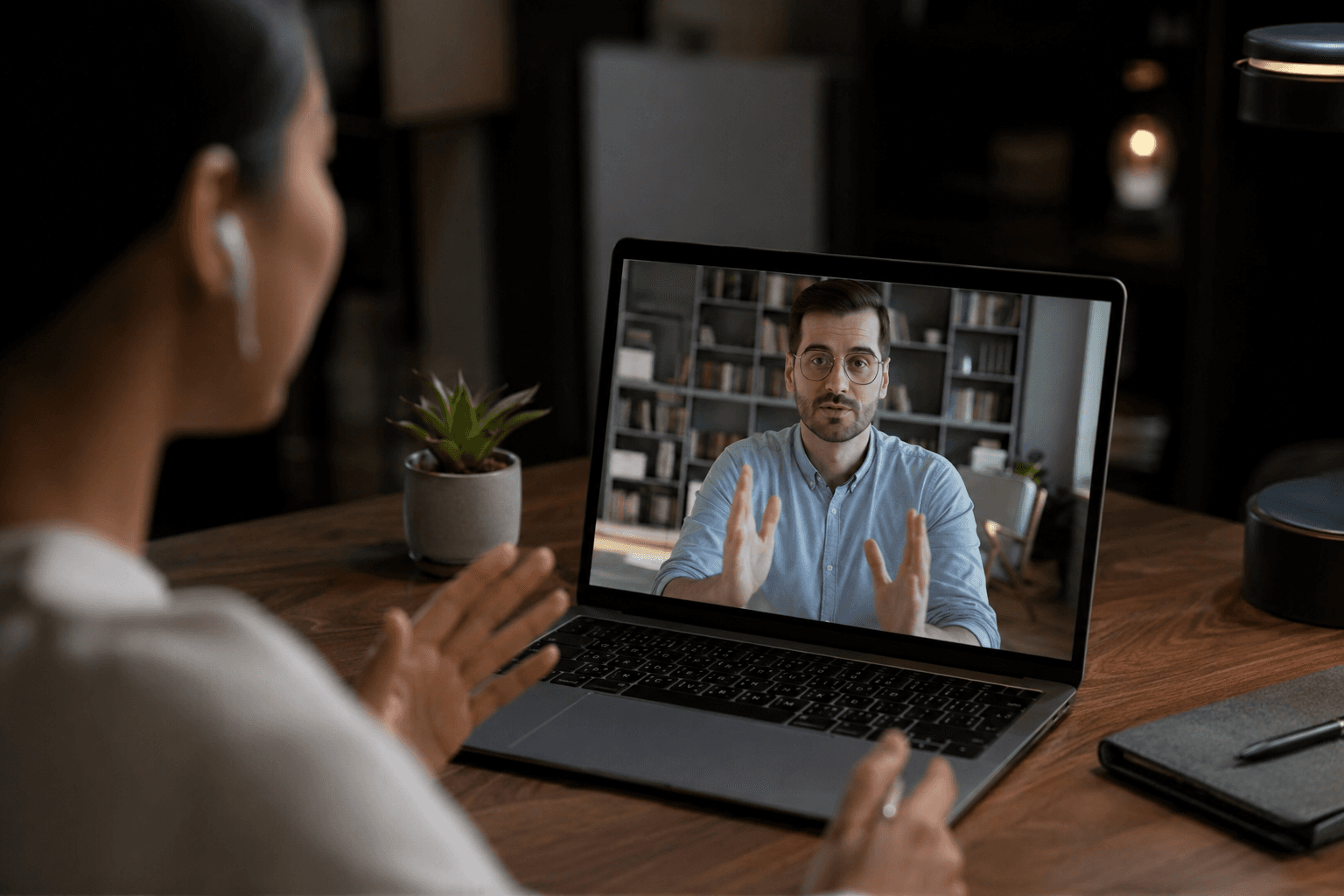
You are on a video call. The person looks professional, speaks confidently, maybe shows an office wall with diplomas. They say they are a recruiter, a bank official, a crypto recovery specialist, or technical support.
They feel real. They may not exist.
Scammers are now using real-time deepfake filters that map a stolen LinkedIn photo—or an AI-generated face—onto the fraudster's actual face. Mouth sync, head movement, and lighting tricks sell the illusion fast. Victims, especially older adults less familiar with the technology, transfer money before they notice the glitches.
This exploded into public awareness after a Reddit video (breakdown: YouTube explainer) where investigator Jim Browning confronted a fake company called Global Metrics offering crypto recovery. One simple challenge—a three-finger test—made the filter collapse live on camera.
This is the detailed guide: how these scams work, every practical detection test, what to do when you suspect a fake call, and how face-mapping technology relates to the same AI problems teams at BGBlur solve in reverse (protecting identity instead of faking it).
What Actually Happened on the Reddit / Jim Browning Call
Jim Browning (known for exposing scam call centers) was on a video call with Global Metrics, a fake firm claiming it could help recover lost cryptocurrency.
If you know what to look for, red flags appeared early:
- Hairline flicker near the forehead as the filter adjusted
- The scammer avoided turning his head—when reaching for a diploma on the wall, he moved his arm but kept his face locked toward camera
- Subtle glitching around the head where the overlay met real skin
Then Jim asked the question that broke the internet: "Can you hold up three fingers in front of your face?"
The scammer stalled. When he finally complied, the deepfake overlay fell apart—distorted fingers, wrapped-looking hand geometry, filter artifacts everywhere. The "executive" on screen was a real-time face map, not the person you thought you were talking to.
That moment turned the three-finger test into the most shared deepfake scam detector of 2026. It works because of how these filters are built—not because scammers are stupid.
How Real-Time Deepfake Video Call Filters Work
Unlike Hollywood deepfakes rendered offline for hours, live scam filters must work frame-by-frame on a video call:
- Capture each frame from the scammer's webcam
- Detect the scammer's real face landmarks
- Overlay a target face (stolen photo or AI-generated identity)
- Sync mouth movement and head pose to audio
- Stream the composited frame back to you
This usually requires a powerful local GPU—the scammer is often in a call center, not the polished executive they appear to be. The fake persona may use a Western face while the operator sits in a different region entirely—trust built in seconds.
Common scam wrappers:
- Fake job recruiters (collect fees or personal data)
- Fake romance personas
- Fake bank or government officials
- Fake crypto recovery agents (Global Metrics pattern)
- Fake tech support
The face is not the product. Trust acceleration is the product.
Test #1: The Three-Finger Test (Hand in Front of Face)
What to do: Ask them to hold three fingers clearly in front of their face—between camera and chin. A open palm works too ("put your hand like this").
Why it works: Real-time filters map one face surface. Occlusion—fingers crossing the face—breaks tracking. Fingers merge, warp, or disappear. The overlay may vanish entirely for a frame.
Limitations: Filters will improve. This test works today and may weaken over time—but hand-occlusion remains hard for real-time pipelines (we know this from building face mapping systems).
Test #2: The Side Profile Test
What to do: Ask them to turn 45–90°—"look at the diploma on the left wall" or "glance at your colleague off camera."
Why it works: Most filters optimize for front-facing webcam angles. Profile views expose edge seams, stretched ears, or full filter collapse.
Real case cue: In the Global Metrics call, the scammer retrieved a diploma without rotating his face—protecting the filter, not mimicking natural behavior.
Test #3: The Lighting Test
What to do: Ask them to turn a light on/off, move nearer a window, or switch rooms.
Why it works: Filters calibrate to initial lighting. Sudden ambient change forces recalibration—during which you may see real skin tone bleed through, flicker at the hairline, or uneven shading on half the face.
Building production-grade face anonymization, we see the same failure modes: lighting shifts expose compositing boundaries.
Test #4: Cover Face With Both Hands
What to do: Ask them to cover their face briefly with both hands—" wipe your eyes" or "adjust your glasses" naturally.
Why it works: Tracking two hands plus a face simultaneously is a nightmare for real-time mapping. Expect warp, lag, or overlay drop.
Test #5: The Background Walk Test
What to do: Ask them to stand up and walk across the room—"grab that file from the shelf" or "show me the rest of your office."
Why it works: Many setups use a static background plate or fixed camera rig optimized for seated frontal scam scripts. Movement reveals scale mismatches, frozen backgrounds, or filter desync.
Test #6: The Blink Test
What to do: Observe blink rate and eye moisture naturally over 2–3 minutes.
Why it works: Early deepfakes famously never blinked. That improved—but many cheap real-time filters still show unnatural blink timing or glassy, static eyes. In the viral Reddit clip, observers noted infrequent blinking.
Not definitive alone—combine with other tests.
Test #7: Unexpected Questions (Script Breakers)
What to do: Ask non-script questions: local weather specifics, name the street outside, what did you eat for lunch, spell your company registration number backwards.
Why it works: Scam floors run scripts. Operators are employees, not the persona. Panic causes stalling, muting, or micro-expressions that stress the filter—small facial stress can increase glitch rate.
Test #8: Live Object Interaction (Without Head Turn)
What to do: Ask them to pick up a specific object live—a pen, a dated newspaper, your handwritten note held to camera.
Why it works: In Global Metrics, the scammer showed a diploma but never turned his head while picking it up—unnatural for a real person reading a frame. Real humans rotate head and eyes together.
Test #9: Audio-Visual Sync Test
What to do: Listen for lip-sync delay—voice arriving late relative to mouth movement, or mouth continuing after speech stops.
Why it works: Separate audio pipelines + video compositing often introduce latency mismatch—classic cheap deepfake tell.
Test #10: Hairline and Edge Inspection
What to do: Watch the hairline, jaw edge, and ears for flicker, blur halos, or color mismatch—especially when they move.
Why it works: This is the most consistent passive tell in live filters. Forehead hair that shimmers independently of head motion is a red flag. Jim Browning's clip shows forehead artifact before the hand test.
Meta-skill: No single test is perfect. Combine profile turns, hand occlusion, lighting changes, and script breaks within one call.
What to Do If You Suspect a Deepfake Scam Call
- Do not confront dramatically — scammers may switch tactics or pressure harder
- End the call calmly — "I'll call back through the official number"
- Do not transfer money, crypto, or gift cards
- Verify out-of-band — use the bank/recruiter's official website number, not links from the call
- Save evidence — screenshots, URLs, wallet addresses (not raw victim biometrics in public channels)
- Report — platform abuse teams, local cybercrime portals, FTC/Action Fraud equivalents
Older adults are disproportionately targeted—not because they are foolish, but because trust + unfamiliarity with live AI is exploitable. Share this guide with family members.
The Bigger Picture: Filters Improve Every Month
Offensive deepfake quality rises monthly. Defensive detection must combine human tests, platform signals, and technical forensics.
Some tells will fade (static blink issues). Occlusion under stress (hands, profile, lighting) remains structurally harder—though not impossible—to perfect in real time on consumer hardware.
The three-finger test that exposed Global Metrics may be partially patched in premium scam kits a year from now. Your goal is not memorizing one trick—it is maintaining healthy skepticism on any high-stakes video call involving money, credentials, or urgency.
Anatomy of a Crypto Recovery Scam Call (Global Metrics Pattern)
Jim Browning's investigation followed a familiar script used by fake "recovery" desks like Global Metrics:
- Hook: "We can trace and recover your lost crypto"
- Credibility layer: Video call with a professional-looking "analyst" (deepfake face)
- Office props: Diplomas, logos, framed certificates—shown without natural head movement
- Urgency: Limited-time recovery window, upfront "processing fee"
- Stalling when tested: Delaying hand gestures, profile turns, or live object requests
The face is stage dressing. The money request is the payload. Recognizing the script matters as much as recognizing the filter.
Who Gets Targeted (and Why Video Works on Them)
| Victim profile | Why video scams land |
|---|---|
| Older adults | Less familiarity with live AI filters; higher trust in "official" faces |
| Recent fraud victims | Emotionally motivated to believe recovery is possible |
| Remote job seekers | Expect video interviews; fake recruiters exploit the norm |
| Crypto newcomers | Confusing legitimate support with fake "recovery agents" |
| Small business owners | Fake bank or tax "video verification" with urgency |
If someone you care about falls in these groups, send them this guide—not after an incident, before.
Platform-Specific Notes
Zoom / Google Meet / Teams
Scammers send calendar invites that look corporate. Join links from email are not proof. Hang up and call back via the institution's public website number.
WhatsApp / Telegram Video
End-to-end encryption does not validate who the face belongs to. Treat unexpected video calls like cold calls—verify out-of-band.
Dating Apps & Social DMs
Romance scams increasingly move to video early to build intimacy. Run lighting and profile tests before emotional investment deepens.
During the Call: Red Flag Checklist
Check any three of these in the first five minutes:
- Hairline flicker or halo when they move slightly
- Refusal to turn head when showing objects
- Lip-sync delay vs. audio
- Over-polished "office" that never changes angle
- Pressure to act today on fees or credentials
- Unwillingness to repeat callback via official number
- Distorted fingers when asked for hand occlusion test
- Unnatural blinking pattern over 2+ minutes
Three or more → end call, no payment, verify independently.
After You Hang Up: Reporting Checklist
- Block the number and report on-platform (WhatsApp, Telegram, etc.)
- File with local cybercrime portal (FBI IC3, Action Fraud UK, Cyber Crime Portal India, etc.)
- Notify your bank if you shared account details
- Do not publish unblurred scammer footage publicly—report through official channels
- Warn family group chats with link to this guide
If your company collects verification video, blur faces on any internal case clips. See KYC video privacy guide.
How This Connects to BGBlur and Face Anonymization
At BGBlur, we build face detection, tracking, and anonymization for legitimate privacy—blurring faces in KYC archives, street video, medical content, and listing tours.
Scammers abuse the same class of technology in reverse: overlay instead of remove, deceive instead of protect.
Understanding filter failure modes—occlusion, profile angles, lighting recalibration, hairline seams—is core to both:
- Fraud investigators spotting fake executives on Zoom
- Privacy engineers building reliable blur that doesn't fall apart when subjects move
If your team handles verification video, blur faces on internal copies before sharing investigation clips. See our KYC video privacy guide and face anonymization feature.
Quick Reference: 10 Deepfake Video Call Tests
| # | Test | Prompt example |
|---|---|---|
| 1 | Three-finger / hand occlusion | "Hold three fingers in front of your face" |
| 2 | Side profile | "Turn and look at the door behind you" |
| 3 | Lighting change | "Switch the room light on and off" |
| 4 | Both hands on face | "Rub your eyes for a second" |
| 5 | Background walk | "Walk to the far wall and back" |
| 6 | Blink observation | Watch for 2–3 min naturally |
| 7 | Script breaker | Unexpected local/personal question |
| 8 | Live object | "Hold today's newspaper to the camera" |
| 9 | Lip-sync | Listen for audio-video delay |
| 10 | Hairline / jaw edge | Watch for shimmer and halo artifacts |
FAQ: Deepfake Video Call Scams
Is the three-finger test guaranteed to work?
No guarantee forever, but it is highly effective today because occlusion breaks most real-time face maps—as seen in the Jim Browning / Global Metrics call viral on Reddit and analyzed in this video.
Are all scam video calls deepfakes?
No. Some use real humans with fake identities, pre-recorded loops, or simple photo static images. Tests still help—script breaks and out-of-band verification always apply.
Can banks and recruiters prove they are real?
Legitimate institutions accept callback verification through official channels. Anyone refusing that while pressuring urgency is a red flag.
Why do scammers use video instead of phone only?
Video compresses trust formation. A face sells authority faster than voice alone—especially for crypto recovery and executive impersonation.
Should I record the scammer?
For reporting, yes—with caution. Do not publish unblurred biometric footage publicly; use platform reporting channels.
Will AI filters beat the three-finger test eventually?
Partially. Better models will improve occlusion handling, but physical world challenges (lighting shifts, walking, asymmetric motion) remain expensive to fake in real time on consumer hardware. Stay skeptical even as tech evolves.
What if the caller is real but still suspicious?
Even real humans run scams. Out-of-band verification and refusal to pay under pressure protect you regardless of deepfake status.
Conclusion: Trust, But Verify—Especially on Video
The Global Metrics call proved something unsettling: you can negotiate with a face that is not real. The three-finger test proved something hopeful: cheap real-time filters still break under simple physical challenges.
Use the full toolkit—profile turns, lighting shifts, hand occlusion, script breaks, hairline inspection, and lip-sync checks. End the call. Verify independently. Never send money under pressure.
If you work with identity or verification video, protect people on both sides: detect fraud aggressively, and blur biometric footage responsibly when sharing cases internally.
Stay safe. Stay skeptical. Share this with someone who needs it.
Update — August 5, 2026: Microsoft has now added an in-meeting way to escalate exactly this kind of suspicious call — see how Teams' new deepfake Report button works, and what it still misses for recorded meetings.
Update — August 5, 2026: Video isn't the only channel scammers fake. AI voice cloning scams have surged 1,210% and now need just 3 seconds of audio — see our guide on AI voice cloning scam protection and why voice anonymization matters before you publish.
Update — August 5, 2026: For the full statistical picture — FBI-tracked losses, market growth, and which industries are most exposed — see our roundup on deepfake fraud statistics 2026 and where detection tools fit.
Update — August 6, 2026: Deepfake scams aren't the only non-consensual likeness risk — see how Meta's Muse Image tool made AI deepfakes from public Instagram photos opt-out by default, and how to opt out.