WA Police Live Facial Recognition Trial Results [2026]
Western Australia Police's live facial recognition trial scanned 905,117 faces across 77 deployments, produced 209 alerts and 79 arrests, and reported eight incorrect alerts. This guide breaks down what the numbers actually mean, what safeguards are in place, and the ethical questions an academic reviewer raised.
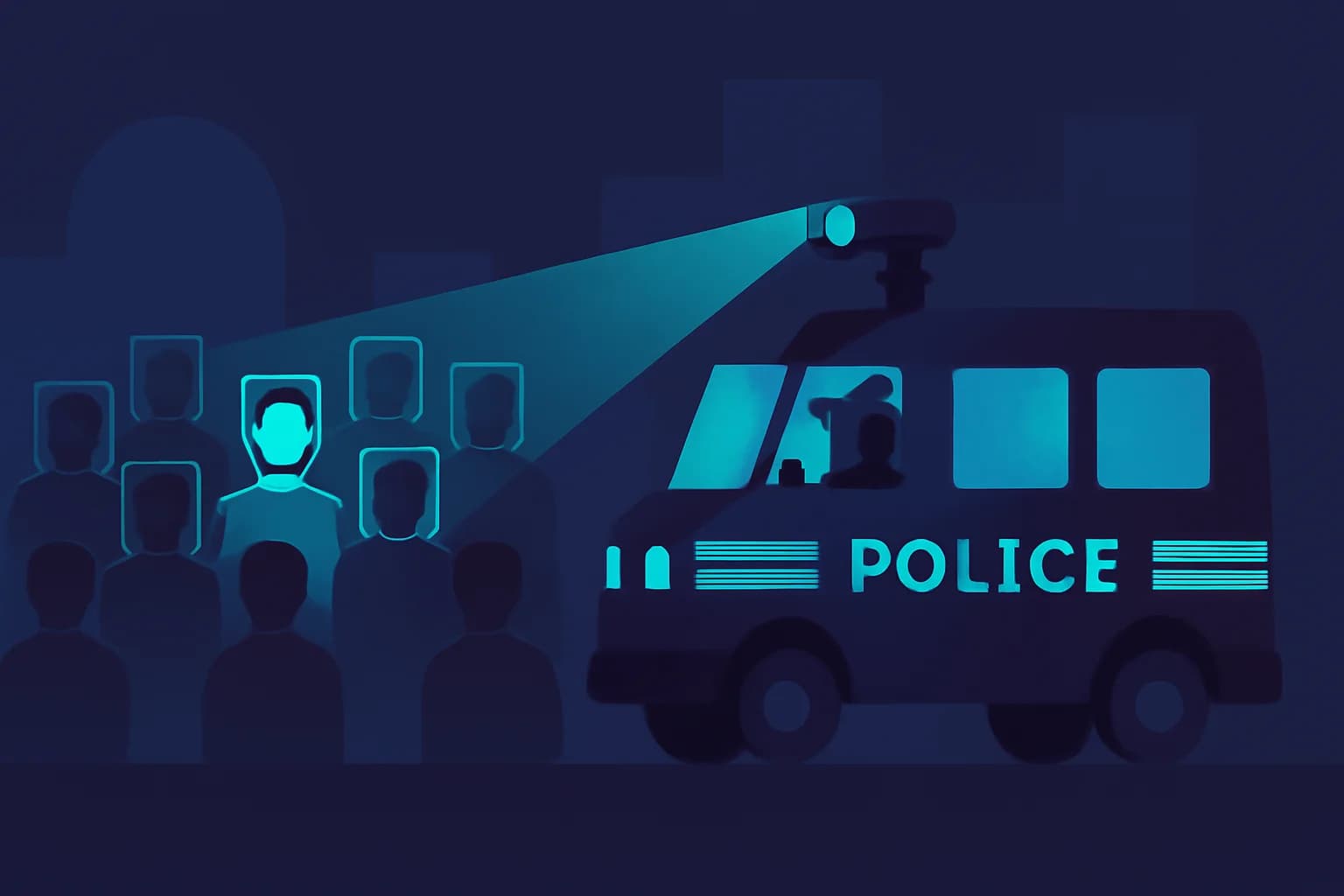
Western Australia Police have published the first three months of results from their live facial recognition trial: 905,117 faces scanned, 209 alerts, 79 arrests, and eight incorrect alerts. On paper that is a striking success, with a reported false-match rate of just 0.0009 percent. But the number a person stopped in the street cares about is different, and the eight mistakes shared a pattern that matters.
This guide breaks down what the trial did, what the numbers do and don't say, the safeguards in place, and the ethical questions raised by an academic reviewer. It also answers a practical question for anyone who films in public: what does blurring faces in your own video do, and what can't it do? If you publish footage with strangers in it, BGBlur's face blur is built for that.
TL;DR: The WA Police Trial in Numbers
| Question | Answer |
|---|---|
| When did it start? | June 22, 2026 |
| Period reported | First three months |
| Deployments and locations | 77 deployments across 36 locations |
| Faces scanned | 905,117 |
| Alerts | 209 |
| Arrests | 79 (36 for outstanding warrants) |
| Registered sex offenders engaged | 114 |
| Incorrect alerts | 8 |
| Reported false-match rate | 0.0009% of faces scanned |
| Wrong alerts as a share of alerts | About 3.8% (our calculation: 8 of 209) |
| Data on non-matches | Pixelated in real time and not saved, per WA government |
What Did the WA Police Facial Recognition Trial Do?
The trial is an "overt" live facial recognition deployment. Marked police vans fitted with real-time biometric cameras compare the faces of passers-by against a predefined alert list of people wanted for serious offences or considered at risk, according to the Western Australia government's trial update. Signs warn the public that facial recognition is in use.
The update also reports 114 engagements with registered sex offenders and a regional deployment in Geraldton on September 11 and 12, 2026. Biometric Update's coverage adds that eight welfare checks were carried out.
What Do the Numbers Actually Mean?
Two true statements can be made about the same eight mistakes:
- 0.0009 percent of faces scanned were wrongly flagged. That is eight divided by 905,117.
- About 3.8 percent of alerts were wrong by our calculation: eight incorrect alerts out of 209 total alerts, or roughly one in 26.
The first figure shows how rarely the system errs across a crowd. The second shows how often an officer walking toward someone is walking toward the wrong person. Because live facial recognition is used to decide whom police approach, the second number is the one that maps to real-world impact on an individual. WA Police report the first; a full picture needs both, plus a breakdown of who was affected.
Was There Bias in the Errors?
The reporting says yes. Biometric Update states that all of the false matches misidentified people with darker skin tones. Commissioner Col Blanch attributed the eight errors to "darker skin and lighting conditions, or quality of reference image," as quoted in an analysis in The Conversation by Adam Andreotta of Curtin University.
Andreotta's critique is measured: the published results, he argues, tell us much less about whether particular groups were disproportionately affected, and lack detail on who is included on the alert list, how those decisions are made, and what safeguards against bias are used. His conclusion is the line worth remembering: "success should not be measured by how often a system gets things right but by how innocent people are protected when it gets things wrong."
What Safeguards Were in Place?
To its credit, the trial reports several safeguards:
- Real-time pixelation. The WA government says images of people not on the alert list are automatically pixelated in real time and not saved, and that there is no record-keeping of that data.
- Human verification. Reported operating rules require officers to actively verify automated match scores before approaching anyone.
- Senior authorization before each deployment.
- Public signage on marked vans.
These are meaningful, and the pixelation approach is a good example of privacy by design: the system doesn't need to keep the faces of the vast majority of people who are not on the list. Whether the controls are enough depends on independent oversight, published demographic accuracy data, and clear legal authority, none of which the trial update itself addresses.
Can Police Scan Your Face in Public Without Consent?
In a live deployment like this, scanning happens to everyone within range, and nobody is asked. Andreotta notes that facial surveillance "raises serious consent problems" because it occurs without meaningful choice or control. Whether it is lawful depends on where you are. Australian privacy law and state statutes differ, and our guide to the Australian Privacy Act and video privacy covers the private-sector rules. The EU regulates the practice in a different way, as we cover in the EU AI Act guide to retrospective facial recognition in CCTV archives.
The larger story is one of drift. Cameras that identify people are spreading from police vans to doorbells and glasses, as in our posts on Ring's Familiar Faces and Meta smart glasses facial recognition.
How Is Live Facial Recognition Different From Other Face Matching?
Facial recognition is used in several distinct ways, and the risks differ.
| Type | What happens | Example | Main risk |
|---|---|---|---|
| Live facial recognition | Faces are scanned in real time as people pass a camera and compared with an alert list | The WA Police vans | Everyone in range is scanned without choosing to be |
| Retrospective facial recognition | Stored footage is searched afterward for a known face | Searching a CCTV archive | Long-term tracking of past movements |
| Verification (one-to-one) | A face is compared with one claimed identity | Unlocking a phone | Lower, since the person opts in |
| Scraped-database search | A photo is matched against images collected from the web | Services like Clearview AI | People never agreed to be in the database |
The EU treats these differently, and our guide to the AI Act and retrospective facial recognition in CCTV archives covers the retrospective case. The WA trial is a live, overt deployment, which is why the debate centers on consent, signage and real-time safeguards rather than on archives.
What Questions Should You Ask About Any Live Deployment?
Andreotta's critique points to what a trustworthy trial would publish. Whether you are a resident, a journalist, a council member or a policymaker, these are the questions to put to any live facial recognition program:
- Who is on the alert list, and who decides? The criteria and approval process shape everything else.
- What is the error rate per alert, not just per scan? Both figures should be published.
- How does accuracy vary by skin tone, age and gender? The eight incorrect alerts in WA reportedly involved darker-skinned people, so demographic breakdowns are essential.
- What happens to a person who is wrongly flagged? Look for a clear process for stops, complaints and redress.
- What is retained? WA reports that non-matching images are pixelated and not saved; ask what happens with matches and alert-list images.
- Who audits it independently? Police-published results are a starting point, not an evaluation.
- What is the legal basis, and is it explicit? Commentary cited by The Conversation argues the law is not ready for the technology.
If a program can answer these publicly, that is a sign of maturity. If it can't, the arrest numbers alone don't tell you whether it is working as intended.
What Can You Do About Live Facial Recognition?
Be realistic. Nothing you edit afterward can stop a live scan, because the identification happens as the camera sees you, before any file exists. What you can do is separate the things you control from the things you don't:
What you can control
- Push for transparency: ask for published accuracy data by demographic group, alert-list criteria, and independent review.
- Ask where the legal authority comes from and who audits it.
- Look for signage and read what the deployment says about retention.
What you can control in your own footage
- If you film in public, blur the faces of people who didn't agree to appear before you publish. Your video shouldn't become the next source of identifiable faces for scrapers and face-search tools.
- If you are a journalist, protect sources and bystanders. Our protest and surveillance privacy guide covers the risks.
How to blur bystanders in public footage
- Open BGBlur and upload your clip (MP4, MOV or M4V up to 4K).
- The AI detects every face, and motion tracking keeps moving people covered across frames.
- Preview the result and check crowds and background figures.
- Export. Processed files are deleted within 24 hours.
Honest Limitations
This article relies on the WA government's own trial update and secondary reporting; the underlying accuracy data by demographic group has not been published, so claims about bias rest on the reported description of the eight errors. The "about 3.8 percent" figure is our own calculation from published numbers and not a statistic WA Police report. Blurring your own footage does not protect you from being scanned by a police camera or someone else's doorbell. This is general information, not legal advice.
The Bottom Line
The WA Police trial shows live facial recognition producing arrests with very few errors per face scanned, but the more informative statistics are that roughly one in 26 alerts was wrong and that all eight errors reportedly involved people with darker skin. The trial's own safeguards, especially real-time pixelation of non-matches, are worth copying, and the open question is oversight and demographic transparency. For the footage you publish, blur faces before you post. Try BGBlur's face blur on your next clip.