AI Ad Disclosure: Meta, Google, TikTok & NY Law Guide [2026]
Platform-level AI disclosure policies from Meta, Google, and TikTok converged with the New York synthetic performer law (S.8420-A) in 2024–2026 to create a complex compliance landscape for advertisers. This guide maps every disclosure trigger across every major platform, explains the EU AI Act Article 50 overlap, and shows why real human models with face blur is the only strategy that sidesteps mandatory disclosure requirements on all platforms simultaneously.
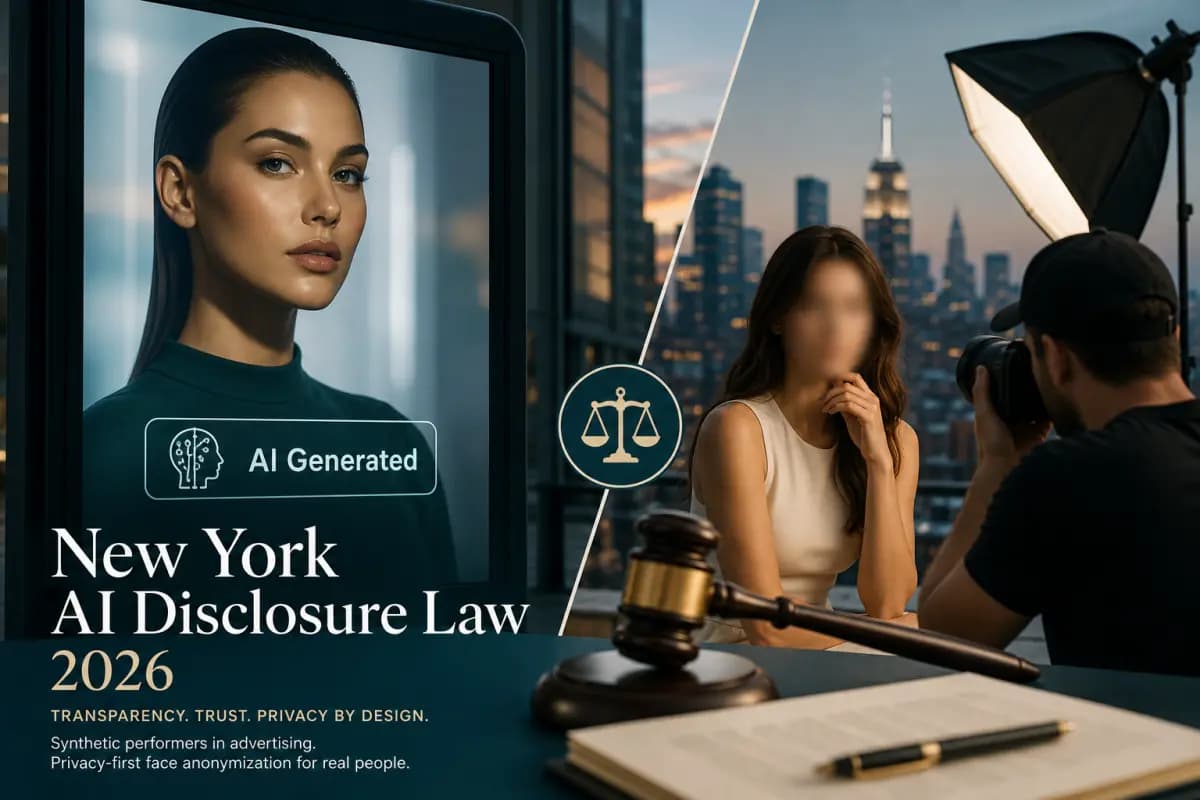
The compliance landscape for AI-generated advertising content has transformed completely between 2024 and 2026. What began as voluntary best-practice guidelines has become a layered system of mandatory platform policies, state law requirements, and international regulation — with fines, enforcement actions, and platform bans for non-compliance.
This guide maps the full landscape: what each major platform requires, what the New York synthetic performer law mandates, how EU AI Act Article 50 intersects with US obligations, and — critically — which advertising strategies trigger disclosure requirements and which do not.
The conclusion reached by a growing number of advertisers: real humans with automated face blur is the only workflow that satisfies all disclosure frameworks simultaneously, across all platforms, in all jurisdictions.
Update — September 15, 2026: For creators asking a narrower TikTok-specific question about language rather than AI disclosure, see TikTok's profanity rules explained, covering what's banned outright versus what only limits For You feed distribution.
Platform-by-Platform Disclosure Requirements
Meta (Facebook, Instagram, Threads)
Political advertising (in effect since March 2024): Meta requires mandatory disclosure for any political, electoral, or social issue ad that uses AI to generate realistic images, audio, or video. Disclosure must appear in the ad creative itself and in the ad's transparency library entry. Non-disclosure of AI use in political ads results in ad disapproval and account restriction.
All advertising (expanded 2025–2026): Meta has extended AI disclosure requirements to all paid advertising. Advertisers must self-certify whether an ad contains AI-generated content when submitting ads through Ads Manager. For content where AI detection systems identify AI-generation signals, Meta may apply an automatic "Made with AI" label even without advertiser self-disclosure.
What triggers disclosure: AI-generated faces, AI-generated bodies, AI-generated backgrounds combined with real humans in ways that materially alter their appearance, AI-generated voiceovers, AI-generated text overlays (in some cases).
What does not trigger disclosure: Real human models filmed on camera, privacy blurring (including BGBlur), color grading, stabilization, standard video editing.
Enforcement: Ad disapproval, account restriction, and for political advertisers, potential referral to the Federal Election Commission.
Google (YouTube, Display, Search)
Election advertising (in effect 2024): Google requires disclosure for election ads that use "synthetic media" — defined as AI-generated or AI-manipulated video, images, or audio — to depict real people saying or doing things they did not say or do. Disclosure must be clearly visible and may not be placed where it will be obscured by other elements.
YouTube and Display expansion (2025–2026): Google's "Synthetic and Manipulated Media" policy, aligned with the Content Authenticity Initiative (CAI) and C2PA standards, has extended disclosure requirements beyond election ads. AI-generated content in YouTube ads must be disclosed in the video itself. Google's Creator Music and Display programs have additional requirements for AI-generated music and imagery.
C2PA integration: Google is a founding member of the C2PA and has committed to reading and displaying C2PA content credentials on YouTube. By late 2025, AI-generated creatives from participating tools (Adobe Firefly, OpenAI DALL-E, Midjourney) automatically carry C2PA metadata that YouTube can detect and display without advertiser action.
What triggers disclosure: Synthetic faces, AI-generated backgrounds with realistic depictions, AI voice clones, AI-generated or manipulated video of real public figures.
What does not trigger disclosure: Real humans on camera, editorial blurring, standard post-production effects.
TikTok
AIGC Label Policy (in effect May 2024): TikTok's AI-Generated Content (AIGC) labeling requirement is currently the most comprehensive of any major platform. All content — organic and paid — that uses AI to generate or significantly alter visual or audio elements must be labeled using TikTok's built-in labeling tool.
TikTok explicitly lists the following as requiring the AIGC label:
- AI-generated faces (including face-swapping, face generation)
- AI-generated voices (voice cloning, text-to-speech voices presented as real)
- AI-generated bodies or scenes presented as real
- Videos where AI has been used to realistically alter a real person's appearance
TikTok for Business / Branded Content: For paid promotions and branded content partnerships, AIGC labeling is enforced more strictly. TikTok's AI detection systems scan ad creatives submitted through TikTok Ads Manager. Unlabeled AI content identified by detection systems is automatically labeled and may receive reduced distribution.
What triggers disclosure: AI-generated or AI-significantly-altered faces, synthetic voices, AI-generated scenes presented as real.
What does not trigger disclosure: Privacy blurring or obscuring of faces (this is an editorial technique, not AI generation), real human models, standard production effects.
NY S.8420-A (New York Synthetic Performers Act)
Effective: Signed into law and in effect from 2024. Amendments expanding scope to commercial advertising took effect in 2025.
Core requirement: Any commercial advertisement that uses a "digital replica" — a computer-generated or AI-generated realistic representation of a specific real individual's likeness or voice — must include clear and conspicuous disclosure. The disclosure must state that the advertisement contains a digital replica.
Penalties: $1,000 to $5,000 per violation. The New York Attorney General has enforcement authority. Individual violations are assessed per advertisement (not per impression), creating significant exposure for large ad campaigns.
Scope: Applies to any advertisement shown to New York consumers, regardless of where the advertiser is based. This means national campaigns targeting US audiences that include New York will be subject to NY S.8420-A.
Critical distinction: S.8420-A covers digital replicas of specific real individuals. A generic AI-generated face that does not represent any specific person is not covered by S.8420-A — but it is still covered by platform policies (Meta, TikTok) and EU AI Act Article 50.
The full analysis of NY S.8420-A's advertising implications is covered in the New York AI disclosure law 2026 synthetic performers guide and the real humans face blur vs synthetic performers AI disclosure comparison.
EU AI Act Article 50
Effective: August 2026 (AI Act enforcement timeline for high-impact AI systems; disclosure obligations for AI-generated content phased in from 2025).
Core requirement: Providers of AI systems that generate synthetic audio, image, video, or text content that could be presented to persons must ensure the output is "marked in a machine-readable format and detectable as artificially generated or manipulated." Natural persons interacting with such systems must also be informed.
Advertising application: Ads distributed in the EU that contain AI-generated visual or audio content must carry C2PA-compatible machine-readable disclosure metadata. The EU's AI Office is developing specific guidance for advertising, which is expected to require visible labels on AI-generated ad creatives shown to EU users.
Stacking with platform policies: EU advertisers who comply with Meta or TikTok's disclosure policies but do not include C2PA metadata in their creatives remain non-compliant with Article 50. The BGBlur approach (real humans + blur) avoids both obligations because the content is not AI-generated.
The EU AI Act Article 50 deepfake disclosure compliance guide covers the Article 50 technical requirements in detail.
Timeline of Disclosure Policy Rollouts (2024–2026)
| Date | Event |
|---|---|
| March 2024 | Meta mandatory AI disclosure for political ads |
| May 2024 | TikTok AIGC label policy takes effect for all content |
| June 2024 | Google "Synthetic Media" policy expands beyond election ads |
| November 2024 | NY S.8420-A signed into law |
| January 2025 | Meta AI disclosure extended to all advertising categories |
| March 2025 | TikTok for Business stricter AI detection for paid ads |
| July 2025 | NY S.8420-A commercial advertising scope amendments |
| August 2025 | EU AI Act Article 50 disclosure obligations begin phased enforcement |
| January 2026 | C2PA metadata detection live on YouTube and Meta |
| June 2026 | EU AI Act Article 50 full enforcement for advertising content |
What Triggers AI Ad Disclosure: The Complete Checklist
Understanding exactly what triggers disclosure is essential for campaign planning.
TRIGGERS disclosure on all platforms:
- AI-generated faces (human likenesses created by generative AI)
- AI face-swapping (replacing a real person's face with another)
- AI voice cloning (voice generated from a real person's voice data)
- AI-generated text-to-speech voices presented as a real human
- Fully AI-generated video scenes presented as real (not animated)
- AI deepfakes of real public figures
- AI-generated bodies, clothing on real faces
TRIGGERS disclosure on some platforms:
- AI-generated backgrounds combined with real humans (Meta, TikTok — when "materially altering" the scene)
- AI color grading or image enhancement that "significantly alters" appearance (TikTok specific guidance)
- AI-generated music or audio beds with AI voices (YouTube-specific)
Does NOT trigger disclosure:
- Real humans filmed on camera
- Standard video production: color grading, stabilization, lighting adjustment, cutting
- Privacy blurring of real faces (BGBlur face blur)
- Background replacement with non-AI stock footage or real locations
- Text overlays and graphics (in most cases)
- BGBlur background blur or object blur applied to real footage
- Voice anonymization/distortion of a real recorded voice (different from AI voice cloning)

Why "Real Human + Face Blur" Is the Only Universal Compliance Strategy
The compliance problem with AI-generated ad content is its multi-platform, multi-jurisdictional nature. An ad that technically complies with Meta's disclosure policy may still violate NY S.8420-A if it depicts a digital replica of a specific person. An ad that avoids S.8420-A because it uses a generic AI face may still require an AIGC label on TikTok and C2PA metadata for EU distribution.
The only approach that avoids disclosure requirements on all platforms, under all laws, in all jurisdictions simultaneously is to use real human models captured on a real camera — and then apply automated face blur where privacy or anonymity is desired.
Here is why this works:
Real camera footage carries camera provenance in its metadata (EXIF, C2PA camera signature). Platform AI detection systems do not flag it as AI-generated. It does not trigger TikTok's AIGC policy, Meta's AI disclosure requirement, or Google's synthetic media policy.
Face blur is a privacy technique, not an AI generation technique. It obscures rather than replaces. No platform policy requires disclosure for privacy blurring. NY S.8420-A does not apply because no digital replica is created. EU AI Act Article 50 does not apply because the content is not AI-generated.
The advertiser's benefit: The ad features a real human presenter — authentic, GDPR-compliant, legally clean — with the face obscured for privacy or stylistic reasons. This is a well-established technique in advertising (blurred crowds, anonymous consumer testimonials, stylized face obscuring) that viewers recognize and accept.
Advertiser Compliance Checklist
Use this checklist when evaluating each ad creative before launch:
Step 1: Identify content type
- Is any face in the creative AI-generated or AI-swapped? → Disclosure required on Meta, TikTok, Google, EU
- Is any voice AI-generated or AI-cloned from a real person? → Disclosure required on all platforms
- Is any scene or background AI-generated and presented as real? → Check platform-specific rules
- Are any real public figures depicted doing or saying things they did not do or say? → Disclosure required + potential legal liability
Step 2: Check jurisdiction
- Does the campaign target New York consumers? → NY S.8420-A applies
- Does the campaign target EU users? → EU AI Act Article 50 applies
- Is the campaign political, electoral, or social issue advertising? → All platforms apply strictest rules
Step 3: Implement disclosure (if triggered)
- Add in-creative disclosure text ("Created with AI" or equivalent)
- Self-certify in platform ad submission interfaces
- Include C2PA metadata in creative files for EU distribution
- Document disclosure decisions for record-keeping
Step 4: Consider alternative approach
- Could this creative use a real human model filmed on camera?
- Could BGBlur be used to blur faces for privacy while preserving authenticity?
- Would this approach eliminate all disclosure obligations while achieving the creative goal?
Integrating BGBlur into Ad Production Workflows
For advertising teams that produce video content at scale, BGBlur's Business tier API can be integrated directly into production workflows:
Step 1: Shoot with real human talent Film your ad with real models on a real set or location. This generates camera-provenance footage that carries authentic metadata.
Step 2: Standard post-production Edit, color grade, add music and text overlays using your standard tools (Premiere Pro, DaVinci Resolve, Final Cut). No disclosure obligations arise at this stage.
Step 3: Privacy processing with BGBlur API If the creative requires face anonymization (anonymous testimonials, crowd scenes, privacy-first content), submit the footage to BGBlur via the Business API. BGBlur applies AI-powered face blur, tracking faces consistently across the video.
Step 4: Export and distribute Download the BGBlur-processed video. The resulting creative shows a real person with a blurred face — authentic, compliant, ready for Meta, Google, TikTok, and EU distribution without any AI disclosure label.
Cost: BGBlur Business at $29/month provides API access, batch processing, and 4K support — a negligible line in any ad production budget.
For post-production teams that already process videos for platform specs, BGBlur integrates as an additional export step requiring no new infrastructure.
The Platform Policy Convergence: What It Means for 2026 and Beyond
The convergence of platform policies and legislation in 2024–2026 signals a permanent shift. AI-generated advertising content will require disclosure in all major markets for the foreseeable future, and enforcement will tighten as detection technology improves.
C2PA metadata detection by platforms means that AI-generated creatives from major tools will automatically carry disclosure-triggering metadata, even when advertisers attempt to remove it. The window for "invisible AI content" is closing rapidly.
The practical implication for advertisers in 2026: brand authenticity, viewer trust, and regulatory compliance all point in the same direction — real humans, real content, real camera. Where privacy requires it, BGBlur provides the bridge: real humans with protected identities, no disclosure required, compliant across every platform and every jurisdiction.
For deeper coverage of the legal frameworks intersecting here, see the EU AI Act Article 50 deepfake disclosure compliance guide, the New York AI disclosure law 2026 synthetic performers guide, and the AI face anonymizer tools guide comparing blur vs synthetic replacement.