EU Driver-Facing Camera Law 2026: What Changed & Privacy
Every new car sold in the EU now needs a camera pointed at the driver's face under the Advanced Driver Distraction Warning rule. Here's exactly what the law requires, what it means for your privacy, and how to protect faces and license plates in any car footage you share.
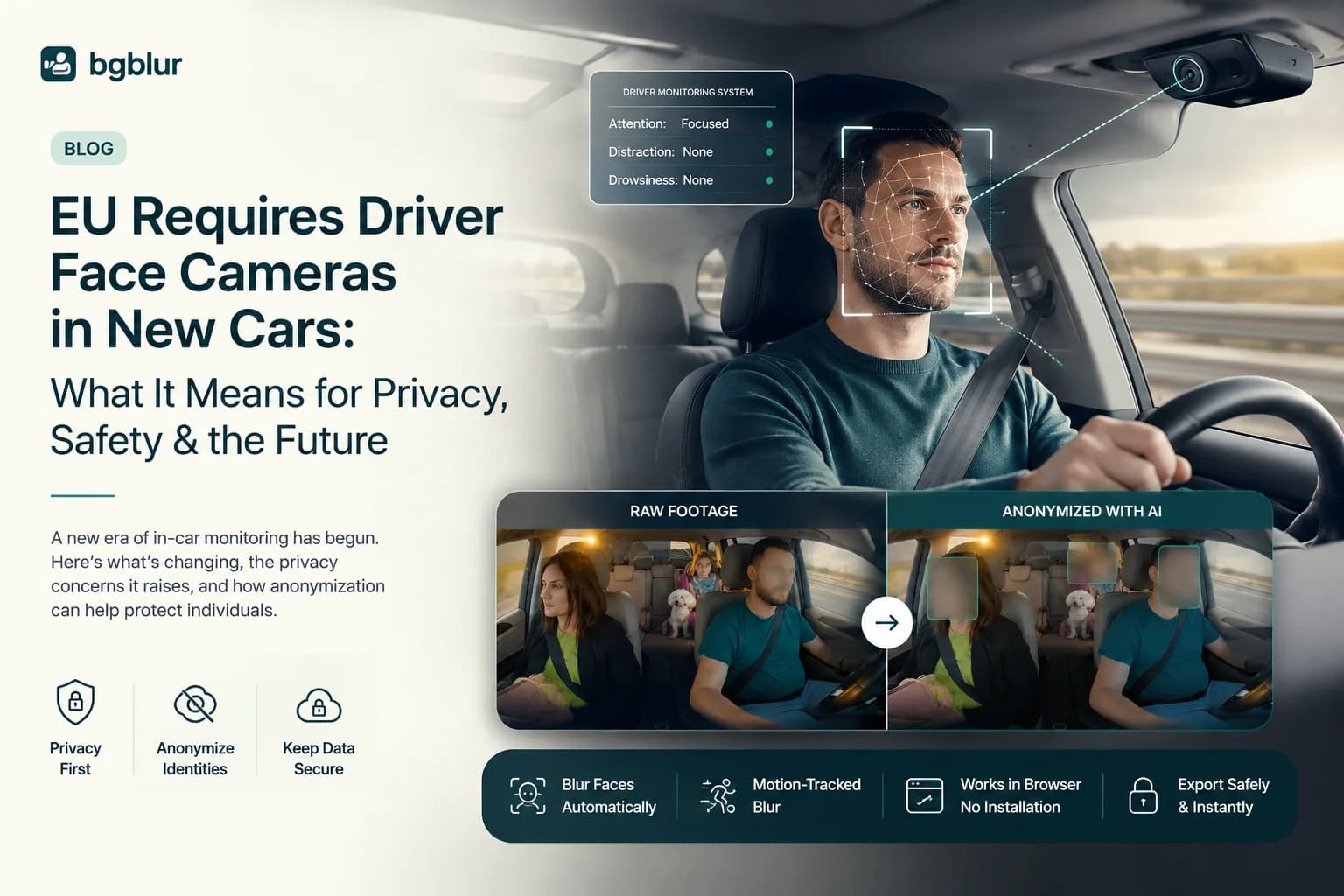
Since July 7, 2026, every new car registered in the European Union has a camera pointed at the driver's face. It's not an aftermarket gadget or a fleet-tracking add-on — it's a legal requirement under the EU's General Safety Regulation, and it applies to essentially every new passenger car, van, and truck sold in the bloc.
The system is called Advanced Driver Distraction Warning (ADDW), and its job is to watch your eyes, head position, and gaze to detect when you're not looking at the road. If it decides you've been distracted too long, it warns you — visually, audibly, or with a seat vibration.
Regulators say this will save lives. Privacy advocates, drivers, and legal experts are asking a more specific question: what exactly is this camera doing with your face, and who else can see it? This guide breaks down what the law actually requires, where the real privacy risk sits, how it compares to what's coming in the US, and — because BGBlur already helps hundreds of thousands of dashcam and car-footage owners protect the faces and plates in their videos — what you can actually do about it today.
TL;DR: EU Driver-Facing Camera Law at a Glance
| Question | Answer |
|---|---|
| What's the law? | Regulation (EU) 2019/2144 (General Safety Regulation), Article 7 — Advanced Driver Distraction Warning (ADDW) |
| When did it take effect? | New vehicle types: July 7, 2024. All new vehicle registrations: July 7, 2026 |
| What does it track? | Eye gaze, head pose, and eyelid closure — not identity |
| Can I turn it off? | Yes, per ignition cycle only (resets each time you start the car) |
| Does it store biometric data? | The technical standard says no biometric identification is required — but enforcement of "no extra data collection" is unclear |
| Is it GDPR-relevant? | Potentially, if manufacturer software goes beyond the mandated gaze-tracking function |
| Is the US doing this too? | A related NHTSA impaired-driving-detection mandate is due by September 2027 under federal law |
| Does BGBlur help here? | Yes — blur faces and license plates in any dashcam, insurance, or exported car footage before you share it |
Why Is the EU Doing This?
This isn't a random regulatory whim — it's the EU acting on a road-safety target it set for itself years ago, backed by numbers that are hard to argue with.
- Nearly 20,000 people died on EU roads in 2024. That's the baseline the European Commission is trying to bring down, not a hypothetical risk.
- Human error is a factor in roughly 95% of all road crashes, and the European Commission estimates driver distraction contributes to 10–30% of all accidents — a range the Commission itself calls likely conservative, since distraction is notoriously hard to prove after the fact.
- The EU's stated goal is "Vision Zero": get as close as possible to zero road deaths by 2050, with an interim target of halving deaths and serious injuries by 2030 compared to 2018 levels.
- ADDW is one line item in a larger package under the General Safety Regulation — alongside automated emergency braking, improved forward visibility, tire wear monitoring, and expanded pedestrian-protection glass — that the Commission is betting will meaningfully move that number.
In other words: the regulatory logic is "distraction is a large, measurable, and previously unaddressed slice of a 20,000-death-a-year problem, and camera-based gaze tracking is the most mature technology available to catch it in real time." Whether a dashboard chime meaningfully changes driver behavior is a fair question — and one raised repeatedly by critics below — but the underlying motivation is a specific, published safety target, not surveillance for its own sake.
What Is the Advanced Driver Distraction Warning (ADDW) System?
The Law Behind the Camera
The driver-facing camera requirement isn't a new 2026 invention — it's the final phase-in of a regulation the EU adopted years ago. Regulation (EU) 2019/2144, the General Safety Regulation (GSR), mandates a list of Advanced Driver Assistance Systems (ADAS) for new vehicles, including automated emergency braking, lane-keeping assistance, driver drowsiness detection (Article 6), and Advanced Driver Distraction Warning (Article 7).
The rollout was staged deliberately:
- July 7, 2022: Requirement applies to newly type-approved vehicle models
- July 7, 2024: All new vehicle types entering the market must comply
- July 7, 2026: The mandate extends to every new vehicle registered, including older approved models still being manufactured and sold
That last date is why this made headlines in July 2026 — it's the point where the requirement stops being about new car designs and starts applying to nearly every car rolling off a dealer lot.
How the Camera Actually Works
ADDW relies on a camera-based Driver Monitoring System (DMS), typically mounted near the rearview mirror or in the instrument cluster, often using infrared sensors so it works day or night. Per the European Commission's implementing technical standard (Commission Implementing Regulation referencing document C(2023)4523), the system must:
- Continuously track the driver's eye gaze direction, head pose, and eyelid movement
- Detect when gaze has left the road-relevant field of view for too long
- Trigger a visual warning, plus an acoustic and/or haptic alert (like a seat vibration), when distraction is confirmed
The warning thresholds are speed-dependent:
| Vehicle Speed | Distraction Warning Trigger |
|---|---|
| 20–50 km/h | Gaze off-road for more than 6 seconds |
| Above 50 km/h | Gaze off-road for more than 3.5 seconds |
| Below 20 km/h | System does not need to be active |
Manufacturers must also let drivers manually deactivate the ADDW warning or the underlying system for the current ignition cycle — the law explicitly gives drivers an opt-out button, but it isn't a permanent setting; it resets every time you restart the vehicle.
The Privacy Question Nobody Fully Answered
What the Law Says About Your Data
Here's the part regulators lean on to defend the rule: the ADDW technical standard states the system must function without processing biometric data for identification purposes. In other words, the camera is engineered to answer "which way are this person's eyes pointing," not "who is this person." No facial recognition, no identity matching, no biometric template stored for authentication — at least according to the letter of the standard.
Where the Gap Actually Is
The catch is enforcement and scope creep, not the base requirement:
- The regulation governs the mandated safety function — not everything the camera hardware is capable of. A camera physically able to capture and process a driver's face can, in principle, be repurposed by manufacturer software for other features (driver profile recognition for seat/mirror memory, drowsiness-linked insurance telematics, in-cabin voice assistants) that were never part of the ADDW mandate.
- "Data stays in the car" is a claim, not an audited guarantee. Authorities and manufacturers have said the processing happens locally and isn't transmitted externally, but the regulation doesn't spell out a penalty regime for a manufacturer that quietly does otherwise, and independent verification of what's happening inside a car's telematics unit is difficult for an average owner.
- GDPR still applies the moment processing goes beyond the mandated function. If a manufacturer's connected-car platform starts linking gaze data to a driver profile, an insurer, or a cloud account, that's Article 9 special-category biometric processing requiring explicit consent, a documented legal basis, and a Data Protection Impact Assessment (DPIA) — GDPR doesn't get suspended just because the camera was installed for a safety mandate.
This is the same tension privacy researchers flagged around dashcams and body-worn cameras years ago: the hardware is neutral, the software policy is where the risk lives. For background on how EU privacy law treats faces and plates captured on video more broadly, see our GDPR video content compliance guide.
What Drivers and Experts Are Actually Saying
The public reaction has been sharply split between "obviously helps prevent distracted-driving crashes" and "mandatory in-car surveillance with no real audit trail." Common criticisms circulating since the July 2026 rollout include:
- "A privacy nightmare that will have no impact on safety" — skepticism that a warning chime meaningfully changes behavior compared to the precedent it sets for in-cabin monitoring
- "First it's your car, then your living room" — concern that normalizing a mandatory in-cabin camera lowers resistance to monitoring in other private spaces
- A visible aftermarket response — online discussion around removing or disabling driver-facing cameras before mandatory annual roadworthiness inspections, then reinstalling them, highlighting how little trust the "opt-out per ignition cycle" design has earned
Regulators counter that the same regulation also mandates genuinely uncontroversial safety tech — improved forward visibility, expanded pedestrian-protection glass zones, automated emergency braking, and tire wear monitoring — and that ADDW is one piece of a broader crash-reduction package, not a surveillance initiative on its own.
EU vs. US: How the Two Driver-Monitoring Mandates Compare
| EU (ADDW) | US (NHTSA impaired-driving tech) | |
|---|---|---|
| Legal basis | Regulation (EU) 2019/2144, Art. 7 | Infrastructure Investment and Jobs Act, Section 24220 |
| Full deadline | July 7, 2026 (all new registrations) | No later than September 2027 |
| What it detects | Distraction (gaze/head pose off-road) | Impairment (originally alcohol-focused) |
| Camera required? | Yes, by design (DMS-based) | Not explicitly, but camera-based monitoring is the most production-ready path given passive-alcohol-sensing tech isn't ready |
| Status as of mid-2026 | In force | NHTSA missed its original Nov. 2024 deadline; a Feb. 2026 report to Congress said current tech isn't ready for full deployment |
| Opt-out | Yes, per ignition cycle | Not yet finalized |
The two mandates solve different problems (distraction vs. impairment), but they converge on the same hardware: a camera pointed at the driver. If you drive a recent US vehicle with adaptive cruise control or "driver attention monitoring," there's a good chance a similar camera is already active in your cabin — Subaru, GM, Ford, and several other automakers have shipped driver-facing cameras on select models since 2020–2024, ahead of any federal mandate.
What This Means If You Already Record Your Drives
Most of this coverage focuses on the new mandatory in-cabin camera. But if you're a dashcam owner, rideshare driver, or fleet operator, you're likely already capturing far more identifiable footage than a gaze-tracking safety camera ever will — and that footage is the part you actually control and share.
Outward-Facing Dashcam Footage Still Needs Blurring
A forward- or rear-facing dashcam captures other people's faces and license plates constantly: pedestrians crossing in front of you, drivers in adjacent lanes, cyclists, parked cars outside someone's home. None of that is covered by the ADDW regulation — it's governed by GDPR the moment you post it, submit it to an insurer, or upload it anywhere public. Our complete guide to blurring faces and license plates in dashcam videos walks through the compliance basics brand-by-brand.
In-Cabin Footage You Export Is Even More Sensitive
If your vehicle's DMS or an aftermarket dual-camera dashcam ever lets you export in-cabin video (for an insurance dispute, a fleet safety review, or to contest a false distraction warning), that clip contains your own face and voice, plus any passengers'. Before that footage leaves your control — sent to an insurer, a manufacturer's support team, or shared as evidence — it's worth reviewing exactly who needs to see your identifiable face versus who just needs to see the road or the incident.
How BGBlur Fits In
This is exactly the gap BGBlur was built to close. Whether the footage is from an outward-facing dashcam, a rideshare interior camera, or an exported in-cabin clip:
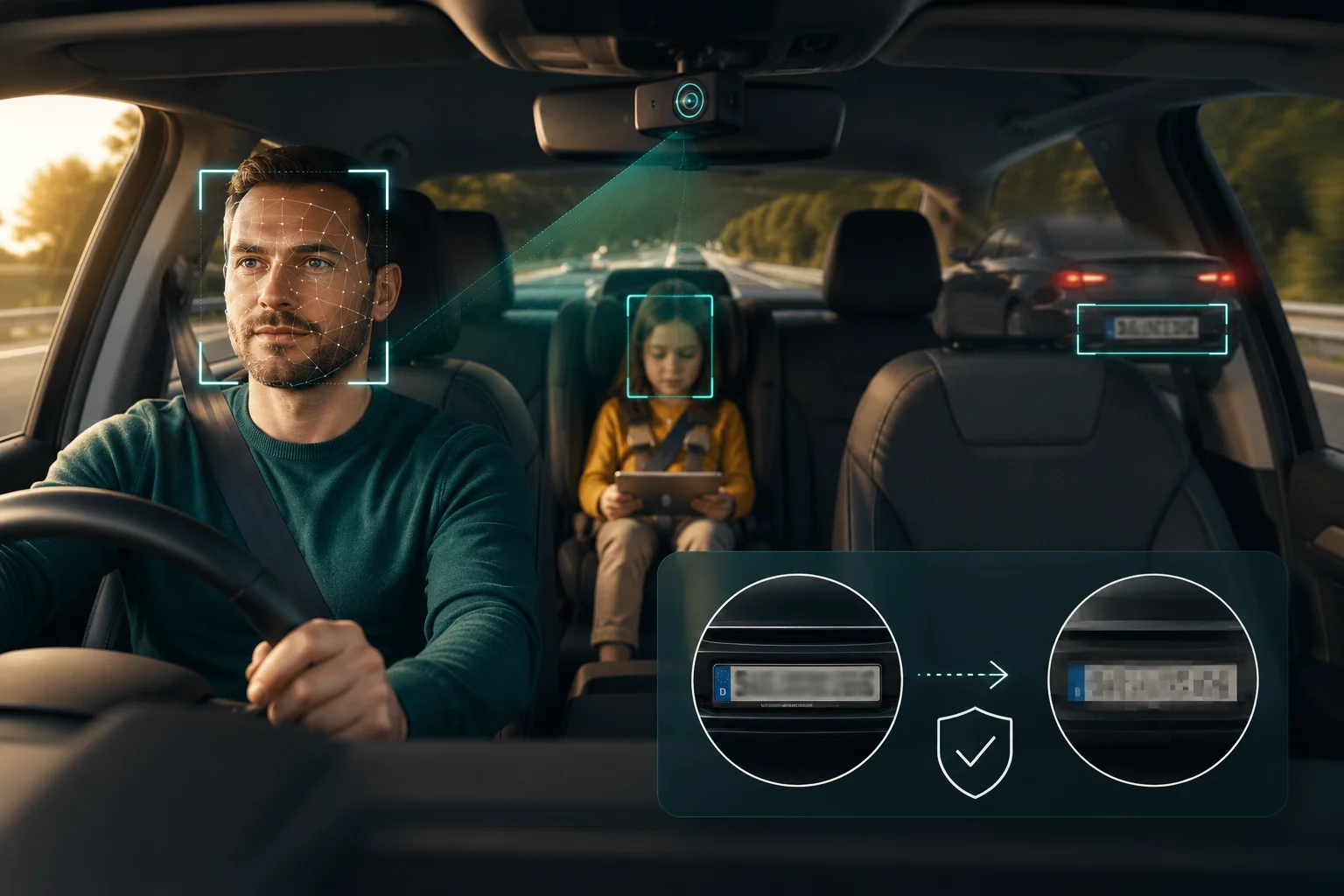
- AI face blur automatically detects and tracks every face frame-by-frame — yours, passengers', or bystanders' — even with motion, low light, or partial occlusion
- AI license plate blur detects and blurs plates on parked and moving vehicles, front and rear, across formats
- Browser-based processing — no software install, works with MP4, MOV, and M4V footage up to 4K
- 24-hour automatic deletion — nothing you upload is stored permanently, which matters if the footage itself is sensitive (an accident, a dispute, a passenger's face)
How to Blur Faces and License Plates Before Sharing Car Footage
Step 1: Upload Your Footage
Go to bgblur.com and drag in your dashcam clip, exported in-cabin recording, or any car-related video (MP4, MOV, M4V, up to 4K).
Step 2: Choose What to Blur
Select Face Blur, License Plate Blur, or both. For most dashcam or in-cabin footage intended for public sharing or a claim, both is the safer default — our universal dashcam privacy guide breaks down when to use each mode.
Step 3: Review the AI Detection
BGBlur's AI scans every frame and highlights detected faces and plates. Adjust blur intensity (light to full anonymization) or exclude specific plates — your own vehicle, for example — from the blur pass.
Step 4: Export and Share
Download the redacted video as MP4, MOV, or WebM. The source file is deleted from BGBlur's servers within 24 hours — nothing lingers after you've got your privacy-safe copy.
Who This Matters Most For
EU drivers concerned about the new in-cabin camera: You can't opt out of the hardware, but you can control what happens to any footage exported from your own systems, and you can push your manufacturer for a clear answer on data retention and transmission — the regulation requires the camera, not silence about how it's used.
Dashcam owners and content creators: The new law doesn't change your GDPR obligations for outward-facing footage one bit. If you're posting drive footage, reaction videos, or motovlogging content, our motovlogging privacy legality guide covers what's changed for creators specifically.
Rideshare and fleet drivers: Interior cameras were already common before ADDW; the compliance burden of blurring passenger faces before any external sharing hasn't gone away, and now sits alongside a second in-cabin camera system.
Anyone recorded without consent: If you were captured by someone else's dashcam or in-cabin system and want that footage handled, GDPR gives you rights around your image — see our breakdown of what to do if you're secretly recorded and want it addressed under GDPR.
Frequently Asked Questions
Is the EU driver-facing camera mandatory for all cars now? Yes. As of July 7, 2026, every new vehicle registered in the EU must include an Advanced Driver Distraction Warning system with a driver-facing camera. The requirement phased in starting with new vehicle types in July 2024, and now covers all new registrations under Regulation (EU) 2019/2144.
Does the camera record and store video of me? The technical standard doesn't require video recording or storage — it processes gaze and head-pose data in real time and isn't supposed to retain biometric identifiers. But the law doesn't specify how that's audited, which is the core of the ongoing privacy debate.
Can I turn off the driver-facing camera warning? Yes, per ignition cycle. You can manually deactivate the ADDW warning or the system while driving, but it resets to active the next time you start the car — there's no permanent off switch through the regulation's minimum requirements.
Is this a GDPR violation? Not inherently — the mandated function is designed to avoid biometric identification. It becomes a GDPR issue the moment a manufacturer's software processes the data beyond that scope (e.g., linking it to a driver identity or exporting it), which would then require a proper legal basis and DPIA under Article 9.
Is the US getting the same law? A related but distinct mandate — NHTSA's impaired-driving detection requirement under the 2021 Infrastructure Investment and Jobs Act — is due for enforcement by September 2027, though NHTSA has already missed one deadline and flagged that passive-sensing technology isn't fully production-ready as of its February 2026 report to Congress.
What happens if I cover the camera? Most systems will show a persistent warning if the camera is obstructed, and some ADAS features tied to driver-attention confirmation may be limited. It generally won't prevent the car from starting under current rules, but check your manufacturer's specific documentation.
How do I protect faces and plates in car footage I already have? Upload it to BGBlur — the AI automatically detects and blurs every face and license plate in the clip, whether it's outward-facing dashcam footage or an exported in-cabin recording, and the source file is deleted within 24 hours.
Conclusion
The EU's driver-facing camera mandate is now fully in force — every new car registered from July 7, 2026 onward has a camera watching your gaze, whether you asked for it or not. The regulation's technical standard is built to avoid identifying you, but "designed not to" and "audited not to" are different guarantees, and that gap is exactly why drivers, privacy advocates, and now US regulators following a similar path are paying close attention.
What you can control is what happens to the footage you generate and choose to share — dashcam clips, insurance submissions, exported in-cabin recordings. BGBlur exists for precisely that moment: automatically blurring faces and license plates before any car-related video leaves your hands, so the one privacy decision you're actually in charge of is handled properly.
Related Resources
- GDPR Video Content Compliance Guide — Full breakdown of how GDPR treats faces and plates in video
- How to Blur Faces and License Plates in Dashcam Videos — Brand-by-brand privacy compliance guide
- Universal Dashcam Privacy Guide — Works with any dashcam brand or format
- Is Motovlogging Legal? Posting Dashcam Videos Online in 2026 — For creators sharing ride footage
- Secretly Recorded in Spain: Your GDPR Rights — What to do if you're captured without consent
- UK GDPR / Data Protection Act Video Privacy Guide — For UK-registered vehicles and footage
Last updated: July 9, 2026