AI Voice Cloning Scam Protection: A 2026 Publishing Guide
AI voice cloning scams have surged 1,210% year over year, and cloning a voice now takes as little as three seconds of audio. This guide explains why voice anonymization is no longer just a whistleblower or journalist tool — it's a defensive publishing habit for anyone who posts audio or video publicly.
AI voice scams have surged 1,210% as cloning tools now need just three seconds of audio to produce a convincing fake, according to reporting from Fox News that cites projected global AI scam losses of $40 billion by 2027 and roughly one in four adults already exposed to an AI voice scam. That three-second sample doesn't have to come from a phone tap or a stolen recording — it can come from a podcast clip, a customer testimonial, a webinar recording, or a vlog you posted yourself.
That's the part most coverage of this story misses. Voice cloning protection has largely been framed as a whistleblower or journalist concern — someone hiding a source's identity in a sensitive interview. But the raw material scammers are using is ordinary public content: the audio track of videos regular people, creators, and businesses publish every day. If you post audio or video with your real voice on it, you are handing out cloning material whether you intend to or not.
This guide covers what's actually been verified about the current surge — including the FTC complaint filed against voice-cloning platform Speechify — what voice anonymization can and can't do about it, and how to strip identifying vocal characteristics from your video's audio before you publish, using BGBlur's browser-based voice anonymization.
Quick Reference: What's Verified So Far
| Question | Answer |
|---|---|
| Is the 1,210% surge figure real? | Yes — reported by Fox News on AI voice scam trends; other outlets cite a separate 400% jump in CFA-tracked impersonation complaints for 2025 |
| How much audio is needed to clone a voice? | As little as 3 seconds, per multiple 2026 reports on current cloning tools |
| Was there an actual FTC complaint? | Yes — CFA and UCLA Law's Information Policy Lab filed a complaint against Speechify in July 2026 alleging inadequate safeguards |
| What law is cited? | Section 5(a) of the FTC Act (unfair and deceptive practices), plus state UDAP and digital forgery statutes |
| Does voice anonymization stop all voice cloning? | No — it only protects audio you control publishing of, not audio someone else records of you |
| Does BGBlur offer voice anonymization? | Yes, alongside face blur, background blur, and object removal, processed in-browser with 24-hour deletion |
Update — September 15, 2026: For a related but distinct audio question — what happens when TikTok's moderation flags profanity rather than a cloned voice — see TikTok's profanity rules explained.
Why Did AI Voice Cloning Scams Surge 1,210% in 2025?
The short answer: cloning tools got dramatically cheaper, faster, and more accessible at the same time impersonation scams were already climbing. Fox News reports that a scammer can pull a few seconds of audio from a social media video, run it through a consumer-grade voice cloning app that costs less than a streaming subscription, and produce a usable clone in well under 30 minutes.
That accessibility compounds an existing trend. The Consumer Federation of America has separately documented that impersonation scams — the broader category voice cloning fraud falls under — cost Americans $3.5 billion in 2025, nearly three times the 2020 total, with a roughly 400% jump specifically tied to AI voice-cloning-enabled complaints. Different organizations are measuring slightly different things over different windows, which is why you'll see both the 1,210% and 400% figures in circulation — but every dataset points the same direction: sharply up, and still rising.
Two forces are driving the timing. First, cloning quality crossed a threshold where a short sample sounds convincing enough over a phone line, where audio compression and background noise already mask small imperfections. Second, distribution of that raw audio exploded — every podcast episode, Instagram Reel, customer testimonial, and Zoom recording uploaded to the public internet is a potential source clip, and there are vastly more of those today than there were even two years ago.
How Little Audio Does It Actually Take to Clone a Voice?
Three seconds, according to the same reporting — enough to capture pitch, cadence, and accent well enough to fool a listener who isn't specifically checking for a fake. Longer samples of 10-30 seconds produce cleaner, more natural-sounding output, but three seconds is the reported floor for a usable clone in a short scam call.
This is the technical detail that reframes the whole risk. It means the danger isn't primarily "someone recorded me without my knowledge" — it's "I posted 90 seconds of myself talking on camera, and any three-second slice of that is fair game." A podcast intro, a "thanks for watching" sign-off, a single sentence from a customer review video — all of it qualifies as cloning material once it's public.
Voice biometrics researchers describe this as an asymmetry problem: publishing audio is instantaneous and often reflexive, while removing it from every platform, cache, and download once posted is close to impossible. That's why the practical intervention has to happen before publishing, not after.
What Is the FTC Complaint Against Speechify — and Why Does It Matter?
In July 2026, the Consumer Federation of America, partnering with students from UCLA Law School's Information Policy Lab, filed a complaint with the FTC and state attorneys general alleging that AI voice-cloning platform Speechify engages in unfair and deceptive trade practices under Section 5(a) of the FTC Act, plus analogous state UDAP and digital forgery statutes.
The complaint's core allegation isn't that voice cloning exists — it's that Speechify's advertised safeguards don't function as marketed. According to the filing, users can clone a voice by checking a single self-attestation box with no actual identity verification behind it, an accompanying "read this script aloud" consent step is easily bypassed, and a free-tier gap lets users access voices already cloned elsewhere on the platform without hitting the subscription paywall that was supposed to limit misuse. CFA's public statement framed the stakes directly: companies "cannot continue releasing powerful AI tools without meaningful safeguards" while impersonation losses climb into the billions.
Speechify isn't uniquely lax here — reporting on the broader voice-cloning market notes that competitors including ElevenLabs, PlayHT, and Lovo rely on comparably thin self-attestation checkboxes rather than verified consent. The complaint matters less as an indictment of one company and more as a signal: regulators are starting to treat "checkbox consent" for voice cloning the way they eventually treated weak age-verification for other online harms — as a compliance gap, not a real control.
Who Actually Needs Voice Anonymization — and Why "Whistleblower Tool" Undersells It
Voice anonymization has a well-earned reputation as a journalist and whistleblower safeguard, and BGBlur's audio anonymization has always served that use case — protecting a confidential source's identity in a recorded interview. But the FTC complaint and the surge data both point to a much larger, ordinary population of exposed voices:
- Podcasters and YouTubers who publish weekly episodes with their real voice as the primary content
- Customers recording testimonial or review videos for a brand, often at that brand's request
- Webinar hosts and panelists whose sessions get uploaded and left public indefinitely
- Vloggers and creators narrating over footage in their own voice
- Small business owners appearing in their own marketing or explainer videos
None of these people think of themselves as high-risk targets. But each is doing the exact thing that generates cloning material: putting a clean, close-mic'd, publicly accessible sample of their voice on the internet, often for years, with no expiration. The whistleblower framing suggested this was a niche concern for people already worried about being tracked. The 1,210% scam surge suggests it's closer to a background tax on being an ordinary voice online.
How Do Scammers Actually Use a Cloned Voice?
The most common pattern by far is the "family emergency" or grandparent scam: a cloned voice calls claiming to be a relative in a car accident, arrested, or stranded abroad, and pressures the recipient into wiring money or buying gift cards within minutes. The urgency is the mechanism — victims are given no time to verify before the caller (or a "lawyer"/"officer" who joins the call) escalates.
Business-facing variants exist too: a cloned executive's voice authorizing a wire transfer to a finance team, or a cloned voice attempting to pass voice-based authentication at a call center or bank. Comparisons to earlier scam formats like the three-finger deepfake video call test are useful here — voice cloning is the audio-only cousin of the real-time video deepfakes scammers already use on video calls, and it's arguably harder to detect because there's no face to scrutinize for glitches, only a voice most people trust instinctively.
What Is Voice Anonymization and How Does BGBlur's Tool Work?
Voice anonymization processes a video's audio track to strip or distort the vocal characteristics — pitch, timbre, and formant structure — that make a voice recognizable and, more importantly, clonable, while keeping the speech intelligible for viewers.
BGBlur runs this entirely in-browser alongside its face blur, background blur, and object removal tools: upload a video, apply voice distortion to the audio track the same way you'd apply a face blur to the video track, and export. There's no separate audio editor to learn, and like every BGBlur job, the uploaded file is deleted within 24 hours with no permanent storage.
Step-by-Step: Anonymizing Your Voice Before Publishing
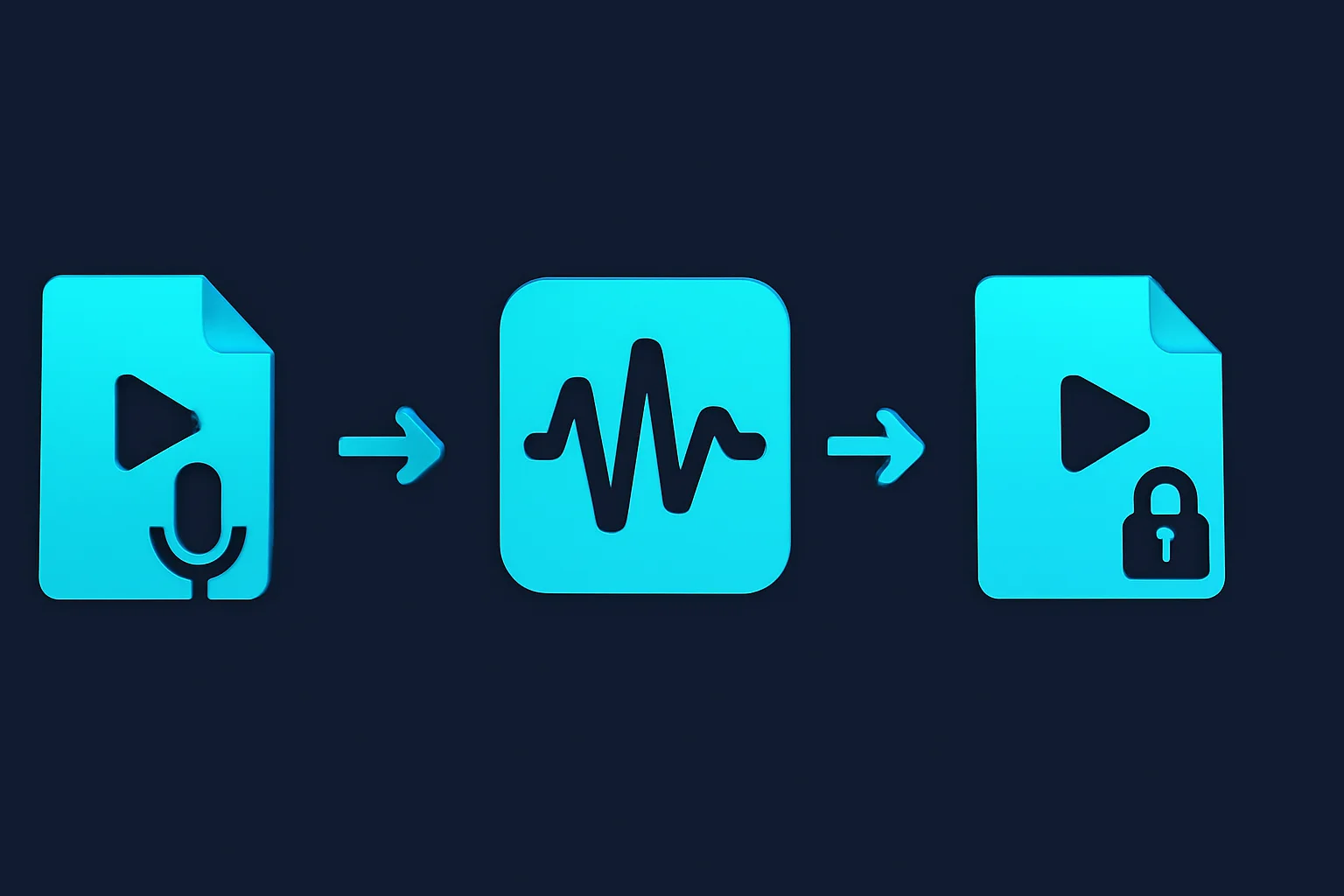
- Upload your video at bgblur.com — MP4, MOV, or M4V, up to 4K resolution.
- Select voice anonymization from the processing options, alongside any face or background blur you also need.
- Preview the distorted audio track to confirm speech is still intelligible for your audience.
- Export as MP4, MOV, or WebM, then publish your podcast clip, testimonial, or vlog knowing the raw voiceprint isn't going out with it.
This is meaningfully different from just adding background music or lowering audio quality, both of which are common but weak workarounds — cloning tools are trained on noisy, compressed audio and remain effective even against a muffled recording. Deliberate pitch and formant distortion targets the specific characteristics a cloning model needs, which is why it's the approach BGBlur's audio anonymization guide recommends over ad hoc muting.
Can Voice Anonymization Actually Stop AI Voice Cloning Scams?
It stops one specific channel of exposure — audio you choose to publish — and it does that reliably. It does not stop anyone from recording your voice on a phone call, at a live event, in a store, or from a video you posted years ago before anonymization was part of your workflow. It also can't retroactively scrub a voiceprint from content already scraped and cached elsewhere.
Being honest about that boundary matters, because overselling voice anonymization as a total scam shield would be exactly the kind of thin, marketing-driven safeguard the FTC complaint against Speechify criticizes in the opposite direction — a claim of protection that doesn't hold up under scrutiny. What voice anonymization reliably does is remove the easiest, most scalable source of clean audio samples: the stuff you're about to publish yourself, right now, before it ever reaches a scraper or a scam call center. Combined with family verification habits (see below) and general skepticism toward urgent financial requests, it closes off a meaningful piece of the exposure without pretending to close all of it.
How Can You Protect Elderly Parents from AI Voice Scams Right Now?
The single most effective, no-cost step is a family code word: agree in advance on a word or phrase that must be given before any request for money is treated as legitimate, and make it a household rule that a distress call is always followed by hanging up and calling the person back directly. Voice cloning defeats the "I recognize that voice" instinct, but it can't defeat a pre-agreed verification step the scammer doesn't know about.
Second, normalize skepticism toward urgency itself. Real emergencies almost never require gift cards, wire transfers, or cryptocurrency sent within minutes — that specific combination of urgency and unconventional payment is close to a scam signature on its own. Third, treat any voicemail or call claiming to be a relative in trouble as unverified until confirmed through a separate channel, even if the voice sounds exactly right — especially because it might.
Who Else Should Be Thinking About This Beyond Individual Scam Targets
Journalists and whistleblowers remain a core audience for voice protection, and BGBlur's existing guides on face anonymization and synthetic identity replacement cover that territory well. But the newer audience — creators, small businesses, and everyday video publishers — often has no existing privacy workflow at all, because until this year, "my voice gets cloned from a YouTube video" wasn't a mainstream concern.
That's also why disclosure regulation is starting to catch up on the adjacent synthetic-voice side: rules like the ones covered in BGBlur's guide to New York's AI disclosure law for synthetic performers exist precisely because AI-generated voices and likenesses are now common enough to need labeling requirements, not just fraud enforcement after the fact.
For enterprise use — a call center that needs to anonymize thousands of hours of customer service recordings, for instance — a dedicated compliance pipeline with audit logging may be a better fit than a browser tool built for individual creators; BGBlur's Business plan covers batch processing and API access for that scale, but very high-volume archival redaction is a case where cost-per-minute matters more than any single feature.
The Bottom Line
The 1,210% surge in AI voice cloning scams and the FTC complaint against Speechify both point to the same underlying shift: cloning a voice no longer requires special access, just three seconds of public audio and a cheap consumer tool. That changes who should be thinking about voice protection — not just whistleblowers and journalists, but anyone who podcasts, vlogs, records a testimonial, or hosts a webinar with their real voice on the track.
Voice anonymization won't stop someone from recording your voice at a coffee shop, but it will stop your own published content from being the easiest clone source available. Run your video's audio through BGBlur's voice anonymization before you publish, keep a family code word in place for urgent calls, and treat the "I recognize that voice" instinct with a little more suspicion than you used to.