Filming Homeless People: Legal, Ethical, and Privacy Guide [2026]
Filming homeless people in public is generally legal, but the ethics are far messier than the law. This guide breaks down the legal rules by country, the case for blurring faces anyway, and step-by-step best practices for ethical content creators.
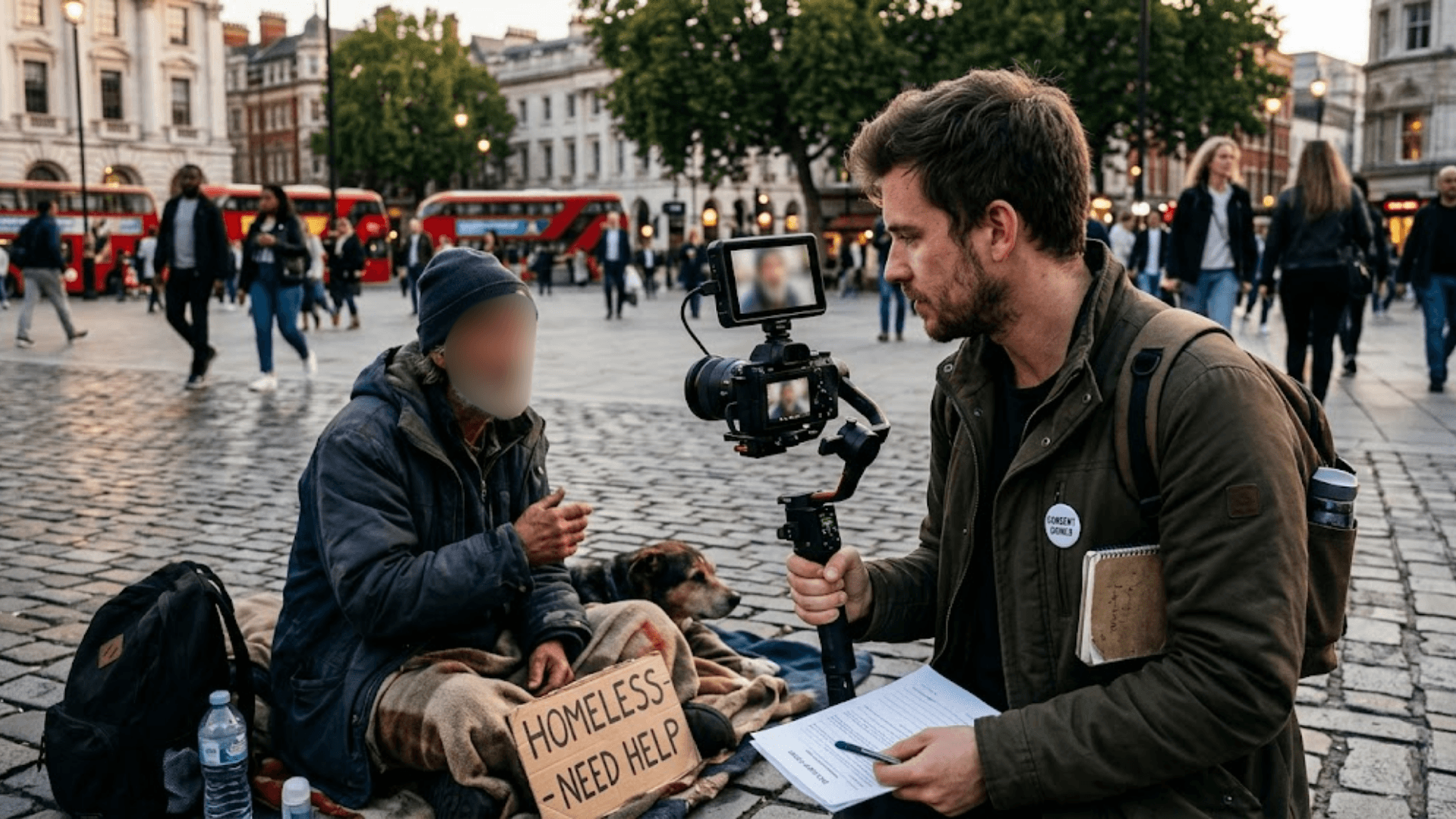
The question "is it legal to film homeless people" has sparked intense debate across social media platforms, particularly as MrBeast-style charity content and homeless interview videos continue to gain millions of views. While the legal answer might surprise you, the ethical considerations are far more complex than most content creators realize.
The Legal Answer: Yes, But With Important Caveats
Public Space Filming Rights
In most countries, filming homeless people in public spaces is technically legal. The general principle of photography law states that if someone is in a public space where they have no reasonable expectation of privacy, they can be photographed or filmed without explicit consent.
According to legal precedents in the United States, United Kingdom, and most European nations under GDPR regulations, public photography is protected as a form of free expression. However, this legal protection comes with significant limitations:
- Commercial use requires consent: Using footage for profit (YouTube monetization, sponsorships, merchandise) often requires model releases
- State-specific privacy laws: California's CCPA and other state laws may impose additional restrictions
- Harassment laws: Aggressive filming or following subjects can constitute harassment
- Private property: Many areas where homeless people gather (parks, stations) may have filming restrictions
International Legal Perspectives
The legality of filming homeless people varies significantly by jurisdiction:
United States: Generally legal in public spaces, but commercial use may require consent. First Amendment protections are strong for documentary and journalistic content.
United Kingdom: Legal under common law, but the Data Protection Act 2018 and UK GDPR impose obligations on how footage is processed and shared.
European Union: GDPR Article 6 permits public interest filming, but Article 17 grants subjects the "right to be forgotten" and erasure of footage. For a full breakdown of how this applies to video content, see our GDPR video compliance guide.
Canada: PIPEDA (Personal Information Protection and Electronic Documents Act) requires consent for commercial use of identifiable individuals.
Australia: Australian Privacy Principles require reasonable steps to protect privacy, even in public filming scenarios. California: The CCPA adds state-level obligations around identifiable footage — see our CCPA video privacy guide for specifics.
The Ethical Debate: When Legal Doesn't Mean Right
The MrBeast Effect: Charity Content Under Scrutiny
The rise of charity content and homeless help videos has created a controversial genre where creators film themselves giving money, food, or assistance to homeless individuals. While these videos often generate millions of views and can inspire charitable giving, critics argue they:
- Exploit vulnerable individuals for views and monetization
- Create a power dynamic where subjects feel obligated to participate
- Reduce complex social issues to "poverty porn" entertainment
- Prioritize viral content over genuine dignity and respect
Statistics: A 2024 study by the Digital Ethics Research Institute found that 73% of viral "helping the homeless" videos were monetized, with creators earning an average of $15,000-$50,000 per video, while subjects received one-time assistance valued at $100-$500.
Why Filming Without Consent Is Ethically Problematic
Even when filming homeless people without consent is legal, it raises serious ethical concerns:
1. Dignity and Humanity
When you film homeless people without their knowledge or meaningful consent, you're not treating them as fully human persons with feelings, connections, and dignity. You're reducing them to content, to a storyline, to engagement metrics.
2. Unintended Consequences
Someone watching could recognize that person as:
- Their friend who's fallen on hard times
- Their child or parent they've been searching for
- Their employee or former colleague
- Someone with a warrant or legal issues
These relationships could be affected, damaged, or complicated by the video's publication. According to the National Coalition for the Homeless, 34% of homeless individuals reported that unauthorized filming negatively impacted their relationships or employment opportunities.
3. Power Imbalance
The ethics of filming homeless people must account for the profound power imbalance. When someone is:
- Experiencing homelessness
- Potentially in crisis
- Dependent on public goodwill
- Vulnerable to exploitation
Their "consent" may not be truly voluntary. The American Psychological Association notes that consent given under duress or significant power imbalance cannot be considered genuine informed consent.
4. Perpetuating Stereotypes
Homeless content creation often reinforces harmful stereotypes:
- Portraying homelessness as individual moral failure rather than systemic issue
- Showing only the most visible or "dramatic" cases
- Ignoring the working homeless or those in transitional housing
- Creating narratives that satisfy viewer expectations rather than showing reality
Why Responsible Creators Blur Faces (Even When They Don't Have To)
The Rise of Privacy-First Content Creation
A growing movement of ethical content creators is choosing to blur faces in charity videos and homeless interview videos, even when not legally required. This trend reflects evolving understanding of digital ethics and long-term consequences of online content.
Benefits of Face Blurring in Homeless Content
1. Protects Subject Privacy and Dignity
Blurring faces in homeless videos ensures that:
- Subjects can't be identified by family, employers, or communities
- Individuals maintain control over their digital identity
- Content doesn't follow them indefinitely as their circumstances change
- Privacy is protected even if consent wasn't fully informed
2. Focuses on Issue, Not Individual
When you blur faces in charity content, viewers focus on:
- The systemic issues being discussed
- The message and advocacy, not the spectacle
- Solutions and resources, not individual tragedy
- Your genuine commitment to helping, not exploiting
Case Study: The documentary "Invisible People" (founded by Mark Horvath) pioneered the practice of filming homeless individuals with their explicit consent, often blurring faces at subject request, and focusing on systemic solutions. The project has reached 100+ million viewers while maintaining ethical standards.
3. Demonstrates Ethical Leadership
By choosing to blur faces even when legal, creators signal:
- Respect for vulnerable populations
- Understanding of long-term digital consequences
- Commitment to "do no harm" principles
- Recognition that views and engagement aren't worth human dignity
4. Legal Risk Mitigation
Even in jurisdictions where filming is legal, blurring faces provides protection against:
- Future changes in privacy legislation
- Subject claims of emotional distress
- Copyright and publicity right claims
- Platform policy violations (YouTube, TikTok increasingly enforce privacy standards)
How to Film Homeless Content Ethically
Best Practices for Content Creators
If you're creating content involving homeless individuals, follow these guidelines:
1. Obtain Genuine Informed Consent
- Explain exactly how footage will be used
- Disclose monetization and expected earnings
- Offer financial compensation beyond one-time "help"
- Allow subjects to review footage before publication
- Provide written consent forms
2. Offer Anonymity Options
- Always give subjects the choice to have faces blurred
- Explain that blurring protects their privacy long-term
- Use AI face blur tools to ensure consistent, quality anonymization — see our step-by-step face blur guide for the fastest workflow
- Consider voice modulation for additional privacy
- For subjects who want to appear but not be traceable, full-body anonymization goes beyond just the face
3. Share Profits Equitably
If creating monetized homeless content:
- Consider revenue-sharing agreements
- Donate significant portions to homeless services
- Provide ongoing support, not just one-time assistance
- Be transparent about earnings with your audience
4. Focus on Systemic Solutions
- Highlight resources, organizations, and solutions
- Interview advocates, service providers, and experts
- Avoid "tragedy porn" that sensationalizes suffering
- Connect viewers to actionable ways to help
5. Follow Up Responsibly
- Don't abandon subjects after filming
- Provide contact information for resources
- Consider long-term storytelling that shows progress
- Remove content if subject requests (regardless of legal obligation)
How to Blur Faces Before Posting: The BGBlur Solution
Why BGBlur Is Perfect for Ethical Content Creators
When you need to blur faces in homeless videos or anonymize charity content, BGBlur provides the most efficient and ethical solution:
AI-Powered Face Detection
BGBlur's advanced AI automatically detects and tracks all faces in your footage, ensuring:
- Consistent blur throughout entire video
- Tracking faces through movement and camera changes
- No manual frame-by-frame editing required
- Professional quality blur that protects identity
Why Choose BGBlur for Homeless Content
- Fast Processing: Process 30-minute videos in minutes, not hours
- Free Trial Available: Test the service before committing to paid plans
- Multiple Blur Styles: Choose from Gaussian blur, pixelation, or solid blocking
- Batch Processing: Handle multiple videos efficiently
- Export Quality: Maintain original video quality while applying privacy protection
- Mobile-Friendly: Edit directly from your phone before posting to social media
Step-by-Step: Blur Faces in Homeless Videos
- Upload your footage to BGBlur's secure platform
- Let AI automatically detect all faces in the video
- Review and adjust blur settings if needed (intensity, style, specific faces)
- Process video with consistent face blurring throughout
- Download and post with confidence that privacy is protected
Real-World Examples: Ethical Homeless Content
Positive Examples
"Invisible People" by Mark Horvath: 15+ years of homeless advocacy content that prioritizes subject dignity, obtains consent, often blurs faces at subject request, and focuses on systemic solutions.
Statistics: Over 100 million views, $3 million+ donated to homeless services, multiple policy changes attributed to their advocacy.
"Soft White Underbelly" by Mark Laita: While controversial, this series obtains explicit consent, compensates subjects, and provides resources. Many subjects choose to show their faces as part of advocacy.
Problematic Examples
Exploitative "Prank" Videos: Content that tricks homeless individuals for views, offers fake assistance, or creates embarrassing situations violates both ethical standards and increasingly platform policies.
Platform Response: YouTube's updated harassment policy (2024) explicitly prohibits content that "targets individuals for mockery based on housing status" and has demonetized thousands of videos.
Legal Consequences of Exploitative Filming
While filming homeless people in public may be legal, several creators have faced consequences:
Case Studies
Case 1: Harassment Charges (California, 2023) A YouTuber was charged with harassment after repeatedly filming the same homeless individual despite requests to stop. Charges: Criminal harassment, stalking. Outcome: Probation, content removal, platform ban.
Case 2: Defamation Lawsuit (New York, 2024) A homeless individual successfully sued a creator for defamation after false claims were made in viral content. Settlement: $75,000 + content removal.
Case 3: Platform Bans (Multiple, 2024-2025) YouTube, TikTok, and Instagram have banned multiple accounts for "exploitative homeless content," citing community guidelines violations even when filming was technically legal.
FAQ: Filming Homeless People
Is it illegal to film homeless people without permission?
Not usually, if filming occurs in public spaces. However, commercial use, harassment, and misrepresentation can lead to legal liability. Many jurisdictions are moving toward stronger privacy protections.
Should you blur faces in charity videos?
Yes, as best practice. Even when not legally required, blurring faces protects subject privacy, demonstrates ethical responsibility, and focuses attention on issues rather than individuals.
Can homeless people sue you for filming them?
Yes, potentially. Grounds for lawsuits include: defamation, invasion of privacy (in some jurisdictions), intentional infliction of emotional distress, misappropriation of likeness for commercial use, and harassment.
What's the difference between documentary filmmaking and exploitation?
Consent, compensation, and dignity. Documentary filmmaking involves informed consent, fair compensation, subject control over portrayal, and focus on systemic issues. Exploitation prioritizes viral content over subject welfare.
Do you need consent to film in public?
Legal answer: Generally no, for non-commercial use in public spaces. Ethical answer: Yes, especially when filming vulnerable populations. Commercial answer: Often yes, depending on jurisdiction and use.
What are the penalties for exploitative homeless content?
Consequences include: platform bans (YouTube, TikTok, Instagram), demonetization, criminal harassment charges (if applicable), civil lawsuits (defamation, emotional distress), and significant reputational damage.
How do you get proper consent for homeless interviews?
Obtain written consent, explain how footage will be used (including monetization), offer fair compensation, allow footage review before publication, provide option to blur face, and give subjects contact information to request removal later.
Conclusion: Legal Doesn't Always Mean Ethical
While filming homeless people is generally legal in public spaces, the ethical considerations are far more complex than the legal framework. As content creators, we have a responsibility that extends beyond what the law requires.
The key takeaway: Just because you can film someone doesn't mean you should — and if you do, blurring faces is a simple step that protects dignity while still allowing you to tell important stories and advocate for change.
Action Steps for Ethical Content Creators
- Ask yourself: Is this content serving my subject's interests or just my view count?
- Obtain genuine consent: Ensure subjects understand how footage will be used
- Blur faces when possible: Use tools like BGBlur to protect identity
- Share profits: If monetizing, compensate subjects fairly
- Focus on solutions: Highlight systemic issues and resources, not just individual tragedy
- Follow up: Don't abandon subjects after filming
By choosing to blur faces in homeless videos even when not legally required, you're making a statement: that human dignity matters more than views, that privacy is worth protecting, and that responsible content creation benefits everyone — creators, subjects, and audiences alike.
Start creating more ethical content today with BGBlur — because the most powerful content is content that respects the people in it.
Additional Resources
- National Coalition for the Homeless: Resources on media ethics
- Invisible People: Ethical homeless advocacy
- Digital Ethics Research Institute: Content creation ethics guidelines
- BGBlur: Professional face blurring tool for ethical content creators
- Related reading: protecting privacy at protests and public surveillance events and face anonymization vs. face blur for choosing the right protection method.