CCPA and video: when your footage becomes 'personal information'
One-click alternative with BGBlur
Upload a clip and preview automatic face, plate, background, or prompt-based blur—no keyframes or nested timelines.
The CCPA (as amended by the CPRA) defines personal information broadly: information that identifies or could reasonably be linked with a particular consumer or household. A face in your store's CCTV, a customer visible in your marketing b-roll, an employee in your training library — each is personal information when the person is identifiable. California businesses over the law's thresholds owe those people the statute's rights: to know, to delete, to limit use.
Video is the hardest data type to honor those rights in. A deletion request against a database is a query; against two years of surveillance archive it's a needle-in-haystack search followed by an editing problem. The practical strategy California businesses are converging on is scope reduction: anonymize people in footage wherever identification isn't needed, so most video stops being personal information at all.

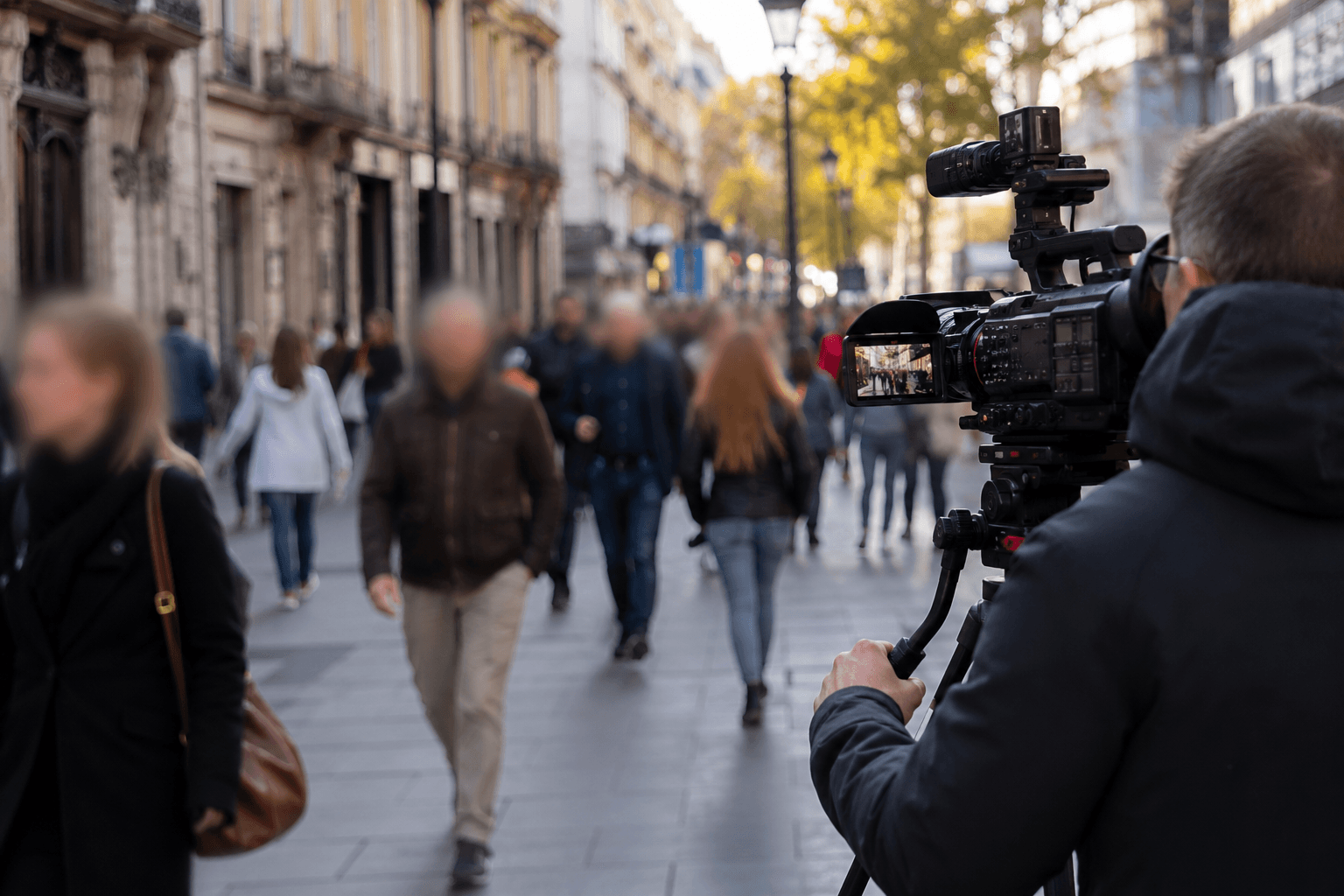
Which video is in scope
In-scope video is footage where consumers or employees are identifiable and the business meets CCPA thresholds (roughly: $25M+ revenue, or data on 100K+ consumers/households, or majority revenue from selling/sharing data). That typically covers retail CCTV, customer-facing marketing footage, recorded support calls with video, event recordings, and — since the CPRA folded employees in — workplace and training video.
Aggregate or de-identified information is expressly outside the definition. Footage where faces, plates, and other identifiers are blurred such that individuals can't reasonably be identified or re-linked stops carrying CCPA duties — which is what makes anonymization a compliance strategy rather than just a courtesy.
The rights that bite: access and deletion against video
A verified consumer request can ask what personal information you hold — including 'the footage of me' — and demand deletion of it. Exceptions exist (security, legal holds, completing a transaction), but a marketing clip or an event recording rarely qualifies. Fulfilling deletion against published video is the nightmare case: pull the asset, edit the person out or blur them, republish.
BGBlur turns that fulfillment into a processing pass: locate the requester's appearances, blur them (deletion of their personal information from the asset), and re-export — the video survives, the obligation is met. For unpublished archives, the same pass at retention-review time keeps old footage from accumulating as unaddressed personal information.
- Deletion request against a published video → blur the requester, republish.
- Retention policy for CCTV → anonymize or purge at the retention boundary.
- Marketing library → blur non-released individuals at ingest, not at request time.
Anonymize-at-ingest: the strategy that scales
Handling rights requests one by one is the expensive path. The scalable posture is to stop collecting identifiable video where you don't need it: blur customer faces in marketing b-roll before it enters the asset library; anonymize training and internal footage by default; apply face blur to CCTV exports that leave the security context (insurance claims, contractor disputes, social posts).
This mirrors the CPRA's data-minimization principle — collection and retention 'reasonably necessary and proportionate' to the purpose. Identifiable faces are rarely necessary to the purpose of a b-roll shot.
CCPA vs GDPR on video, in one paragraph
If you operate in both markets: GDPR requires a lawful basis before you process identifiable footage at all; CCPA lets you collect but attaches notice, access, deletion, and (for sale/sharing) opt-out duties afterwards. Anonymization satisfies both frameworks the same way — footage without identifiable people largely exits both regimes. A single anonymize-by-default pipeline is therefore cheaper than maintaining two regional postures. For GDPR-specific workflows, see our GDPR video compliance page.
Answering a CCPA deletion request against video
- Verify and scope. Confirm the requester's identity per your CCPA procedure; identify which assets they appear in.
- Check exceptions. Security holds, legal obligations, or pending transactions may exempt specific footage — counsel decides.
- Blur the requester. Upload the asset, mask the requester's appearances; other people and content are untouched.
- Replace the asset. Republish or re-archive the anonymized version; retire the identifiable original per policy.
- Document fulfillment. Log the request, action, and date — the CPRA's enforcement agency expects records.
Note: Cal. Civ. Code §1798.140 defines personal information to include information reasonably capable of being associated with a particular consumer or household, and expressly excludes de-identified information (§1798.140(m)). The CPRA's data-minimization standard (§1798.100(c)) supports anonymizing identifiable video not needed for the stated purpose. This page is educational, not legal advice.
Related guides
Frequently asked questions
- Is security camera footage really 'personal information' under CCPA?
- When individuals are identifiable in it, yes — the definition covers information capable of being associated with a particular consumer or household, and regulators and courts have treated identifiable imagery accordingly. Security-purpose exceptions affect deletion duties, not the classification itself.
- Does blurring faces take footage out of CCPA scope?
- De-identified information is excluded from the personal-information definition when individuals can't reasonably be identified or re-linked. Blurring faces, plates, and other identifiers — done properly and consistently — is the standard route to de-identification for video. Edge cases (unique clothing, gait, context) deserve judgment.
- Do employees have these rights too?
- Yes — since January 2023 the CPRA extends CCPA rights to employees and job applicants, which pulls workplace, training, and internal-event video into scope for covered businesses.
- Someone asked us to delete footage of them from a marketing video. Do we have to?
- If no exception applies, a verified request generally requires it. Blurring the requester in the asset — rather than deleting the whole video — fulfills the deletion of their personal information while preserving the asset. Confirm specifics with counsel.
- We're under the CCPA thresholds. Should we care?
- The thresholds decide legal duty, not risk. Sub-threshold businesses still face platform complaints and reputational fallout from identifiable-footage disputes — and thresholds have trended downward. Anonymize-by-default is cheap insurance either way.
BGBlur provides privacy tooling for creators and teams; consult counsel for broadcast, evidentiary, or regulated workflows.