Secretly Recorded in Japan: Your Rights and What to Do [2026]
Japan passed a landmark Photography Crime Law in 2023 that finally gives victims of secret filming a unified national remedy alongside the APPI and prefectural nuisance ordinances. This guide covers the exact steps to preserve evidence, file a police report, and get footage removed.
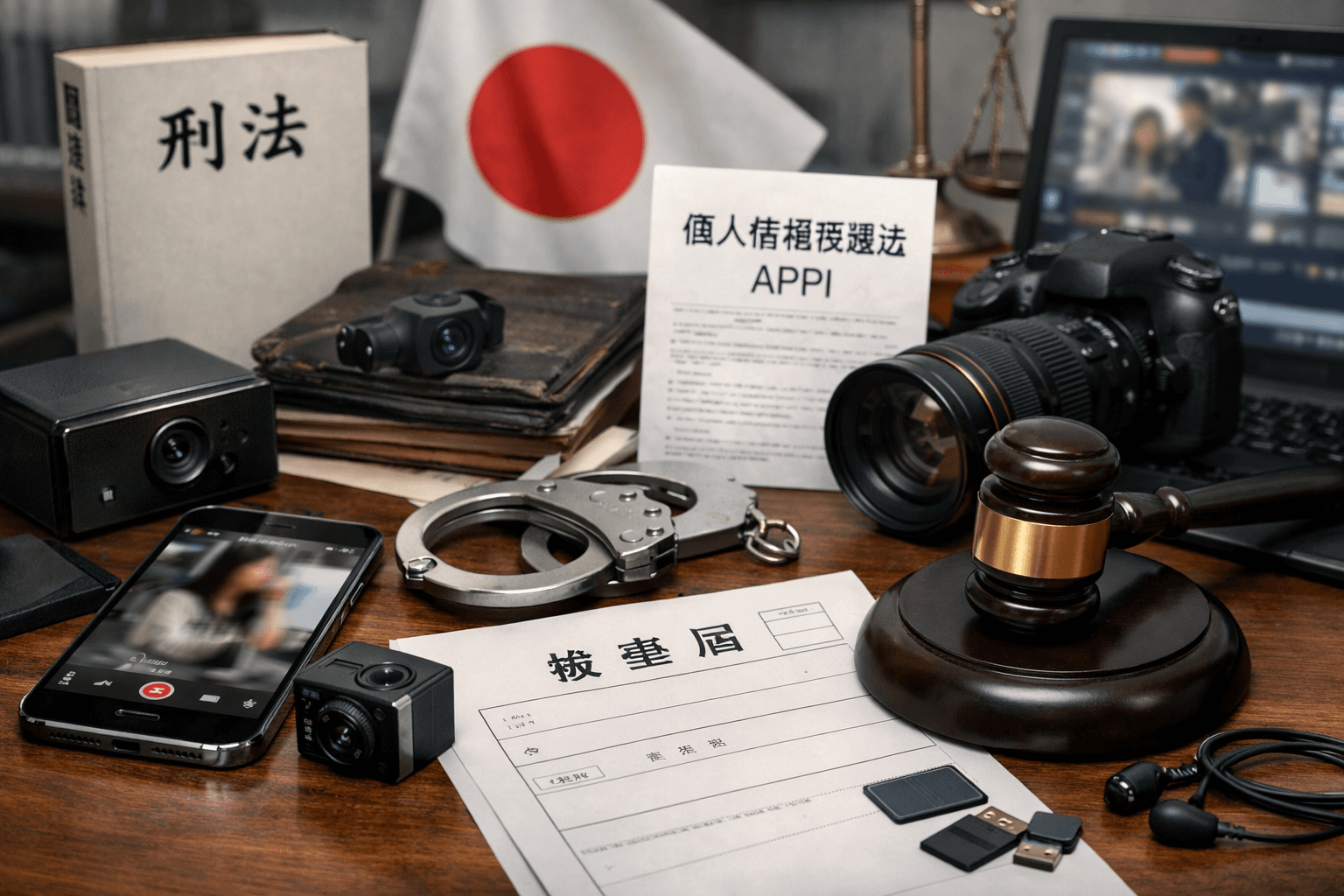
Being recorded without your knowledge is violating, frightening, and increasingly common. If you've been secretly filmed in Japan — through a hidden camera, a stranger's phone, or a surveillance device placed without your knowledge — you now have stronger legal protection than ever before. Japan passed a landmark secret filming law in 2023 that transformed how the country handles non-consensual recording, giving victims real, enforceable rights for the first time at a national level.
This guide walks you through exactly what laws apply, what your rights are, and the precise steps to take if you've been recorded without consent in Japan.
| Question | Answer |
|---|---|
| Is secret recording illegal in Japan? | Yes — under the 2023 Photography Crime Law, the APPI, and prefectural nuisance ordinances |
| Who enforces it? | The National Police Agency and the Personal Information Protection Commission (PPC) |
| Maximum penalty for filming? | Up to 3 years in prison or a ¥3,000,000 fine |
| Maximum penalty for sharing footage? | Up to 5 years in prison or a ¥5,000,000 fine |
| Can I report online without visiting a police station? | Yes — via www.npa.go.jp/cyber or your prefecture's Cyber Crime Consultation Window |
| Is free legal help available? | Yes — Hōterasu (法テラス) in all 47 prefectures |
Outline
- Is Secret Recording Illegal in Japan?
- Japan's Photography Crime Law 2023 — The Game-Changer
- Other Laws That Protect You
- Your Immediate Rights Under Japanese Privacy Law
- Step-by-Step: What to Do If You Were Secretly Recorded
- How to Protect Your Privacy Before It Happens — bgblur
- FAQs
Is Secret Recording Illegal in Japan?
The short answer is yes — recording someone without consent in Japan is illegal, and the penalties are now severe enough to act as a genuine deterrent. Before 2023, victims had to navigate a patchwork of inconsistent prefectural ordinances that varied wildly depending on which part of Japan the incident occurred in. That created a frustrating and often unjust situation where the same act could be handled very differently depending on location.
The 2023 national law ended that inconsistency. Today, whether someone used a hidden camera in Japan, filmed you without permission on a smartphone, or shared footage of you online without your approval, a unified national framework applies — and it applies with real teeth.
Japan's Photography Crime Law 2023 — The Foundation of Your Protection
Japan's Photography Crime Law (撮影罪), enforced from July 13, 2023, is the country's first nationwide voyeurism and non-consensual recording law. This is the most important piece of legislation protecting victims of secret filming in Japan, and understanding it puts you in a much stronger position when dealing with police, platforms, or lawyers.
The law covers non-consensual filming in private spaces, hidden camera recording of a sexual or invasive nature, and any footage captured without the subject's knowledge or agreement. Crucially, it also covers the act of sharing or live-streaming such footage — recognising that distribution is often as harmful as the original recording.
Penalties under the Photography Crime Law:
- Filming without consent: Up to 3 years in prison or a ¥3,000,000 fine
- Sharing or live-streaming the footage: Up to 5 years in prison or a ¥5,000,000 fine
- Police are empowered to confiscate and permanently delete all copies — not just the original file
This last point matters enormously. Victims no longer have to worry that a perpetrator will simply restore a backup or re-upload footage after deletion. The law gives authorities the power to pursue and eliminate all copies at the source.
Other Laws That Protect You Against Non-Consensual Recording
Japan's legal system doesn't rely on a single statute to protect victims of secret filming. Several overlapping laws work together to give you multiple avenues of recourse simultaneously.
APPI — Japan's Privacy Law
The Act on the Protection of Personal Information (APPI) is Japan's equivalent of the GDPR. Under the APPI, video recordings, photographs, and audio recordings of you are classified as personal data. Any organisation or individual that collects, stores, or shares that data without your consent is in direct violation of this law.
Corporate violators face fines up to ¥100,000,000, and you can demand the complete erasure of any recording of you — without going to court first. This is a powerful right that many victims don't know they have.
Prefectural Nuisance Prevention Ordinances (迷惑防止条例)
Every prefecture in Japan maintains its own local laws covering voyeurism, upskirting, and unwanted filming. These ordinances continue to apply alongside the national Photography Crime Law, which means perpetrators can face charges under both simultaneously. For non-sexual surveillance cases, these local laws often remain the most relevant instrument.
Penal Code — Defamation (Articles 230–231)
If footage was shared specifically to damage your reputation — at your workplace, within your social circle, or in your personal relationships — a defamation claim under the Penal Code can run parallel to criminal charges under the Photography Crime Law. This lets you pursue both criminal punishment and financial compensation through civil action at the same time.
Your Immediate Rights Under Japanese Privacy Law
One of the most important things victims of non-consensual recording need to understand is that you don't have to wait for a court case to enforce your rights. Under the APPI, you have several immediate, enforceable rights that can be exercised directly against the person or organisation holding recordings of you.
Right to Erasure: You can legally demand that any recording of you be permanently deleted. This applies to individuals, companies, and platforms operating in Japan.
Right to Disclosure: You can demand to know exactly what recordings exist and who currently holds them — a crucial first step in understanding the scope of a violation.
Right to Stop Transfer: You can legally block anyone from further sharing your data. If footage has already been distributed, this right applies to each entity currently in possession of it.
Right to File a Complaint with the Personal Information Protection Commission (PPC): Filing a complaint with Japan's PPC can trigger an official investigation and result in heavy fines against the violator — and no court appearance is required on your part.
Step-by-Step: What to Do If You Were Secretly Recorded in Japan
Knowing your rights is the starting point. Acting on them quickly and correctly is what turns those rights into results. Here's exactly what to do.
Step 1: Save All Evidence First
Before you do anything else, screenshot every URL, post, message, or reference to the footage. Document timestamps, usernames, and platform locations. Do not delete anything, even if seeing the content is distressing — evidence preservation is the single most important factor in both criminal and civil outcomes in Japanese courts.
Step 2: Report the Content to the Platform
File a privacy violation report on YouTube, Instagram, TikTok, LINE, Twitter/X, or whichever platform hosts the footage. Use the "Privacy Violation" or "Non-consensual image" categories where available. Most major platforms remove qualifying content within 24 to 72 hours of a verified report. For content appearing in Google search results, submit a separate removal request through Google's dedicated removal portal.
Step 3: File a Police Report (被害届)
Go to your nearest police station and file a Higai Todoke (被害届). When you do, explicitly name both the 2023 Photography Crime Law (撮影罪) and the APPI by name — this signals to the receiving officer that a national law applies and ensures the report is handled with appropriate seriousness. Under the new law, police have the power to order platforms to delete footage and to confiscate all copies. Always request a copy of your filed report before leaving the station.
Step 4: Use Japan's Cybercrime Helpline
If you cannot visit a police station in person, Japan's National Police Agency cybercrime desk is accessible at www.npa.go.jp/cyber. Each prefecture also operates a dedicated Cyber Crime Consultation Window (サイバー犯罪相談窓口) reachable by phone or online. These channels are specifically designed for situations involving non-consensual recording and digital privacy violations.
Step 5: Get Free Legal Help via Hōterasu
Japan's government-funded Legal Support Center — Hōterasu (法テラス) — provides free legal consultations across all 47 prefectures. A qualified bengoshi (lawyer) can send a formal legal notice demanding both deletion and compensation, and can advise you on whether to pursue civil action alongside criminal charges. Hōterasu is the fastest, most accessible route to professional legal support at zero upfront cost.
Step 6: File a Privacy Complaint with the Personal Information Protection Commission
At www.ppc.go.jp, you can file a formal APPI complaint entirely separately from any police case you've already opened. A successful PPC complaint can result in significant fines against the perpetrator and an official order to delete all copies of the footage. No court appearance is required.
Protect Your Privacy Before It Happens — bgblur
Dealing with a secret filming incident after it has already occurred is stressful, time-consuming, and deeply distressing. The most powerful thing you can do is protect your privacy before a problem ever starts — and that's precisely where bgblur comes in.
bgblur is an AI-powered video background blur tool built for creators, professionals, and everyday users who want complete control over what is visible in their content. It uses advanced artificial intelligence to automatically detect and blur faces, backgrounds, license plates, and any identifying detail in your videos — in seconds, with no technical skill required.
When you share videos on social media, in group chats, or on any public platform, your background reveals far more than you might realise. Your home address, your neighbourhood, your family members, your daily routine — all of it can be identified from a single unguarded video clip. bgblur removes that risk entirely. Before posting any personal video online, run it through bgblur. The AI detects every identifying element in the background — street signs, house numbers, faces of bystanders, location landmarks — and blurs them automatically.
bgblur also serves a critical legal purpose for victims already dealing with a non-consensual recording situation. You can create a fully anonymised version of any footage — with your face and identifying details blurred — to share safely with police, lawyers, and platforms, without further exposing your identity in public records or court documents. Always keep the original unedited file as your primary legal evidence and use the bgblur version only for sharing purposes.
Key features include automatic AI face blur, full video background blur, bulk processing for multiple videos simultaneously, cloud-based processing with no software installation required, and results ready in minutes. bgblur is trusted by vloggers protecting their home location, journalists anonymising sources and witnesses, government agencies handling sensitive footage, businesses managing customer data, and everyday users who simply want to share personal moments without exposing private details.
Try bgblur today at bgblur.com — upload your first video free and see exactly what AI-powered privacy protection looks like in practice.
For more on protecting your digital presence, read our guide on how to blur faces in a photo or video in 3 seconds, our comparison of face anonymization tools versus face blur, and our full-body anonymization guide if you need to protect more than just faces in shared footage.
Conclusion
If you've been the victim of secret filming in Japan, hidden camera recording, or non-consensual image sharing, Japanese law now gives you real and immediate protection. The 2023 Photography Crime Law, the APPI, and the Penal Code all work in your favour — and you have the right to demand erasure, file criminal reports, and pursue financial compensation simultaneously.
Act fast: save your evidence, report to the platform, file a police report naming the Photography Crime Law explicitly, and contact Hōterasu for free legal support. Recording someone without consent in Japan is no longer a grey area — the law is clear, the penalties are serious, and the process for victims to take action has never been more straightforward.
And to make sure this never happens to you again — protect every video you share with bgblur. Blur your background, hide your location, protect your identity, and take back full control of your digital privacy before a problem ever starts.
Frequently Asked Questions
Is upskirting illegal in Japan?
Yes. Upskirting is directly criminalised under the 2023 Photography Crime Law and carries up to 3 years in prison or a ¥3,000,000 fine. It is also covered under prefectural nuisance prevention ordinances, meaning perpetrators can face charges under both simultaneously.
What is the penalty for sharing someone's private video without consent in Japan?
Sharing or live-streaming non-consensual footage carries up to 5 years in prison or a ¥5,000,000 fine under the Photography Crime Law, with additional charges possible under the APPI and Penal Code defamation provisions depending on how the footage was distributed.
Can I report secret filming in Japan online without visiting a police station?
Yes. Use Japan's National Police Agency cybercrime consultation desk at www.npa.go.jp/cyber, or contact your prefecture's dedicated Cyber Crime Consultation Window (サイバー犯罪相談窓口) via phone or online form.
Is there free legal help for victims of non-consensual recording in Japan?
Yes. Hōterasu (法テラス), Japan's government-funded Legal Support Center, provides free legal consultations in all 47 prefectures and can connect you with a specialist lawyer who handles privacy and digital rights cases.
How do I get a video of me removed from the internet in Japan?
Report directly to the hosting platform, submit a Google removal request for search results, file a police report under the Photography Crime Law, and file a separate APPI complaint with the Personal Information Protection Commission at www.ppc.go.jp.
How does bgblur protect my privacy before filming incidents happen?
bgblur uses AI to automatically detect and blur faces, backgrounds, license plates, and identifying details in your videos before you share them online. It requires no technical skill, processes files in the cloud, and produces results in minutes — ensuring your home, location, and personal details remain completely private. Try it free at bgblur.com.