Recorded Without Consent in India: Rights and Steps 2026
A step-by-step guide for anyone recorded without consent in India, covering exactly which laws apply, how to exercise your DPDP Act 2023 rights, and the practical actions to take within the first 24-48 hours to get content removed and pursue legal recourse.
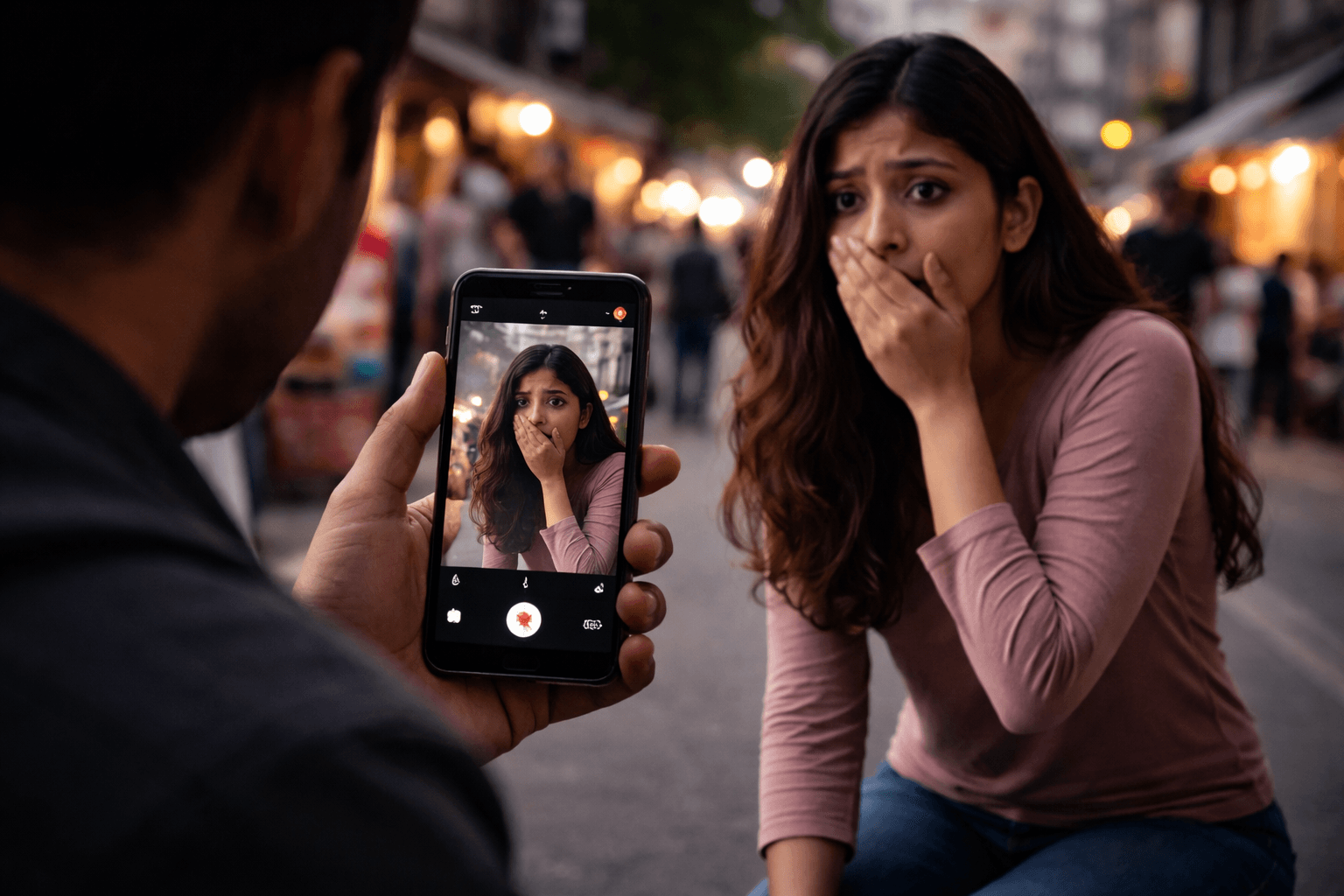
Finding out that someone has recorded you without consent in India is one of the most violating experiences a person can go through. Whether it happened in a private space, a workplace, or even online, the emotional distress is immediate and most people have no idea what to do next. What are your legal rights? Which laws protect you? And how do you actually get the content removed?
This guide covers everything you need to know the exact laws that apply, your rights under India's newest privacy legislation, a step-by-step action plan, and practical tools to protect yourself right now.
Is Being Recorded Without Consent in India Actually Illegal?
The short answer is: usually yes but context determines the severity. If someone filmed you in a public space without your knowledge, the act of recording itself may sit in a legal grey area. However, the moment that footage is used for harassment, blackmail, defamation, or circulation without your approval, it becomes a criminal matter instantly no grey area whatsoever.
The situation becomes far more serious when recording happens in a private space. If you were recorded without consent in India inside your home, a hotel room, a changing room, a bathroom, or any space where you had a reasonable expectation of privacy that is a serious criminal offence. The law treats this with zero tolerance, and multiple statutes apply simultaneously.
Workplace and school recordings used to intimidate, humiliate, or damage reputation also fall under multiple overlapping legal protections. Understanding which law applies to your specific situation is the first step toward taking effective action.
The Laws That Protect You If You Were Recorded Without Permission
India actually has robust legislation covering non-consensual recording. Most victims are unaware of how many laws apply to their situation at once.
DPDP Act 2023 — India's Most Powerful Privacy Law
The Digital Personal Data Protection Act, 2023 is India's newest and most comprehensive privacy legislation. Under this law, your video, audio, and photographs are classified as personal data. No one can collect, process, or share this data without your explicit consent. Penalties under this act go up to ₹250 crore making it one of the most financially punishing privacy laws in the country. More importantly, this law gives you the legal right to demand that any recording of you be permanently deleted. For a full walkthrough of how the DPDP Act applies to video and image content specifically, see our DPDP Act video privacy compliance guide.
IT Act Section 66E — Intentional Capture of Private Images
This section directly addresses the intentional capture or publication of someone's private image or video without their consent. If you were secretly filmed in a private moment, this is the primary statute that applies. Conviction carries up to 3 years in prison and a fine. This is one of the most frequently cited laws in non-consensual recording cases across India.
IPC Section 354C — Voyeurism Law for Women
Specifically designed to protect women, IPC Section 354C makes it illegal to record a woman engaged in a private act without her consent. On the first conviction, the punishment is up to 3 years in prison. On a second conviction, it rises to 7 years. If you are a woman who has been recorded without consent in India, explicitly mention this section when filing your complaint.
IT Act Section 67A — Revenge Porn and Explicit Content
If sexually explicit content featuring you was shared online even once without your consent, IT Act Section 67A applies directly. Commonly referred to as the revenge porn law in India, it carries a penalty of 5 to 7 years in prison and fines of up to ₹10 lakh. This law applies regardless of whether you are male or female.
IPC Sections 499 and 500 — Defamation
If the recording was shared specifically to damage your reputation whether professionally or personally a defamation case can run simultaneously alongside all of the above criminal charges. These sections allow you to pursue both criminal and civil remedies at the same time.
Your Digital Rights Under the DPDP Act 2023
Most people who have been recorded without consent don't realize they hold powerful digital rights under India's DPDP Act 2023. These rights exist independently of any criminal case and can be exercised immediately.
Your Right to Access means you can formally demand to know exactly what data someone holds about you including video files, screenshots, or audio recordings. Your Right to Correction allows you to request that any inaccurate or misleading data associated with you be corrected. Most critically, your Right to Erasure gives you the legal power to demand that any recording of you be permanently and irreversibly deleted from all systems and platforms.
Beyond erasure, your Right to Grievance Redressal allows you to file a formal complaint with the Data Protection Board of India a dedicated regulatory body specifically created to handle violations under this act. And your Right to Nominate means you can appoint a trusted person to exercise these rights on your behalf if you are unable to do so personally.
These rights under the DPDP Act 2023 are enforceable even before going to court, making them an important first step in asserting control over your situation. If you want to see how India's framework compares to other jurisdictions handling the same problem, our global privacy laws and video redaction guide covers DPDP alongside POPIA and other regional laws, and our GDPR video compliance guide is a useful reference if the footage or platform involved has any EU connection.
What to Do Right Now A Step-by-Step Action Plan
If you've been recorded without consent in India, your actions in the first 24–48 hours are critical. Here is exactly what to do.
Step 1: Secure All Evidence Immediately
Before doing anything else, save every screenshot, URL, link, and platform reference you can find. Do not delete anything even content that feels embarrassing or distressing. Evidence is the foundation of every legal claim, and courts require documentation. Store copies in multiple secure locations.
Step 2: Report to the Platform
Every major platform YouTube, Instagram, WhatsApp, Telegram, and Facebook has built-in content removal mechanisms. Navigate to the specific content, select Report > Privacy Violation or Non-consensual intimate image, and submit the report. Most platforms act within 24 to 72 hours for privacy-related violations. If the content appears in Google search results, you can also submit a formal takedown request directly to Google's removal portal.
Step 3: File a Police Complaint
Visit your nearest police station and file a First Information Report (FIR). When filing, explicitly mention IT Act Section 66E, IPC Section 354C (if applicable), and the DPDP Act 2023 by name. Police are far more responsive when a complainant demonstrates knowledge of the specific laws involved. You are legally entitled to a copy of the FIR always ask for it and keep it safe.
Step 4: Use the Cybercrime Portal
India's national cybercrime portal at cybercrime.gov.in allows you to file a complaint online without visiting a police station in person. This is especially useful if you face intimidation or if the perpetrator is someone you know locally. The portal has a dedicated priority reporting track for cases involving intimate content use it.
Step 5: Send a Legal Notice
A lawyer can send a formal legal notice to the perpetrator demanding immediate content removal, a public apology, and financial compensation. Even before any court proceedings begin, this notice creates a formal legal paper trail and often results in faster voluntary compliance from individuals who fear escalation.
Step 6: Approach the Data Protection Board of India
Under the DPDP Act 2023, you can file a separate and parallel complaint with the Data Protection Board of India. This complaint focuses specifically on the video privacy rights violation the collection and sharing of your personal data without consent and can result in substantial financial penalties against the perpetrator.
How to Protect Your Identity With AI Video Blur Tools
Whether you need to handle a video that already exists or want to protect yourself going forward, AI-powered tools like bgblur offer one of the most practical solutions available today.
Bgblur uses artificial intelligence to automatically detect and blur video backgrounds, faces, and identifying details in both videos and images. No technical expertise is required you simply upload your file, select what to blur, and the AI handles the rest. The use cases for someone dealing with non-consensual recording are highly specific and genuinely valuable.
If a video of you is already circulating, you can use a blur background tool to create an anonymized version where your face and any identifying details are fully obscured. This version can then be submitted as evidence to the police or cybercrime cell giving authorities the context they need without further exposing your identity in public records or court documents.
When sharing footage with your lawyer or for court submission, the blur background in video feature lets you redact irrelevant or private portions, so only legally relevant content is visible to the people who need it. This protects your privacy while fully cooperating with the legal process.
As a precautionary measure going forward, running any personal video through a video background blur tool before posting or sharing anywhere significantly reduces the risk of location identification, background detail exposure, or the accidental inclusion of family members. Even if content ends up in the wrong hands, it cannot be traced back to your private life or home address.
The process is straightforward: upload the video, choose face blur or background blur, let the AI process it, preview the result, and export. Always preserve the original unedited version as your primary legal evidence the blurred version is for sharing purposes only. If you're dealing with a situation outside India, our guide on being secretly recorded in Spain and your GDPR rights walks through a comparable process under EU law.
For more on how AI tools can protect your digital identity, see how AI tools improve brand visibility without paid ads and the broader applications of automating content safely across social platforms.
What Counts as a Private Space Under Indian Law?
One of the most common points of confusion is understanding where "private space" begins. Indian courts have consistently held that a private space is any location where a person has a reasonable expectation of privacy this includes your home, a hotel room, a hospital room, a changing room, a bathroom, a private vehicle, or even a closed office during a confidential meeting.
The key phrase is reasonable expectation of privacy. Even if you were technically in a semi-public place, if the circumstances were such that you would not reasonably expect to be filmed a private conversation in a quiet restaurant corner, for example the recording may still qualify as a privacy violation under the DPDP Act 2023 and IT Act Section 66E.
When Does Workplace or School Recording Become a Criminal Matter?
Recorded without consent in India in a professional or educational context is more common than most people acknowledge. Hidden cameras in offices, unauthorized screen recordings of private calls, and video surveillance used beyond its stated purpose all fall into this category.
When workplace recordings are used to intimidate employees, influence their behaviour through fear, or leak confidential personal moments, the IT Act and the DPDP Act apply in full force. Employees have a right to know what is being recorded and for what stated purpose. Recording beyond that stated purpose or sharing that footage with unauthorized parties triggers criminal liability for employers and individuals alike.
In schools and colleges, recording students or staff without consent for any purpose other than documented and disclosed security monitoring is a serious violation. If such footage is used to humiliate, harass, or defame a student, the consequences under voyeurism law and IT Act provisions are identical to those in private settings.
Conclusion
Being recorded without consent in India is a violation of your fundamental right to privacy and Indian law recognizes this with increasing seriousness. From the DPDP Act 2023 to IT Act Section 66E and IPC Section 354C, multiple powerful laws exist specifically to protect you. Your video privacy rights are enforceable, your data erasure demand is legally backed, and your path to justice through the police, cybercrime portal, or Data Protection Board is clearly defined.
The most important thing you can do is act quickly: secure evidence, report to platforms, file an FIR, and consult a lawyer. Use tools like AI-powered video blur to protect your identity during the process without compromising your legal case. You have more protection than you think and now you know exactly how to use it.
Update — September 14, 2026: A new category of non-consensual recording is emerging at scale: gig workers wearing head-mounted cameras to sell footage to AI and robotics labs, often capturing customers and bystanders who never consented at all. See our guide on whether recording customers for AI training is legal in India for how the DPDP Act applies to this specific situation.
For related reading on managing your digital presence and protecting your online identity, explore how social media management strategies work in 2025 and understand the growing role of digital creators in the modern content landscape.
FAQ's
What should I do if I've been recorded without consent in India and the video is already online?
Act immediately. Take screenshots of the content and its URL, report it to the platform under the privacy violation category, visit cybercrime.gov.in to file an online complaint, and consult a lawyer for a legal notice. The sooner you act, the easier it is to prevent further distribution.
How long does it take to get content removed after reporting to a platform?
Most major platforms remove privacy-violating content within 24 to 72 hours of a valid report. Google search result removal may take longer typically 3 to 7 business days after a valid takedown request.
Can I file a case under the DPDP Act 2023 even if the recording is not sexually explicit?
Yes. The DPDP Act 2023 applies to any personal data including non-explicit videos and audio recordings collected or shared without your consent. You do not need to prove sexual intent to exercise your data erasure and grievance rights under this act.
What are my video privacy rights if someone recorded me in a public place?
Recording in a public space is generally permitted, but using that footage to harass, defame, or distribute without consent crosses into criminal territory. Your rights under the DPDP Act and IT Act still apply to how the footage is used and shared, even if the original recording location was public.
Is there a way to protect my identity when submitting video evidence to the police?
Yes. Using an AI blur background tool like bgblur, you can create an anonymized version of the video that obscures your face and identifying details before submission. Always retain the unedited original as your primary evidence only share the blurred version for administrative or public purposes.