Secretly Recorded in Korea? Your Legal Rights & What to Do Now
Is Secret Recording Illegal in Korea?
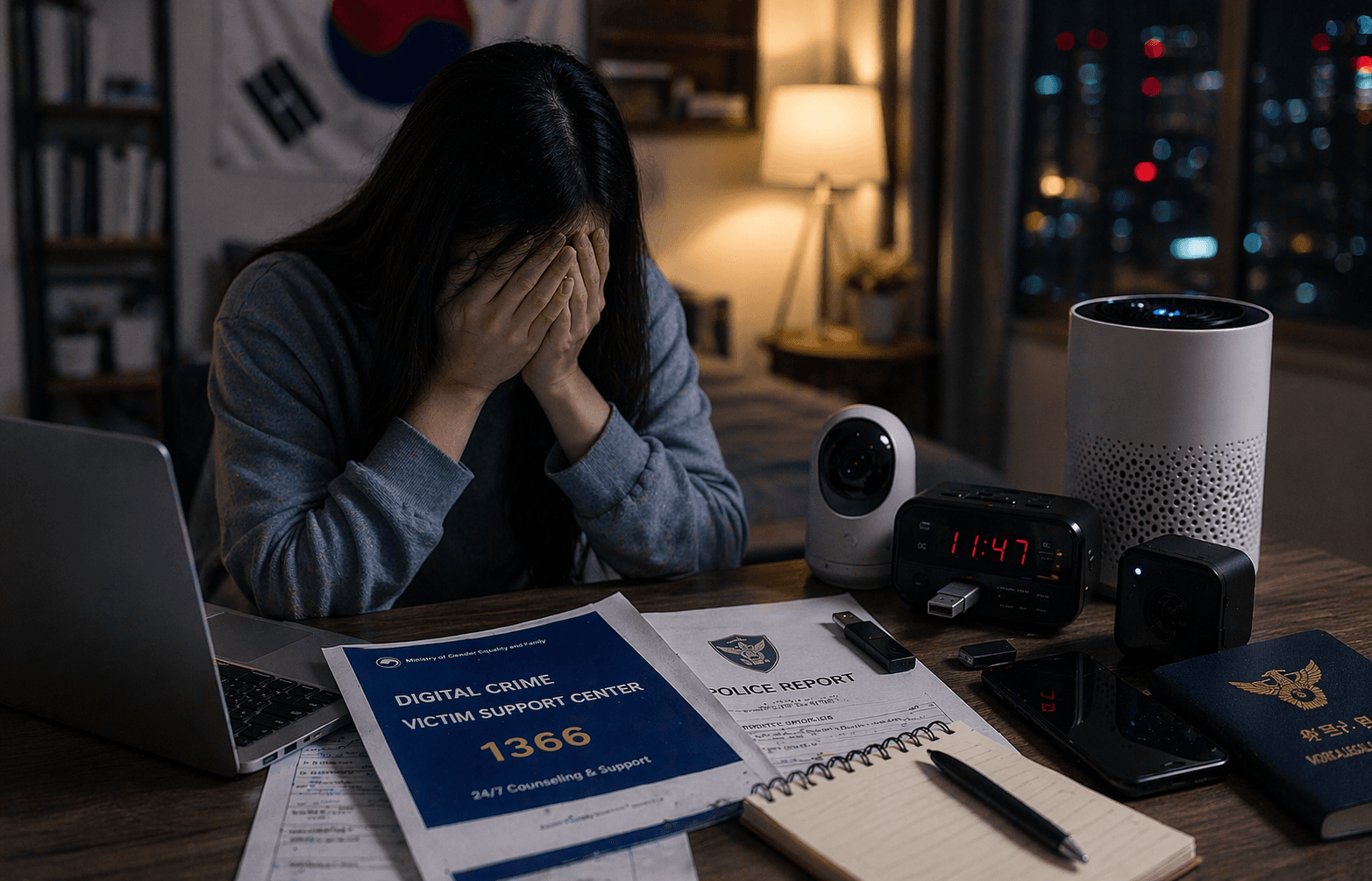
Being recorded without your knowledge is violating and increasingly common in South Korea. Hidden cameras — locally called molka (몰카) — have been found disguised inside alarm clocks, air purifiers, USB sticks, and bathroom fixtures. If this has happened to you, Korean law gives you real, immediate protection backed by some of the toughest digital privacy penalties in Asia.
Is Secret Recording Illegal in Korea?
Yes — and the penalties are severe. South Korea criminalises the filming, distribution, and even possession of non-consensual recordings under a layered framework of national laws. Whether someone used a hidden device, filmed you on a smartphone, or shared footage of you online without approval, multiple laws apply simultaneously — and all work in your favour.
Korea's Key Laws — What Protects You
Act on Special Cases Concerning the Punishment of Sexual Crimes — Article 14
This is the cornerstone law for hidden camera offences in Korea. Article 14 directly criminalises filming, distributing, or possessing recordings of another person's body without consent where the recording causes sexual humiliation or shame.
Penalties:
- Filming without consent: Up to 7 years in prison or a ₩50,000,000 fine
- Distributing or sharing non-consensual footage: Up to 7 years in prison or a ₩50,000,000 fine
- Distributing for profit: Up to 7 years — mandatory imprisonment, no fine alternative
A critical ruling from the Korean Supreme Court: even if the recording was never saved, pressing record is a crime. Temporary storage in a device's RAM at the moment of filming is legally sufficient to constitute the offence.
2024 Deepfake Amendment
In September 2024, South Korea passed landmark legislation targeting AI-generated non-consensual intimate content — the first law in the world to criminalise not just creation and distribution of deepfakes, but their consumption.
Penalties:
- Creating or distributing sexually explicit deepfakes: Up to 7 years in prison
- Possessing or watching deepfake sexual content: Up to 3 years in prison or a ₩30,000,000 fine
Personal Information Protection Act (PIPA / 개인정보 보호법)
Korea's PIPA is one of the world's strictest privacy laws, comparable to the EU's GDPR. Any video or photograph of you is classified as personal data. Anyone who collects, stores, or shares it without your consent is in direct violation.
Under PIPA, you can demand the permanent erasure of any recording without going to court first. Corporate violators face fines up to ₩100,000,000, and the Personal Information Protection Commission (PIPC) can investigate and impose penalties on your behalf at no cost to you.
Protection of Communications Secrets Act (통신비밀보호법)
This law prohibits the recording of private conversations without authorisation. Violations carry 1 to 10 years imprisonment. Recordings obtained in violation of this Act are inadmissible as criminal evidence — a perpetrator cannot weaponise secretly obtained audio against you in court.
Penal Code — Defamation
If footage was shared to damage your reputation at work, in your social circle, or publicly, a defamation claim under the Penal Code can run parallel to criminal charges. Defamation via false information carries up to 5 years in prison or a ₩10,000,000 fine. Civil compensation can be pursued simultaneously.
Your Immediate Rights
You do not have to wait for a court case. Korean law gives you enforceable rights you can act on right now:
- Right to Erasure — demand permanent deletion of any recording from individuals, companies, or platforms
- Right to Disclosure — demand to know what recordings exist and who holds them
- Right to Stop Transfer — legally block further sharing of footage
- Right to Free Government Deletion Help — the Digital Sex Crime Victim Support Center will actively remove content on your behalf at no cost
Step-by-Step: What to Do
Step 1 — Save all evidence. Screenshot every URL, post, and reference to the footage before doing anything else. Document usernames and timestamps. Do not delete anything — evidence preservation is decisive in Korean courts.
Step 2 — Contact the Digital Sex Crime Victim Support Center. This is your most powerful first resource. Operated under the Ministry of Gender Equality and Family, the Center provides free video deletion support, counselling, investigative support, and legal aid. Reach them at www.women1366.kr or call 02-735-8994. For 24-hour emergency support, call 1366 (interpreter services available).
Step 3 — Report to the platform. File a non-consensual image report on KakaoTalk, YouTube, Instagram, TikTok, Twitter/X, or wherever the footage appears. Under Korean law, platforms must remove confirmed illegal content. Most act within 24–72 hours of a verified report.
Step 4 — File a police report. Go to your nearest police station and name Article 14 of the Act on Special Cases Concerning the Punishment of Sexual Crimes explicitly in your complaint. Non-Korean speakers: call 112 and say "I need English help" — an interpreter will be connected immediately. You can also report online at ecrm.police.go.kr.
Step 5 — File a PIPA complaint. At www.privacy.go.kr, file a separate complaint with the Personal Information Protection Commission. A successful complaint can result in fines against the perpetrator and an official deletion order — no court appearance required.
Step 6 — Get free legal help. The Korea Legal Aid Corporation provides free legal consultations nationwide. Call 132 or visit www.klac.or.kr to connect with a specialist lawyer who can pursue civil compensation alongside criminal charges.
Protect Your Privacy Before It Happens — bgblur
The most powerful protection is prevention. bgblur is an AI-powered video tool that automatically detects and blurs faces, backgrounds, licence plates, and any identifying details in your videos before you share them — in minutes, with no technical skill required.
Every video you post online can reveal your home, neighbourhood, and daily routine. bgblur removes that risk entirely. It's also invaluable for victims: create a fully anonymised version of footage to share safely with police and lawyers, while keeping the original as your legal evidence.
Try bgblur free at bgblur.com.
Conclusion
If you've been secretly filmed in South Korea, the law is firmly on your side. The Sexual Crimes Act, the 2024 Deepfake Amendment, PIPA, and the Penal Code all give you simultaneous routes to justice — criminal prosecution, platform removal, and civil compensation. Act quickly: save your evidence, call the Digital Sex Crime Victim Support Center, file a police report, and get free legal help through the Korea Legal Aid Corporation.
And before it ever happens again — protect every video you share with bgblur.
Frequently Asked Questions
Is upskirting illegal in South Korea? Yes. It is directly criminalised under Article 14 of the Act on Special Cases Concerning the Punishment of Sexual Crimes, carrying up to 7 years in prison or a ₩50,000,000 fine — even if the recording was never saved.
What is the penalty for sharing a private video without consent? Up to 7 years in prison or a ₩50,000,000 fine. If shared for profit, imprisonment is mandatory with no fine alternative. Additional charges under PIPA and defamation law may also apply.
Can I report without visiting a police station? Yes. Report online at ecrm.police.go.kr, or contact the Digital Sex Crime Victim Support Center at www.women1366.kr. The Women's Safety Hotline 1366 is available 24/7 with interpreter services.
Is there free help for victims? Yes. The Digital Sex Crime Victim Support Center offers free deletion support, counselling, and legal aid. The Korea Legal Aid Corporation (132) provides free legal consultations nationwide.
How do I get footage removed from the internet? Contact the Digital Sex Crime Victim Support Center, report to the hosting platform, file a complaint with the Korea Communications Standards Commission at www.kocsc.or.kr, and submit a PIPA complaint at www.privacy.go.kr.