Secretly Recorded in Egypt? Your Rights & What to Do Right Now
Is Secret Recording Illegal in Egypt?
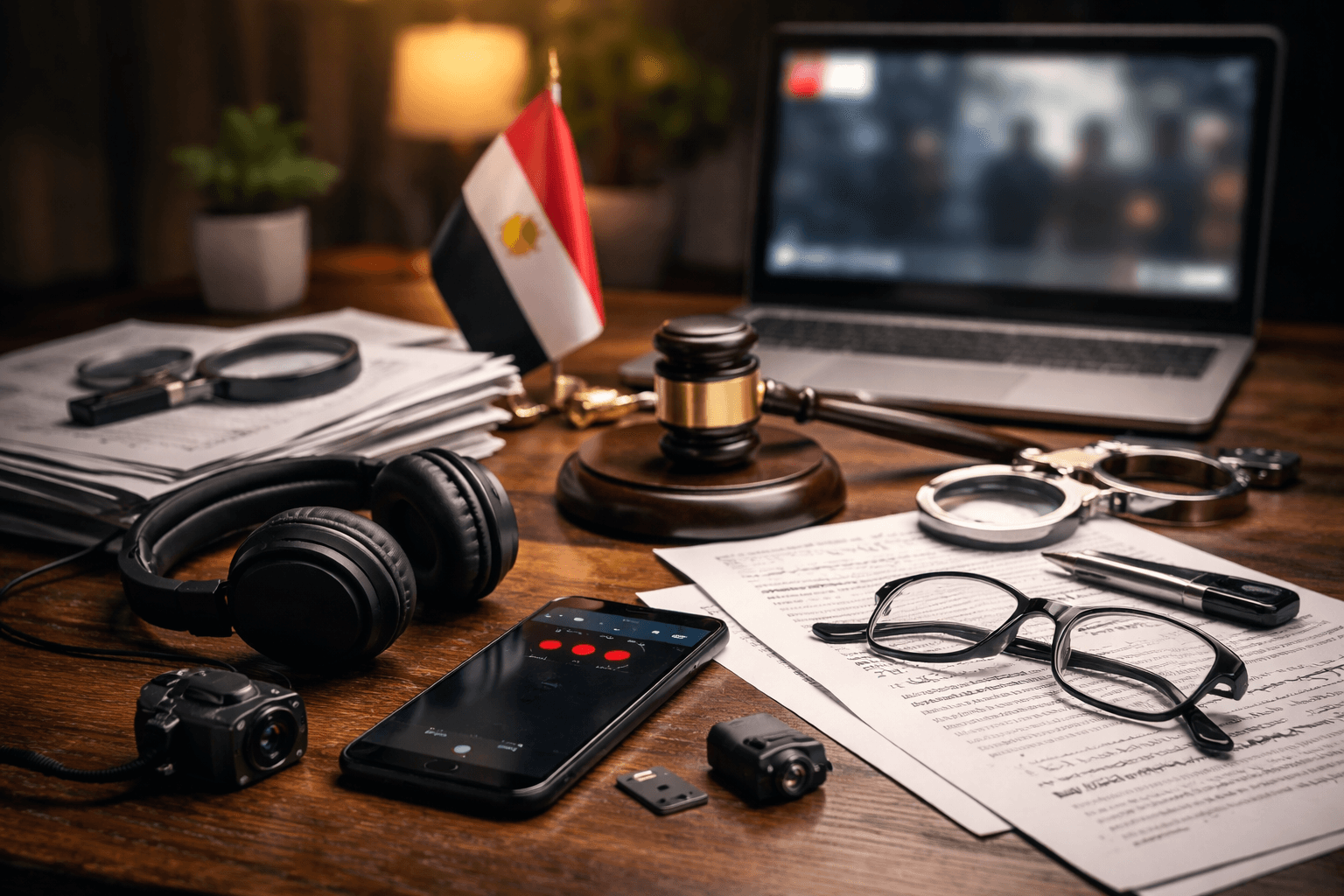
Is Secret Recording Illegal in Egypt?
Yes, and Egyptian law takes it seriously. Egypt has several overlapping laws that protect your right to privacy, and secretly recording someone — in a home, workplace, or any private space can expose the person who did it to criminal charges, imprisonment, and financial penalties. The problem most victims face is not knowing where to start. This guide breaks it down simply.
The Acts That Apply
Egyptian Constitution -Article 57
The Constitution guarantees every citizen's right to privacy in personal communications, whether by phone, letter, or any other means. No surveillance or interception is allowed without a judicial order. This is the foundation everything else builds on.
Personal Data Protection Law -Law No. 151 of 2020 (PDPL)
This is Egypt's primary and most comprehensive privacy law. It was a landmark moment for privacy rights in the country Egypt became one of the first nations in the Arab world to introduce dedicated data protection legislation at this level. Under the PDPL, any video footage, photograph, or audio recording of you is classified as personal data. Anyone who collects, stores, processes, or shares that material without your explicit consent is in direct violation of this law.
The PDPL is enforced by the Personal Data Protection Center (PDPC) under the Ministry of Communications, which has the authority to investigate complaints, issue orders for data deletion, and impose financial penalties. Fines under the PDPL can reach up to 5 million Egyptian pounds, and in cases involving sensitive personal data — which includes anything of an intimate or private nature penalties are significantly higher. The law also gives you the right to access any data held about you, the right to correct it, and the right to demand its permanent deletion.
The Penal Code -Articles 309 bis and 309 bis (a)
These articles directly criminalise secret recording. Article 309 bis covers the interception or recording of private conversations without consent. Article 309 bis (a) covers capturing photographs or recordings of people in private places and sharing them without permission. Penalties include imprisonment of up to one year and fines, rising to two years if the content is shared publicly or through any broadcast medium.
The Cybercrime Act
Egypt's dedicated digital crimes legislation covers the non-consensual sharing of private images and recordings online through social media, messaging apps, and websites. If someone shared your footage on Facebook, WhatsApp, TikTok, or any platform, this act applies directly on top of the PDPL. Penalties can reach imprisonment of six months to two years and fines between 50,000 and 100,000 Egyptian pounds, with harsher sentences if the victim is a minor or the content is intimate in nature.
The Telecommunications Regulation Act
This act prohibits the interception or monitoring of communications without legal authorisation. It applies when interception happens through networks or devices rather than in-person recording, and works alongside the PDPL in digital contexts.
Why These Acts Matter
Most people assume privacy violations are a personal issue to deal with quietly. They are not. Every one of the acts above exists because the Egyptian state recognises that secret recording is not just embarrassing it is a tool of control, coercion, and abuse. When someone records you without consent, they are not just invading your privacy in that moment. They are holding leverage over you. The law exists precisely to take that leverage away.
The PDPL in particular changed the landscape significantly. Before it, victims had to rely solely on the Penal Code. Now there is a dedicated law that treats your image, your voice, and your footage as personal data you own and anyone who handles it without your permission is accountable. The PDPC can act faster than criminal courts, ordering deletion of content and launching investigations without requiring a full trial to run its course first.
These acts matter because they give you the upper hand. The person who recorded you is the one with criminal and legal liability. You are the one with rights. Filing a complaint does not just help you it creates a formal record that prevents the same person from doing this to someone else.
How bgblur Keeps You Protected
This is where prevention matters as much as reaction. bgblur is a privacy tool designed to protect your images before they can be misused — not after. Here is how it works in your corner:
Metadata removal — Every photo and video you take carries invisible data: your location, your device, the exact time it was captured. bgblur strips all of that out before you share anything, so even if an image ends up somewhere it should not, it cannot be traced back to you or used to build a profile of your movements.
Background blurring — When you share images, the background often reveals more than you intend your home, your neighbourhood, your workplace. bgblur automatically blurs backgrounds so your environment stays private even when you choose to share a photo publicly.
Consent documentation — For anyone sharing images that include other people, bgblur helps document that consent was given, creating a clear record that protects both parties and satisfies the requirements under the PDPL directly.
In short, bgblur does not just react to privacy violations it makes them significantly harder to commit in the first place.
Conclusion
Egyptian law gives you real, actionable protection. The Personal Data Protection Law is the cornerstone it treats your image and your recordings as data you own, with serious penalties for anyone who violates that. The Penal Code, the Cybercrime Act, and the Telecommunications Regulation Act all reinforce it from different angles, meaning a single violation can trigger multiple simultaneous legal consequences for the person who wronged you.
But the strongest position is one where the violation never gets to cause damage in the first place. Use the legal system when you need to. Use bgblur so you need it less often. Preserve your evidence, file your complaint, name the acts that apply, and get legal help much of it is available for free. Your rights are already there. This guide just helps you use them.
Frequently Asked Questions
Is secretly filming someone in a bathroom or bedroom illegal in Egypt? Yes. The Penal Code makes it a criminal offence to capture images of someone in a private place without consent, and the PDPL adds a separate layer of liability for the collection of that personal data without consent. Penalties include imprisonment and fines, with higher sentences if the footage is shared.
What exactly does the Personal Data Protection Law cover? The PDPL covers any personal data — including photos, videos, and audio recordings of you. It gives you the right to know what data exists about you, the right to demand its deletion, and the right to file a complaint with the PDPC if someone has processed your data without permission. Violations carry fines of up to 5 million Egyptian pounds, higher for sensitive personal data.
What if someone posted my private video online? Report it to the platform immediately. Then file a complaint with the PDPC under the PDPL and a criminal complaint under the Cybercrime Act. You can also contact the National Telecom Regulatory Authority (NTRA) at 16000. Each act of sharing can be treated as a separate offence.
Can I get compensation as a victim? Yes. You can file a civil case for damages alongside a criminal complaint and a PDPC complaint. All three can proceed at the same time and are entirely compatible under Egyptian law.
Is there free legal help available? Yes. The Public Defender system and Bar Association offices in each governorate provide free or low-cost legal assistance to eligible individuals.
Can I report online without going to a police station? You can contact the cybercrime reporting line at 08008880 and submit a complaint through the NTRA online portal at www.tra.gov.eg. For a PDPC complaint, you can approach the Personal Data Protection Center through the Ministry of Communications. For a formal criminal complaint, visiting the police station or Public Prosecution office in person is generally still required.